
Locomotives of Greenfield Village
Share
share
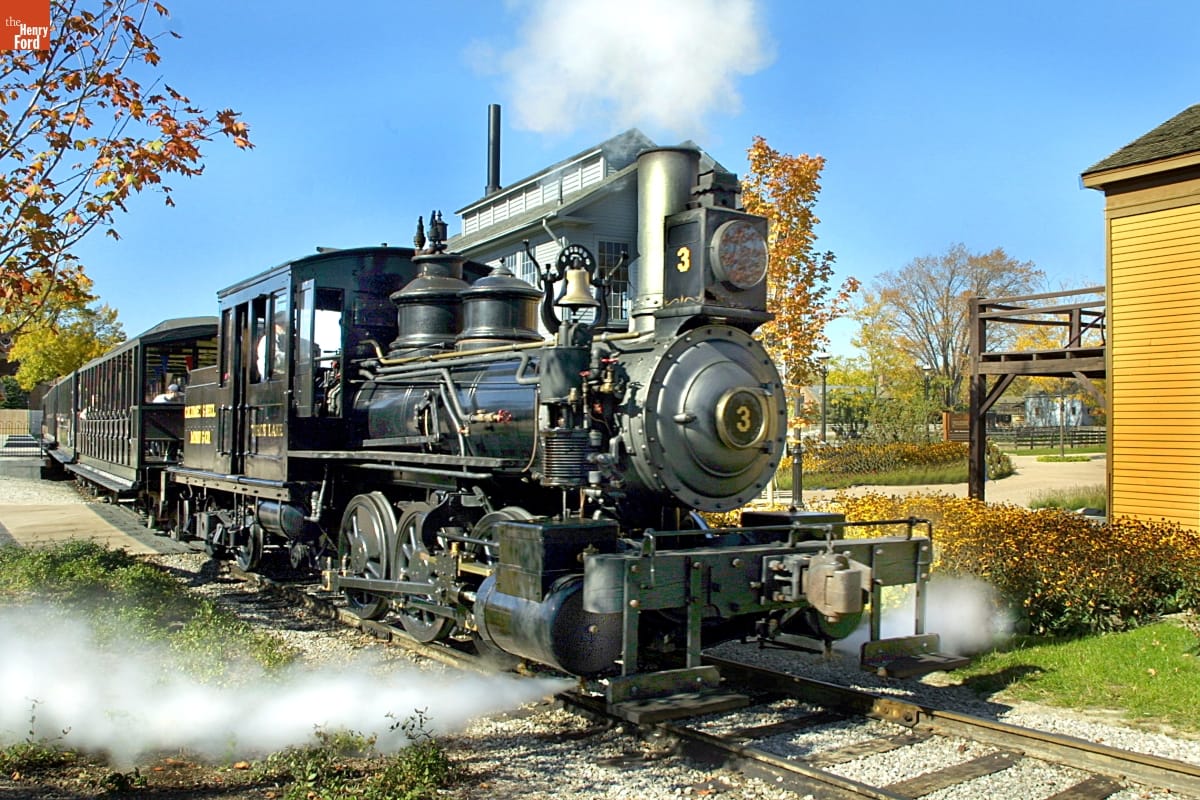
Hard working people, steam, and mighty locomotives power Greenfield Village’s rail line. Here is a selection of the locomotives serviced by workers at the Detroit, Toledo & Milwaukee Roundhouse–the only working roundhouse of its kind in the Midwest.
THF15919
1927 Plymouth Gasoline-Mechanical Locomotive
Because they didn't use the coal and water required by steam engines, Plymouth gasoline locomotives were well suited to small industrial railroads. This engine shuttled coal cars at the Mistersky Power Plant in Detroit. Unlike modern diesel locomotives, which operate via electric motors powered by on-board generators, this locomotive's gas engine is mechanically connected to its wheels.
View ArtifactBaldwin Locomotive Works Steam Locomotive, 1897
This locomotive pulled passenger trains on the Detroit & Lima Northern Railway, a predecessor of the Detroit, Toledo & Ironton Railroad. After Henry Ford purchased the DT&I in 1920, this engine was the first modified under his extensive plan for improvements to the line. Ford adopted the locomotive as his favorite and donated it to The Henry Ford in 1930.
View ArtifactAmerican Locomotive Company Steam Locomotive, 1902
The American Locomotive Company of Schenectady, New York, built this locomotive in 1902. It is a 4-4-2 Atlantic type, with four leading wheels, four driving wheels, and two trailing wheels. The Atlantic was designed to pull light wooden passenger cars at high speeds. This locomotive operated on the Michigan Central Railroad's Detroit-Chicago line until heavier steel cars made it obsolete.
View ArtifactTorch Lake Steam Locomotive, 1873
Torch Lake, built by Mason Machine Works in 1873, hauled ore for the Calumet and Hecla Mining Company on Michigan's Keweenaw Peninsula. The engine is an articulated design. The driving wheels pivot under the boiler, allowing the locomotive to handle sharp curves. Torch Lake joined The Henry Ford's collection in 1969.
View Artifact"Edison" Steam Locomotive
Edison is based on an 0-4-0 switcher locomotive built about 1870 by Manchester Locomotive Works. Henry Ford purchased the switcher from Edison Portland Cement Company in 1932. Mr. Ford had the locomotive rebuilt into a 4-4-0 wheel arrangement by staff at Ford Motor Company's Rouge locomotive shop. Edison later went into regular service on Greenfield Village's railroad.
View ArtifactGeneral Electric Diesel-Electric Locomotive, 1942
Lightweight 44-, 45- and 50-ton diesel-electric locomotives proved popular in industrial and yard switching duties. They were less expensive to operate than steam locomotives and could run on lightly built track. This 50-ton unit served a U.S. Navy ammunition depot in Charleston, South Carolina, during World War II. It later operated at a scrapyard in Ecorse, Michigan.
View Artifact

