
Technological Innovations at La-Z-Boy
Share
share
In 1927, Edwin Shoemaker and Edward Knabusch -- cousins with a shared interest in building things -- founded a furniture-making business. Their ambition to create new products (and to improve upon existing ones) became a defining characteristic of the company. This group of artifacts represents La-Z-Boy's history of innovation motivated by consumers' ever-changing tastes and demands.
THF162703
Galena Crystal Radio Set, Made by Edwin Shoemaker, circa 1923
Edwin Shoemaker, a mechanically-minded teenager from rural southeast Michigan, built this crystal radio set in the early 1920s. He collaborated with his cousin, Edward Knabusch, to fabricate a cabinet for it. Through this experience, the young men discovered a shared interest in building things and began a close friendship.
View ArtifactTHF290021
La-Z-Boy Founders Edwin Shoemaker and Edward Knabusch, 1927-1928
Edwin Shoemaker and Edward Knabusch became business partners in 1927, when they established a furniture-making business in Monroe, Michigan. They experimented over the next three years, introducing new types of furniture that consumers had never seen before.
View ArtifactTHF162705
Floral City Furniture Company "Gossiper" Telephone Stand, 1928
One of Knabusch and Shoemaker's most successful early efforts was the "Gossiper," a combination telephone stand, bench, and built-in telephone book rack.
View ArtifactTHF162922
Kna-Shoe Manufacturing Company Reclining Porch Chair, 1928
The company's breakthrough product was a reclining porch chair. Loosely based on an Adirondack chair, Knabusch and Shoemaker's version reclined as the user leaned back.
View ArtifactTHF290342
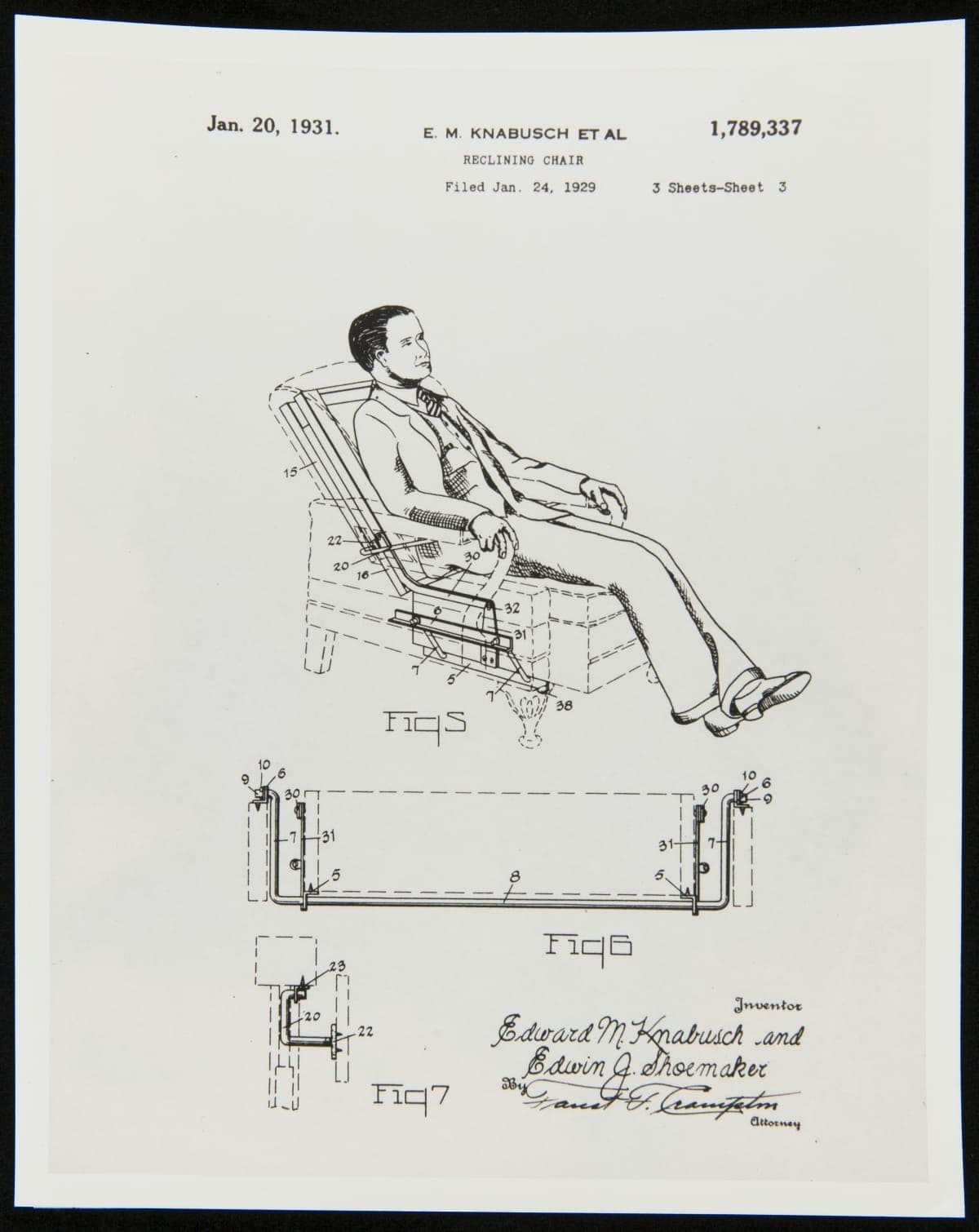
Patent for the First La-Z-Boy Reclining Chair, January 24, 1929
Realizing that a porch chair would only be useful in warm weather (and only saleable during one season each year), Shoemaker and Knabusch developed and patented their reclining mechanism for upholstered indoor chairs.
View ArtifactTHF162692
Floral City Furniture Company La-Z-Boy Reclining Chair with Ottoman, 1929
This chair and ottoman are indistinguishable from most late-1920s furniture. The chair deftly hides Knabusch and Shoemaker's patented reclining mechanism. By 1929, the cousins had settled on "La-Z-Boy" as the name for their new chair.
View ArtifactTHF290384
La-Z-Boy Upholstery Department, 1940-1959
Knabusch and Shoemaker built the first La-Z-Boy factory with very little outside help, completing it by 1928. The cousins planned for efficiency in their three-story structure from the start, but they always looked for ways to improve the factory layout and manufacturing process.
View ArtifactTHF290304
La-Z-Boy Advertisement, "What a Wonderful Feeling to Relax in a La-Z-Boy," May 22, 1954
To keep La-Z-Boy in the lead among an increasing field of competitors in the years after World War II, Shoemaker and Knabusch introduced new technological innovations. One of the most important was the "Ottomatic." This built-in, adjustable footrest eliminated the need for an ottoman, saving space while still allowing users to fully recline.
View ArtifactTHF162688
La-Z-Boy Chair Company Reclining Chair with Ottomatic Footrest, 1955
Soon after its introduction, the revolutionary "Ottomatic" became a fixture on all La-Z-Boy recliners. The chairs found a welcome place in dens and family rooms, where Americans were increasingly making time to relax.
View ArtifactTHF290396
La-Z-Boy Advertising Poster for Naugahyde, 1955
In addition to the company's own innovations, La-Z-Boy incorporated those developed by others. This advertisement announced recliners upholstered in Naugahyde, a coated fabric created by the U.S. Rubber Company. Naugahyde was the quintessential home décor material of the 1950s and 1960s.
View ArtifactTHF162683
La-Z-Boy Chair Company Hi-Lo Matic Reclining Chair with Ottomatic Footrest, 1956-1962
Some of La-Z-Boy's attempts to innovate were less successful than others. The "Hi-Lo Matic" chair, introduced in 1956, featured two height adjustments. The lower setting was intended for a housewife; the higher setting was intended for her husband. La-Z-Boy discontinued the "Hi-Lo Matic" in 1962 in favor of chairs with more sophisticated technology.
View ArtifactTHF290398
La-Z-Boy Advertising Poster for "Chairs Now Equipped with Vibrator," circa 1958
In line with La-Z-Boy's ongoing pursuit of innovative technologies, the company offered customizable features by the 1950s. Customers could add vibrating or heating elements to their new recliner.
View ArtifactTHF162404
La-Z-Boy Chair Company Sales Model "Reclina Rocker" Chair, 1961
The "Reclina-Rocker," introduced in 1961, combined all of La-Z-Boy's earlier innovations with some new features. For the first time, consumers could buy a platform rocker that reclined. A mounted lever locked the adjustable footrest in place while users rocked, reclined, or did both.
View ArtifactTHF290370
La-Z-Boy Advertisement in American Home Magazine, "Comfort Chairs for Leisure Living," November 1965
Though the "Reclina-Rocker" was an immediate success that boosted sales dramatically, La-Z-Boy continued to update its offerings. This advertisement promotes upholstery options treated with Scotchgard, a new stain repellent developed by the 3M Company.
View ArtifactTHF162666
La-Z-Boy Chair Company Reclining Sofette, 1970
With the success of the "Reclina-Rocker," La-Z-Boy began introducing other forms of seating furniture.
View ArtifactTHF290344
Couple in a La-Z-Boy Reclining Loveseat, 1969-1975
La-Z-Boy's "Sofette," introduced in 1969, offered families the opportunity to sit together while still enjoying the comfort and versatility of individual recliners.
View ArtifactTHF162660
Test Figure, "Jake," Made for and Used by La-Z-Boy, 1980-1983
During the 1980s, La-Z-Boy -- like other manufacturers of the time -- embraced new production technologies and testing standards. The company opened a testing facility that became home to this carved maple figure. In response to the new science of ergonomics, “Jake” tested chairs for durability and support.
View ArtifactTHF290393
Advertising Poster, "It's the New La-Z-Boy Signature II Sleep Sofa," 1984
La-Z-Boy continued to pursue new technologies and products through the 1980s and 1990s. This advertisement introduced a new line of sleep sofas, calling out "state-of-the-art engineering" and "an innovative new mechanism."
View ArtifactTHF163084
La-Z-Boy Advertising Sign, 2005
Into the 21st century, La-Z-Boy's commitment to innovation -- motivated by consumers' ever-changing tastes and demands -- remained central to the company's operation.
View Artifact

