
Agriculture and the Environment
Share
share
Raising livestock and growing crops requires year-round work and specialized knowledge and skills. Farm families used tools to reduce the physical strain of daily and seasonal work. The shift from animal to mechanical power further transformed farm life and raised questions about sustainable practices. Understanding changing relationships between humans, plants, animals, and the environment begins by exploring historic farming technologies.
THF286191
Man and Child Using a Mule-Drawn Reaper, 1875-1900
Children worked alongside adults to feed livestock and complete other daily farm chores. They also teamed up to complete seasonal tasks. This man and child pose with a team of mules hitched to a reaper in their farmyard, on the way to their grain field.
View ArtifactTHF284458
"The Great Minneapolis Line: The Whole Season without a Hitch," 1917
Manufacturers appealed to farm families by featuring them in advertising. This farmer, two children, and the farm dog watch the crew operate a thresher. Separating kernels of grain from the straw was the last step in preparing the crop for market. While most farmers could not afford expensive machines, they could hire crews with the best threshers.
View ArtifactTHF289569
Wagonloads of Hops in Sacks Being Taken to a Hop-Drying Plant in Oregon, 1923-1924
Harvest time was a busy and stressful time for farm families. They had to get crops to market in the best condition to earn the best prices. Each step in the process of hop harvesting required careful handling. Laborers picked the crop at the precise time, and drivers lined up at drying facilities to offload their precious cargo bound for breweries.
View ArtifactTHF727024
Print Showing Norman Rockwell's "Model T on the Farm"
Farm families assessed the merits of the Model T, as this Norman Rockwell print depicts, but curiosity coexisted with skepticism. Automobiles shortened travel time but raised questions about who would pay for roads and whether horses or horse-less carriages had the right of way. Intrepid farmers made their autos more useful by modifying them into stationary engines to run sawmills, corn shellers, and other equipment.
View ArtifactTHF289450
Ford-Ferguson 9N Tractor and Potato Digging Machine, October 18, 1940
Ford Motor Company lost money on every Ford-Ferguson tractor it sold. Yet, its affordable price tag appealed to cash-strapped farmers in 1939 when the tractor entered the market. It became an indispensable tool on smaller farms, including those raising specialty crops such as potatoes. The 9N reduced the physical strain on farmers' backs without adding too much to their burden of debt.
View ArtifactTHF374008
FMC Tomato Harvester, 1969
Tomatoes need careful handling. Growers who contract with processors used to rely on human laborers. The quest to plant and harvest more, faster, gave mechanical engineers and plant geneticists incentive to design a machine and a tomato it could harvest. The FMC Cascade Harvester carried 10-12 laborers who sorted debris out of the crop, fewer laborers than growers had needed for handpicking.
View ArtifactTHF173900
Seeds of Change "Double Rich Tomato" Seed Packet, circa 1999
Consumers concerned about the source of their food seek certified organic seeds to grow their own vegetables including tomatoes. The label, "certified organic," means that the seeds came from crops raised with natural fertilizer by growers who practiced integrated pest management rather than using synthetic pesticide or insecticide applications.
View ArtifactTHF172338
Langstroth-Style Beehive, 1870-1920
Lorenzo L. Langstroth devised the most enduring beehive innovation with his 1852 patent for an "Improved Mode of Constructing Beehives." Careful observation of bee behavior proved to him that frames had to be separated by 3/8th of an inch within the hive and between the frames and hive walls to allow space for bees to function. His discovery revolutionized beekeeping.
View ArtifactTHF172095
Revolving Beehive, 1869-1877
Charles Eldad Spaulding's work as a cheese-box maker in Theresa, New York, influenced his design for a circular revolving beehive. His invention, patented in 1869, was not successful -- though this one is visually appealing with its hand-painted scrollwork and colorful scenes. Instead, rectangular beehives with removable frames in a bee-friendly space were becoming the standard for the growing commercial beekeeping industry.
View ArtifactTHF37619
Oliver Chilled Cast Iron Plow, circa 1895
The high-quality Oliver Chilled Plow dominated the market during the late 19th and early 20th centuries. Its creator, James Oliver, perfected "chilling," a casting process that created durable iron moldboards and shares that retained a smooth surface during heavy use. Farmers relied on dependable plows like the Oliver when preparing soil prior to planting crops.
View ArtifactTHF89810
International Harvester Manure Spreader, circa 1905
Spreading manure to rejuvenate the soil is one of the most important, but least popular jobs on the farm. Mechanical manure spreaders made an awful job slightly less so. This circa 1905 International Harvester Manure Spreader No. 3 is a very rare survivor and an excellent example of the prevailing manure spreader design of the early 1900s.
View ArtifactTHF734909
New York Dutch or Hog Plow, circa 1780
This light-draft, single-handle plow was used by Dutch farmers of the Hudson Valley of New York well into the 1800s, despite being surrounded by English communities. A key feature of this traditional plow, the distinctive pyramidal plowshare, was adapted by English neighbors to create the "Carey" or "Connecticut" plow, which became popular across the new American nation.
View ArtifactTHF79128
Ox Yoke with Two Bows, 1800-1900
This carved, wooden yoke captures the strength of oxen's necks and shoulders. The carved beam is placed across the back of the neck and shoulders of a team of oxen while the curved wood bows are secured around each ox's neck. Once trained and fitted with a yoke, these large, powerful animals can pull wagons, transport heavy loads, and plow fields.
View ArtifactTHF32753
Grain Sickle, 1800-1840
Sickles helped farmers harvest grain crops. Using this age-old tool, however, was backbreaking work. Laborers constantly had to stoop over to gather and cut the stalks. The work also had to be done quickly before ripen grains were scattered by the wind or poor weather destroyed the crop. The invention of mechanized reapers did away with this laborious task on large acre farms.
View ArtifactTHF93008
John Deere Moldboard Plow, circa 1845
John Deere is popularly credited with developing the first steel plow. In fact, his earliest plows, such as this, were wrought iron with a welded steel share. Deere's innovation was the highly polished surface of the moldboard, which plowed the sticky prairie soils without dirt binding up on the moldboard. True steel plows came later with improvements in steel production.
View ArtifactTHF173881
Ambler's Mowing Machine, circa 1836
This is probably the oldest surviving American harvester. Enoch Ambler, a resident of Montgomery County, New York, patented this machine in 1834 and demonstrated it by cutting about 100 acres of grass in 1835. Interest in the mower led Beale & Griswold of Spencertown, New York, to buy Ambler's patent and attempt commercial production for the 1836 and 1837 seasons.
View ArtifactTHF95493
Manny's Combined Reaper and Mower, circa 1854
John Manny developed this reaper in 1853 in Rockford, Illinois. It was the first to successfully challenge the Cyrus McCormick Company's dominance in reaper manufacture. Sued for patent infringement by McCormick in 1854, Manny won, paving the way for other manufacturers, and a broad expansion of the industry. Included in Manny's legal team was a young Illinois lawyer, Abraham Lincoln.
View ArtifactTHF32383
Hay Knife, circa 1860
Farm families cut and cured enough grass each summer to make hay to feed their livestock all winter. Stored hay settled over time and farmers used special knives to cut out chunks for feed. The farmer who used this knife likely put one foot on the metal rod to push the blade into the haystack, and then pulled on the wooden handle to drag the blade out. Someone repaired the broken handle with a wrought-iron band and screws.
View ArtifactTHF96715
Threshing Machine, circa 1845
Farm families raised most of their own food during the early 1800s. The more grain they raised for themselves and for market, the more they sought machines to reduce labor. This thresher beat the kernels from grain heads, thus replacing a laborer with a flail, but farmers needed a treadmill and oxen or horses to generate power to thresh grain. After threshing, farmers used a fanning mill to clean grain and bag it for market.
View ArtifactTHF32612
Prairie Breaking Plow, circa 1860
The thick, root-bound sod of the American prairies was too tough for regular plows. Huge steel plows, drawn by many oxen, were specially developed to break through the unplowed prairie soils. This is a smaller version of those sod-busting plows, made possible by improved casting techniques which made the plow share smoother and easier to pull through the soil.
View ArtifactTHF284044
"Breaking Prairie Sod With 'Case' 32 Horse Plow Engine," 1915
Treeless grasslands covered 1.4 million square miles of North America, but crews with plowing engines like this created crop fields in short order. Work crews traveled from farm to farm pulling their equipment, a cook wagon, and fuel supplies. Others invested in "bonanza farms," intensely cultivating thousands of acres season after season. This system of agriculture destroyed the semi-arid plains ecosystem.
View ArtifactTHF140103
Superior Grain Drill, circa 1900
Drilling grain was superior to hand sowing because it distributed seed uniformly at a controlled depth and covered it properly. Less seed per acre was used, but higher yields resulted. Early grain drills opened the seedbed with hoes, but they tended to clog with field debris. The disk-type opener easily cut through the debris, allowing for larger, more effective drills.
View ArtifactTHF289047
Finger Family Farm, Berthold Township, North Dakota, 1916-1917
This photograph shows the young Finger family on their 240-acre "bonanza" farm. They raised grain for market, but also grew feed for their poultry, pigs, horse, and dairy cow. Their farm, two miles east of the Great Northern Railroad depot in Berthold, N.D., gave them market access, while living on a Rural Federal Delivery mail route and telephone line right-of-way connected them beyond Berthold.
View ArtifactTHF284059
"Avery Tractors, Plows, Separators and Steam Engines," 1916
Farmers invested in machinery to reduce the back-breaking labor of agriculture. Two Illinois farm boys, Robert H. and Cyrus M. Avery, incorporated the Avery Planter Company in 1883 to build corn planters, cultivators, and corn-stalk cutters. Avery added steam traction engines and threshing machines in 1891 as grain farms proliferated. This 1916 catalog featured gas, oil, and steam engines at work.
View ArtifactTHF72058
Fordson Tractor, 1917-1918, Used by Luther Burbank
The Fordson tractor, manufactured by Henry Ford and Son, Inc., was the first lightweight, mass-produced tractor that was affordable to the average farmer. Through this and other efforts, Henry Ford sought to relieve farmers of the burden of heavy labor. Ford gave this Fordson, the first production model, to fellow innovator Luther Burbank, creator of hundreds of new plant varieties.
View ArtifactTHF133854
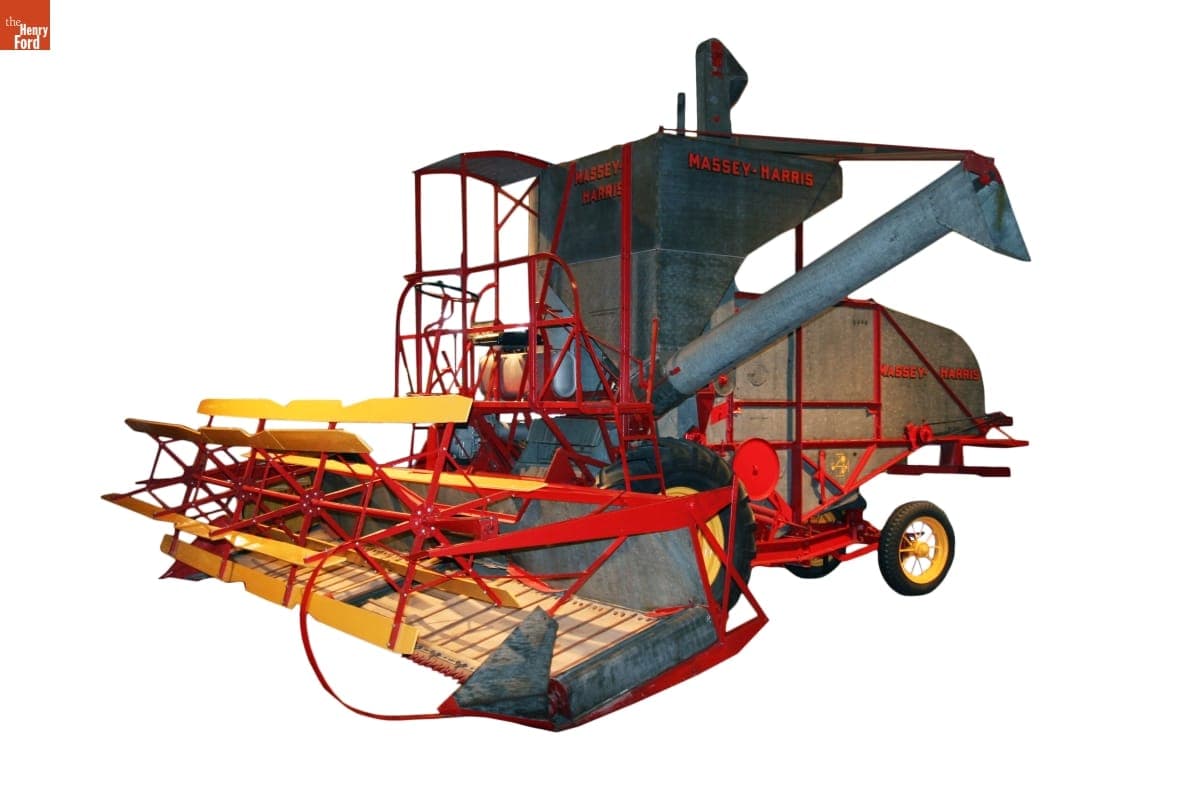
Massey-Harris Model 20 Self-Propelled Combine, 1938
"Combines" combine the major tasks of grain harvest: cutting and gathering the crop, threshing and separating the kernels from the chaff, and disposing of the straw. The Massey-Harris Model 20, introduced in 1938, culminated over 100 years of mechanical improvements. One driver operated the self-propelled machine, which reduced the need for hired help during the labor shortages of World War II.
View ArtifactTHF173322
Ford Model 9N Prototype Tractor, 1939
This is the first prototype of the Model 9N tractor. This tractor marked the first practical hydraulic three-point hitch on a tractor, a feature standard on all tractors today. Henry Ford helped debut this machine when he demonstrated its versatility on April 1, 1939 at a media event on the property of his Dearborn home.
View ArtifactTHF172897
John Deere Model B Tractor, 1941
Deere & Company released the streamlined Model B, styled by industrial designer, Henry Dreyfuss, in late 1938. Farmers used the four-gear forward tractor to pull a two-bottom plow, cultivate corn or soybeans, power a mounted corn picker, or run a corn sheller off the belt-drive. The rounded hood and grill and more expensive rubber-tire option meant the tractor looked as good as it performed.
View ArtifactTHF91786
1952 Ford Model 8N Tractor
The Ford Motor Company, after Henry Ford's death, released its most popular tractor in 1948. The 8N broke with Ford tradition by sporting new paint colors. Farmers bought the affordable tractor because it retained Ferguson's revolutionary 3-point hitch system and included a "crawler" gear and PTO (power-take-off) that transferred engine power to new equipment like forage choppers.
View ArtifactTHF151663
Self-Propelled Cotton Picker, 1950
This is the first commercially successful self-propelled cotton picker. The inventor, John Rust, worked for decades to develop a machine that would end the back-breaking labor of picking cotton that he experienced in his youth. The machine reduced the labor required to pick cotton by 80%, contributing to the Great Migration from the rural south to northern cities in the 1950s.
View ArtifactTHF96718
Corn Planter, circa 1880
Farmers started a year-round effort to raise food for livestock and the farm family by planting corn in hills. Double-row planters cut the time required to plant in half. Farmers cultivated with a shovel plow until corn was knee-high. They then planted squash or pumpkins to retain soil moisture (a form of double cropping). At harvest they husked ears (to feed pigs) and shocked stalks (to feed cattle).
View ArtifactTHF289462
Ford-Ferguson 9N Tractor Filling Silo, November 29, 1940
Dairy farmers raised silage crops, harvested them while green, and blew them into airtight silos to ferment them into high-energy feed. By 1940, they used tractors like the Ford-Ferguson 9N, to prepare the soil, plant the crop, cultivate it, and power the chopper-blower. This photograph shows a wagon load of grain sorghum ready to be chopped and blown into a concrete-block silo.
View ArtifactTHF290284
1943 New Holland Automatic Pick-Up Baler in Use
This tractor-drawn baler changed the way farmers made hay. Before pick-up balers, farmers hauled hay to the stationary baler. This baler went to the hayfield where it picked up cured grass, pressed it into rectangular bales, and automatically tied the compressed grasses into a hay bale. Farmers could pick up and move these bales, and they had a higher market value as fresh hay.
View ArtifactTHF288962
Member of the Lancaster Unit of Woman's National Farm and Garden Association, 1918
After the United States entered World War I in 1917, Americans worried about labor and food shortages as a result of men going off to fight. Organizations like the Woman's Land Army of America and the Woman's National Farm and Garden Association recruited and trained women to perform agricultural work across the country. Land workers tended to crops, animals, and various farm needs.
View ArtifactTHF169524
Champion Egg Case Machine, 1900-1925
Civil War veteran James K. Ashley patented this machine in 1896. Egg farmers used it to build uniform boxes that held 360 eggs each. Farmers clamped wood boards between the vices, and then nailed the sides, middle and bottom together to complete a box. They stenciled finished boxes with the farm name and other advertising before shipping their eggs to urban markets.
View ArtifactTHF276149
Stark Bro's Nurseries & Orchards Company Trade Card, "Burbank's 5 Greatest Creations," 1901
Luther Burbank's 1893 catalog, New Creations in Fruits and Flowers, captured the attention of established nursery businesses, including Stark Brothers Nurseries in Missouri. Clarence Stark traveled to California to see Burbank's creations for himself and purchased the rights to sell some of Burbank's plum varieties. This began an exclusive distribution partnership that continued after Burbank's death.
View ArtifactTHF173439
Ladder, Used by Luther Burbank, circa 1910
Luther Burbank (1849-1926), an American horticulturalist and author, gained a reputation for selective breeding that yielded more than 800 new fruits, vegetables, flowers, and other plants. He used traditional gardening tools in his plant research, like this ladder designed for use with fruit trees. With it he could climb into the limbs bearing fruit and clip buds or twigs for grafting.
View ArtifactTHF119358
"Picking Oranges, California," circa 1912
From 1895 to 1924, the Detroit Publishing Company was one of the major image publishers in the world. It had a wide-ranging stock of original photographs, many of which were colored using the company's patented "Phostint" process. Popular "Phostint" postcards, the Detroit Publishing Company claimed, were delicately "executed in Nature's Coloring" to be truthful, tasteful, beautiful, and educational.
View ArtifactTHF163071
Microscope Used by George Washington Carver, circa 1900
By 1900, cotton production had depleted Southern soils, so George Washington Carver (1864-1943) developed nutritious crops like peanuts that nurtured the soil and could be sold to make industrial products. He used this microscope in his laboratory at the Tuskegee Institute in Alabama.
View ArtifactTHF153893
Model of Soybean Oil Extractor, circa 1935
Henry Ford had a vision of farmers being part of the industrial process -- an idea he called "chemurgy." This idea was most completely played out in his experimentation with soybeans, a versatile crop that could be used for industrial products as well as food. This model demonstrates how oil could be extracted from soybeans and converted into many plastic-like products.
View ArtifactTHF373910
John Deere 7000 No-Till Planter, 1978
Deere and Company introduced their first commercially successful no-till or minimum tillage planter in 1978. Rolling disks open a furrow for a seed, and another set of rolling disks cover the seed. Conservation tillage reduces wind and water erosion, but no-till does not mean no chemicals. Farmers may apply commercial fertilizers, herbicides to control weeds, and insecticides to control pests.
View ArtifactTHF93043
Pioneer Stump Puller & Rock Lifter Models, 1867
Preparing newly cleared land for cultivation sometimes involved the difficult task of pulling stumps and removing rocks. Salesmen used scale models such as this "Pioneer" kit to persuade customers to invest in devices to leverage obstacles out of fields.
View ArtifactTHF177061
Granger #201 Fanning Mill, 1886
Farmers had no control over markets, but fanning mills helped them secure a higher price per bushel of clean grain. A special-interest organization, the Grange, helped farmers leverage better prices through cooperative marketing and purchasing, and by lobbying congressmen to regulate markets. J. A. Bradmon of Lansing, Michigan, made this mill distinctive by branding it "Granger" and by colorfully decorating it.
View ArtifactTHF166812
Button, "Boycott Grapes," 1966-1970
In September 1965, Filipino members of the Agricultural Workers Organizing Committee refused to pick grapes in Delano, California. Strike leaders sought solidarity with Cesar Chavez's Latino/a National Farm Workers Association. They formed the United Farm Workers and organized a consumer boycott of grapes in 1966. The non-violent strike and boycott lasted until 1970 when grape growers signed union contracts granting workers better pay and benefits.
View ArtifactTHF95494
Zenith Radio Wincharger, 1935-1937
Radio connected Americans to the larger world in many ways. However, most rural Americans were not on the limited power grid of the 1930s so could not use radios. Portable wind generators, like this Wincharger, were developed to power radios, continuing a long tradition of local power production on farms--by horse, steam and wind power.
View ArtifactTHF81864
Poster, "Farm Work: Rural Electrification Administration," 1935
The struggles of the Great Depression caused old ideas to be cast aside for new approaches. The modern design of this poster supports the message promoting the newly formed Rural Electrification Administration. The REA brought power to rural areas, transforming rural life, reducing isolation, and making a range of new products available for the farm and home.
View ArtifactTHF171639
Fly-Tox Hand Sprayer, 1940-1950
The Toledo Rex Spray Company trademarked "Fly-Tox" in 1923. The Rex Company (later Rex Research Corporation) marketed Fly-Tox to kill common household pests. As the organochlorine Dichlorodiphenyltrichloroethane (DDT) gained creditability after World War II as a less-toxic compound, Fly-Tox incorporated DDT. Widespread use of DDT and its documented negative effects on ecosystems led U.S. legislators to ban the chemical in 1972.
View ArtifactTHF127375
Rachel L. Carson Postage Stamp First Day Cover, May 28, 1981
Marine biologist Rachel Carson helped spark the environmental movements of the 1960s with her book Silent Spring. It described how widespread pesticide use, in particular DDT, was harming and killing birds and other animals as well as threatening the health of humans. Her book helped the general population understand the interconnected nature of ecosystems and how localized polluting affects larger natural systems.
View ArtifactTHF81862
Advertising Poster, "Earth Day April 22, 1970"
Earth Day originated after an oil spill in January 1969 galvanized a nation-wide teach-in about the environment. Schools and communities across the United States participated on April 22, 1970. Posters like this promoted events coordinated by new organizations such as the Environmental Action Coalition.
View Artifact

