
Glass from the Artist-in-Residence Program at The Henry Ford
Share
share
Each summer, The Henry Ford invites "Artists-in-Residence" to the Greenfield Village Glass Shop where they demonstrate their distinct and intricate approaches to creating Studio Glass art. This series helps our staff glassblowers learn new techniques and expand their talents by working with masters of the craft, and visitors get to observe major artists at work. Each visiting artist also creates a work destined for The Henry Ford's collection.
THF180573
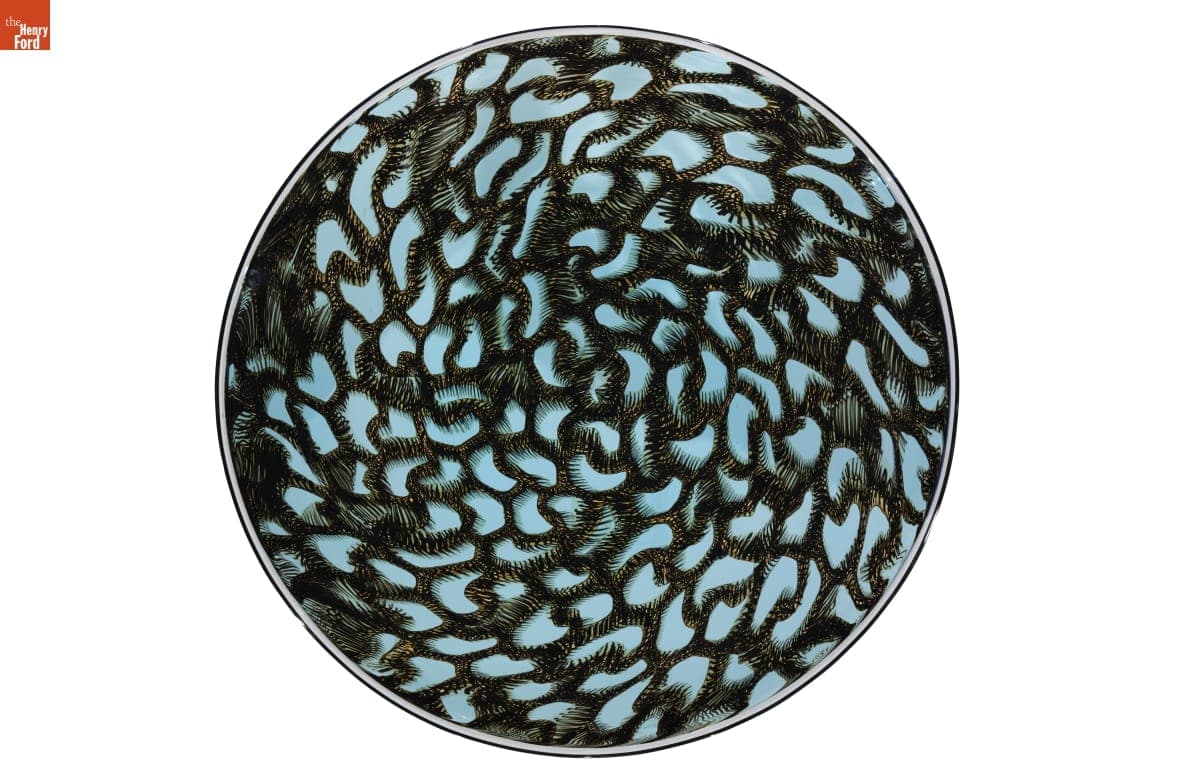
Platter by Janusz Pozniak, 2017
This platter is a new form for Janusz Pozniak, based on experimental pieces he first produced at a glass furnace in Istanbul, Turkey, in 2017 and developed in conversation with Josh Wojick, Greenfield Village master glassblower. The colorations in the platter are from bits of murrini glass sandwiched together and fused into shape.
View ArtifactTHF180564
Vase by Hiroshi Yamano, 2017
One of Japan's leading glass artists, Hiroshi Yamano is known for technical skills and innovative surface applications. Hiroshi uses the fish as a symbol to describe his journeys from Japan to America -- literally crossing the ocean. Most recently he has been focusing on imagery of his homeland and has included flowers and birds to complete his scenes of Japan.
View ArtifactTHF180561
Vase by Herb Babcock, 2017
Herb Babcock is known for large-scale, public sculptures fabricated of steel and stone in combination with glass. His earliest glass pieces, however, were vessel forms, produced from the early 1970s until the mid-1980s. This piece, made during Babcock's 2017 residency at The Henry Ford, references his earlier work in terms of scale and abstract decoration.
View ArtifactTHF180568
"Avian" by Marc Petrovic, 2017
This bird is a motif that appears in much of Marc Petrovic's work. As he states: For nearly two decades I have employed birds and bird imagery as a metaphor for my ruminations on relationships, parenting, home, shelter, and geographical identification. As an artist, I have been drawn to the ideas of identity that grow out of a sense of place and self.
View ArtifactTHF174155
Vase by Davide Salvadore, 2018
Davide Salvadore is one of the top Venetian glass artists working today. His unique combination of murrini, or canework, and cold-cutting techniques are what make his work so distinctive. This vessel, initially produced in our shop using Greenfield Village glass, was finished in Salvadore's studio to produce the vivid "Encalmo" cold work on the surface.
View ArtifactTHF180566
Untitled by Giles Bettison, 2018
Giles Bettison is a master of the Murano "murrini" technique -- the use of cut up canework. Bettison fashioned this vessel using murrini fragments that he created over the past 20 years. As Greenfield Village master glassblower Josh Wojick states, "It is almost like a retrospective of the artist in a single object." Bettison's arrangement of murrini is like the imagery of a painting by the American abstract artist Mark Rothko.
View ArtifactTHF180570
"Humpty Dumpty," by David Walters, 2018
Dave Walters loves narrative in his sculptures. Initially fascinated with Classical mythology and subjects like Aesop's fables, he found that audiences responded to more accessible fairy tales and nursery rhymes, which is how he turned to the Humpty Dumpty story. This piece in his long-running series is fabricated from Greenfield Village glass.
View ArtifactTHF177784
"Chalcedony Bear" by Shelley Muzylowski Allen, 2019
Animals of all sorts, usually in action poses, are the subjects of Shelley Muzylowski Allen's sculptural work. Using her background in anatomy and fine arts, combined with her work for the acclaimed glass artist William Morris, Shelley creates contemplative sculptural vignettes with hot glass. Her signature coloring and textural surfaces intrigue the viewer into questions of just how she achieves her subtle effects.
View ArtifactTHF177787
"Aureate Scarlet Tenax" by Robin Cass, 2019
Robin Cass teaches glass at the Rochester Institute of Technology. According to the artist, this is the first piece in a new series that will contemplate on post-industrial nostalgia, resilience, and hope. Cass used Greenfield Village glass shop's "brake-light" ruby glass, blowing it into lightbulb and automobile lens molds, as well as using automobile spray and detailing paints.
View Artifact

