
Design Line Telephones
Share
share
In 1973, AT&T partnered with Henry Dreyfuss & Associates, creating a collection of specialty "Design Line" telephones. From colonial pastiche to space age futurism, customers could tailor their telephone to fit a range of home decors. These devices were sold before the Bell System divestiture in the early-1980s. Customers paid a premium for the custom phone shell, but its interior mechanisms continued to be maintained and owned by AT&T.
THF97577
"Chestphone" Design Line Telephone, 1974
The Chestphone could be hidden from view by closing its box lid. Advertised as a perfect fit for dens, it was available in simulated walnut, leatherette, or an abstract "optique" pattern.
View ArtifactTHF97585
"Telstar" Design Line Telephone, 1979
The futuristic-looking Telstar model was named after the 1962 satellite. It was advertised as a "piece of modern sculpture," perfect "for that forward-looking person who is never satisfied with today."
View ArtifactTHF97584
"Stowaway" Design Line Telephone, 1979
Stowaway models were advertised "for those special places where a phone should be heard but not seen." The Stowaway was available in this "Mediterranean Oak" finish or an "Oiled Walnut" version.
View ArtifactTHF97582
"Noteworthy" Design Line Telephone, 1978
The Noteworthy models featured chalkboard or corkboard options to take notes and pin up messages. A convenient compartment allowed people to store their telephone book out of view.
View ArtifactTHF97579
"Coquette" Design Line Telephone, 1976
Released in 1976, the Coquette references 19th century Danish design. An "elegant offering" intended for rooms "decorated with a delicate touch, " customers could inscribe their name on the filigreed brass plate.
View ArtifactTHF97583
"Celebrity" Design Line Telephone, 1979
The Celebrity model references the opulence and glamour of Hollywood Regency design, popular from the 1920s-50s. Scaled for a bedside table, it was available in ivory and powder blue.
View ArtifactTHF97580
"Elite" Design Line Telephone, 1976
The Elite model of Design Line telephones appears to parallel the look of 1970s executive briefcases. It came in green or brown leatherette and a Bicentennial commemorative model.
View ArtifactTHF97576
"Early American" Design Line Telephone, 1974
The Early American rotary phone is a pastiche of colonial design -- an era well before telephones existed. A brass eagle adorns the cradle, above a simulated maple base.
View ArtifactTHF97586
"Antique Gold" Design Line Telephone, 1980
This "Antique Gold" telephone is a 1980s interpretation of 18th century French Provincial style. With illustrated faux-gold plates, advertisements imagined it in homes "decorated with the quiet dignity of discriminating taste."
View ArtifactTHF97587
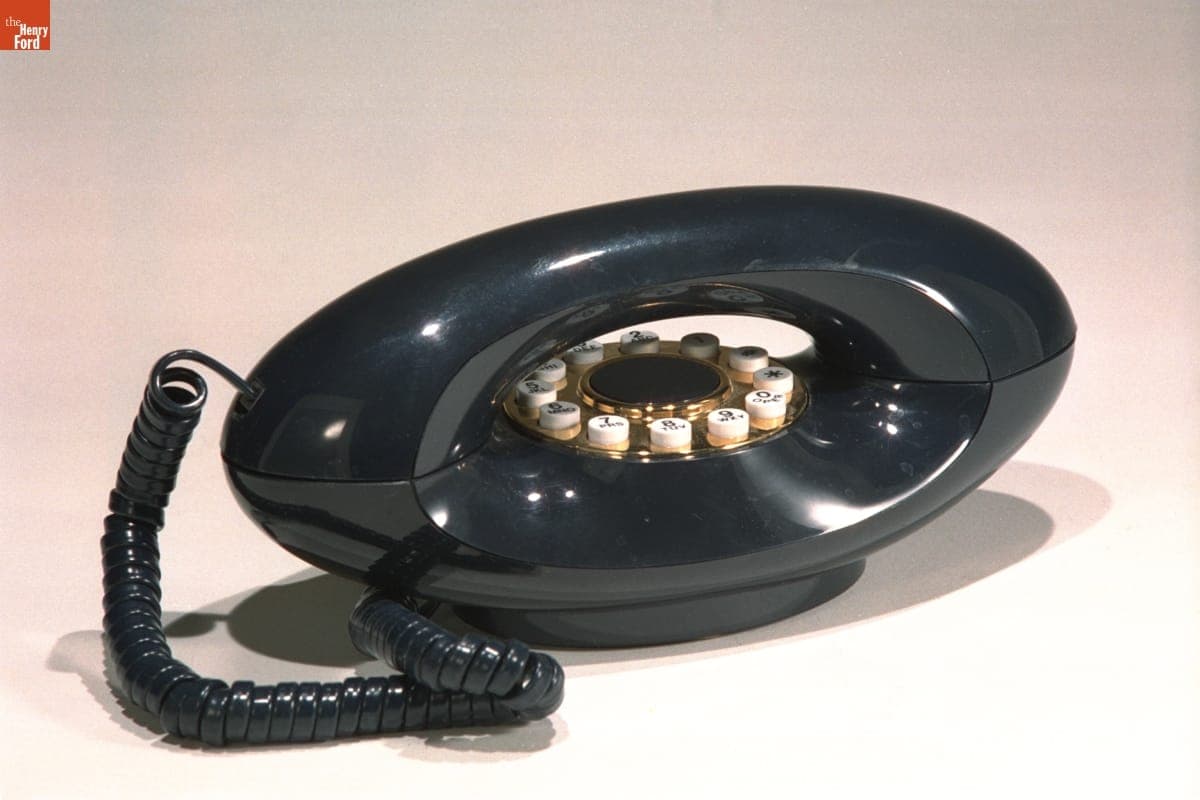
"Genie" Design Line Telephone, circa 1980
The Genie telephone is meant to resemble Aladdin's lamp. It is a push button model but maintains the circular number layout of a rotary dial.
View ArtifactTHF136638
Western Electric "Sculptura" Telephone, circa 1978
The Sculptura model was designed by Donald Genaro and is a classic example of Pop Art's influence on everyday consumer goods. Eye-catching and playful, it came in white, brown, and yellow.
View ArtifactTHF97578
Snoopy & Woodstock Telephone, 1976
Good grief, it's a Peanuts phone! Design Line character phones were marketed for use in bedrooms and family rooms. Other characters included Mickey Mouse, Kermit the Frog, and Winnie the Pooh.
View ArtifactTHF728416
United States Bicentennial Telephone, circa 1976
Candlestick models in the Design Line included a stars and stripes version, commemorating the 1976 U.S. Bicentennial. Many mid-1970s products associated themselves with this celebration by using patriotic color schemes.
View Artifact

