
"How Long?": Revisiting Dr. Martin Luther King Jr. and His Legacy
Share
share
The life and accomplishments of Dr. Martin Luther King Jr. are often hidden behind the replaying of a few memorable lines from his "I Have a Dream" speech. In fact, Dr. King's real story--from unknown Baptist minister to American civil rights leader to international human rights spokesperson--is deeper, more subtle, and more complex.
Ebenezer Baptist Church, Atlanta, Georgia, 1968-1972
Dr. King grew up steeped in the Christian gospel at the Ebenezer Baptist Church in Atlanta, Georgia. His maternal grandfather and his father had preached here. He was ordained as a minister here, and co-pastored with his father from 1960 until his assassination in 1968. It is here that he realized that his rich, impassioned voice could deeply move people.
View ArtifactGandhi: Fighter Without a Sword, 1950
While attending Crozer Theological Seminary, Dr. King became inspired by the life and teachings of Mohandas K. Gandhi, who freed the people of India from British oppression using non-violent methods. When King decided to pursue a career in the ministry, he wanted to be a different kind of minister--one who used non-violence as a tool to fight oppression.
View ArtifactComic Book, "Martin Luther King and the Montgomery Story," 1957
Dr. King put his philosophy about non-violent protest into action when he answered the call to lead the Black community in Montgomery, Alabama, in a bus boycott. When the boycott started in December 1955, he was a relatively unknown local Baptist minister. By the time it ended, 381 days later, he had risen to national prominence.
View Artifact"The S.C.L.C. Story in Words and Pictures," 1964
Wanting to build momentum after the successful Montgomery bus boycott, Dr. King--along with other ministers and like-minded civil rights activists--formed the Southern Christian Leadership Conference (SCLC). King determinedly led the SCLC in planning, directing, and supervising non-violent protests across the South.
View ArtifactStride Toward Freedom, 1958
By now the nation's best-known civil rights advocate, Dr. King was encouraged to chronicle the story of the Montgomery bus boycott in this book. It included the boycott's origin, Black community involvement, the reactions of local white officials and residents, and the key role of non-violent tactics in its success. Several writers and editors reputedly helped King complete this book.
View ArtifactRecord Album, "The Great March to Freedom: Rev. Martin Luther King Speaks," June 23, 1963
Detroit's Walk to Freedom--a protest that grew to a national event attracting some 125,000 people--helped move the civil rights struggle to a new focus on the urban North. Dr. King presented a prelude to his famous "I Have a Dream" speech here. Berry Gordy, founder of the Motown Record Corporation, produced this record album documenting the event.
View Artifact"Walk to Freedom" March in Detroit, Michigan, June 23, 1963
This candid snapshot, taken by an attendee to Detroit's Walk to Freedom protest, captures the excitement and frenzy of the moment.
View Artifact"March on Washington for Jobs and Freedom, August 28, 1963. Lincoln Memorial Program"
The August 28, 1963, March on Washington has been considered a watershed moment in the Black freedom struggle. Today, Dr. King's oft-repeated lines from his "I Have a Dream" speech tend to overshadow the rest of his 17-minute speech, the other speakers' presentations, and the day's original purpose--to advocate for Black employment opportunities and equitable wages.
View Artifact"Why We Can't Wait," 1964
Dr. King wrote this book to ensure that the civil rights struggle was as widely known as possible. It describes 1963 as a landmark year for the Civil Rights Movement. Like his earlier book, Stride Toward Freedom, King was assisted in the writing by others who understood him and knew what he wanted to say.
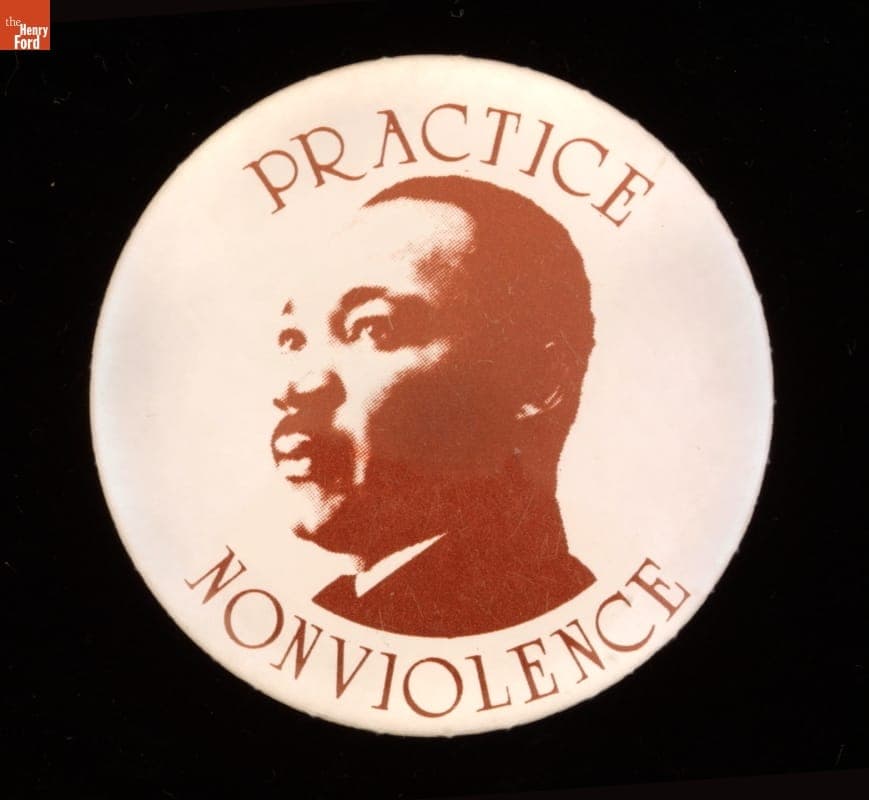
View ArtifactButton, "Practice Nonviolence," circa 1965
Dr. King's championing of non-violent tactics as a tool for social change was--and continues to be--misunderstood. To King, this did not mean being passive, weak, or cowardly. In a world shadowed by racism, poverty, and violence, he intended it as a peaceful way to persevere through adversity and to preserve human dignity. Many came to criticize his tactics.
View ArtifactButton, "Poor People's Campaign 1968"
Dr. King grew increasingly bold as he turned the Civil Rights Movement into a larger human rights struggle. In late 1967, he launched his Poor People's Campaign to leverage the power of poor people--Black, white, Latino, and Indigenous--through strategic political alliances. But he lacked both organizational and financial resources to implement his ambitious agenda.
View ArtifactWhere Do We Go from Here: Chaos or Community?, 1967
In this book--his last--Dr. King reflected upon the successes of the Civil Rights Movement but then encouraged Americans to unite to fight poverty, allow equality of opportunity for all, and create a new society without resorting to violence and brutality. With the rise of the Black Power Movement, this book--unlike his previous books--met with mixed reviews.
View ArtifactI Am a Man: Photographs of the 1968 Memphis Sanitation Strike and Dr. Martin Luther King, Jr., 1993
In early 1968, when Black sanitation workers in Memphis, Tennessee, went on strike for better working conditions and higher pay, Dr. King agreed to speak to--then march with--the strikers. By the time of the march, the strikers were using "I Am a Man" signs for solidarity and to express their desire to be treated with dignity.
View ArtifactSoldiers on Chicago Streets after Riots Following the Death of Martin Luther King, Jr., April 7, 1968
On April 4, 1968, the champion of non-violence was silenced by an act of violence, as Dr. King was fatally shot while standing on the balcony of the Lorraine Motel in Memphis, Tennessee. His assassination brought deep mourning and sparked civil unrest across the country--built upon root causes like poverty, discrimination, racist housing policies, and police brutality.
View ArtifactLife Magazine for April 12, 1968, "Martin Luther King, 1929-1968"
Life, a weekly general-interest magazine known for the quality of its photographs, was one of the most popular magazines in the nation in the 1960s. This issue commemorates Dr. King's life and legacy.
View ArtifactHandheld Advertising Fan Showing Dr. Martin Luther King, Jr., 1968-1970
This cardboard fan commemorates Dr. King on the front and features an advertisement for a Black funeral home in Kentucky on the back. Fans like these were often used during church services. This example was produced soon after King's assassination in 1968. During this period, various attempts were made to establish his birthday as a national holiday.
View Artifact"January 15th Must be a National Holiday" Button, circa 1980
Efforts to establish Dr. Martin Luther King, Jr.'s birthday as a national holiday met with initial pushback about cost concerns and the dearth of holidays that honor private citizens. But, with advocacy from the Martin Luther King Center for Social Change (the creators of this button), President Reagan finally signed a bill into law in 1983, creating a federal holiday honoring King.
View ArtifactWhat is Martin Luther King, Jr. Day?, 1990
The first Martin Luther King holiday was observed on January 20, 1986. This 1990 children's book encourages young people to recognize King's accomplishments, celebrate the Civil Rights Movement, and honor the memory of Dr. King by taking action to make the world a better place.
View ArtifactProtest Poster, "Injustice Anywhere Threatens Justice Everywhere," 2020
Dr. King's tireless efforts turned civil rights into a national movement, aiding in the passage of the Civil Rights Act (1964) and the Voting Rights Act (1965). Unfortunately, while his visionary leadership failed to lead to a new era of racial equality and social justice, his message has continual relevance. This Black Lives Matter-era poster includes a 1963 King quote.
View Artifact

