
Polar Exploration
Share
share
In the first four decades of the 20th century, polar explorers set off to discover what lay in the vast cold regions surrounding the North and South Poles. Their expeditions navigated a long-sought-for passage, crossed frozen oceans, charted a continent, and conquered the Earth's poles.
THF621173
Roald Amundsen, Commander of the Gjoa Expedition with Mrs. R.T. Lyng, Wife of the Norwegian Consul, 1906
For centuries, European explorers sought an easy trade route to Asia--one that connected the Atlantic and Pacific Oceans. Many believed that a "Northwest Passage" existed along the northern coast of North America. But a maze of islands and frozen polar waters hindered the ultimate discovery and navigation of this longed-for route until early in the 1900s.
View ArtifactTHF190758
Norwegian Flag Carried by Roald Amundsen During Navigation of the Northwest Passage and Presented to Mary P. Bruner, 1906
Under the command of Norwegian explorer Roald Amundsen, the Gjoa was the first ship to sail the entire Northwest Passage. Amundsen and six crew members left Kristiania (present-day Oslo), Norway, in June 1903 and arrived at Nome, Alaska, in September 1906.
View ArtifactTHF707879
"The Conquest of the North : An Authentic Account of the Finding of the North Pole," 1909
In 1909, two Americans claimed to have reached the North Pole: Dr. Frederick Cook and Robert Peary. But who was first? Cook asserted he arrived at the Pole in April 1908; Peary declared he made it to the Pole in April 1909. Both explorers had their supporters and detractors.
View ArtifactTHF707908
"The North Pole : Its Discovery in 1909 under the Auspices of the Peary Arctic Club," 1910
Poor documentation of Frederick Cook's and Robert Peary's expeditions only heightened the ensuing debate. Serious questions arose about the veracity of Cook's report. Backers of Peary praised his claim, though it was also suspect. Both explorers published accounts of their treks to the Pole. The prize went to Peary.
View ArtifactTHF190384
"Peary Raised This Flag, Who Will Raise the Other?" Commemorative Medal, circa 1909
With one pole conquered, explorers began the race for the other prize: the South Pole. Two contenders set off in 1911. Norwegian Roald Amundsen was first to reach the pole on December 14, 1911. British explorer Robert Falcon Scott arrived more than a month later, in January 1912. Tragically, Scott and his party perished during their return, victims of the freezing weather of the Antarctic summer.
View ArtifactTHF700647
Letter from Sir George H. Wilkins to Edsel Ford, July 22, 1926
Many citizens, businesses, and civic and private organizations from Detroit, Michigan, supported George Wilkins' expeditions. Edsel Ford made such a generous donation that Wilkins sent this handwritten letter personally thanking Ford for his contribution.
View ArtifactTHF99003
Aviator Floyd Bennett and Explorer Richard Byrd with Edsel Ford at Ford Airport, Dearborn, Michigan, 1926
Edsel Ford supported other polar explorers during the 1920s. When Richard Byrd proposed a flight over the North Pole with pilot Floyd Bennett, he turned to Ford for financial support. Not only did Ford provide considerable aid himself, but he also encouraged other business leaders to contribute as well. Following Byrd's flight, he wrote to Edsel Ford: "I owe more to you than all the rest put together."
View ArtifactTHF621193
Roald Amundsen and Lincoln Ellsworth greet Richard Byrd and Floyd Bennett before the North Pole Flight, May 1926
Kings Bay, Spitsbergen, Norway, became the starting point for two historic polar flights in 1926. Richard Byrd and Floyd Bennett planned to fly to the North Pole and back, while Roald Amundsen and American explorer and adventurer Lincoln Ellsworth intended to fly over the Pole and cross the Arctic Ocean in an airship. The two expeditions arrived in April and crowded the small coastal community.
View ArtifactTHF123647
The "Josephine Ford" Airplane outside the Hangar for Airship "Norge" during the Byrd Arctic Expedition, 1926
Polar explorers Roald Amundsen and Lincoln Ellsworth secured the Italian semi-rigid airship N1--rechristened Norge after Amundsen's native Norway--and hired its designer Umberto Nobile to pilot it for the flight across the Arctic Ocean. Amundsen and Ellsworth landed in Kings Bay, Norway, in mid-April 1926 to prepare the airship's hangar. The Norge would arrive in early May.
View ArtifactTHF39665
1925 Fokker F.VII Tri-Motor Airplane, "Josephine Ford," Flown Over the North Pole by Richard Byrd
On May 9, 1926, Richard Byrd and pilot Floyd Bennett flew toward the North Pole in a Fokker F.VII Tri-Motor airplane. Edsel Ford provided considerable financial support to the expedition, and Byrd named his airplane Josephine Ford to honor Mr. Ford's young daughter. Though Byrd is generally credited with reaching the pole, controversy remains about whether he could have made the 1,350-mile journey in the elapsed time.
View ArtifactTHF621183
Airship "Norge," Designed and Piloted by Umberto Nobile, before Departure to the North Pole, May 1926
A few days after Richard Byrd's flight, Roald Amundsen, Lincoln Ellsworth, Umberto Nobile, and a crew of 13 began their journey. On May 12, 1926, the airship Norge flew over the North Pole--the first confirmed visit to the pole. The Norge continued south. After staying aloft for more than 70 hours and traveling nearly 3,200 miles, the airship landed in Alaska. The expedition members had become the first to fly across the Arctic.
View ArtifactTHF621152
Umberto Nobile 1885-1985: Nei Centenario della Nascita, 1985
Umberto Nobile returned to Kings Bay, Norway, in 1928, leading his own expedition and commanding the airship Italia. Nobile planned to conduct scientific flights over the Arctic. He flew successfully over several Russian archipelagos during Italia's second flight and headed back to the North Pole on its third.
View ArtifactTHF621154
60th Anniversary "Italia" Airship Polar Expedition, 1988
Umberto Nobile reached the North Pole for a second time in May 1928. Unfortunately, Italia crashed on the Arctic ice 180 miles northeast of Kings Bay, Norway, during its return. An international rescue mission found the survivors weeks later. Nobile was injured but survived; seven members of the expedition died. Tragically, Roald Amundsen also perished during one of the many missions to look for the lost airship crew.
View ArtifactTHF701457
Mechanics Working on the Ford Tri-Motor Airplane "Floyd Bennett," Flown by Richard E. Byrd in Antarctica, 1928-1930
After his flight to the North Pole, Richard Byrd led a scientific expedition to study Antarctica and to fly over the South Pole. The expedition embarked in late 1928, and in 1929 Byrd established the base Little America on the Ross Ice Shelf. From here, he would make his historic flight.
View ArtifactTHF39668
1928 Ford 4-AT-B Tri-Motor Airplane, "Floyd Bennett," Flown Over the South Pole by Richard E. Byrd
Richard Byrd chose a rugged and dependable Ford Tri-Motor for his attempt to fly to the pole. He named the airplane Floyd Bennett after the pilot who accompanied him on his North Pole flight. (Bennett passed away in April 1928 before the Antarctic expedition got underway.) On November 28-29, 1929, Byrd and a crew of three became the first to fly over the South Pole.
View ArtifactTHF252210
Little America: Aerial Exploration In the Antarctic: The Flight To the South Pole
Published accounts of polar expeditions provided the public with information about the newest discoveries. Books also gave explorers the needed publicity to continue funding future ventures. Richard Byrd detailed the accounts of his first Antarctic expedition in this book, championing his scientific research and leadership and leaving no doubts about the validity of his South Pole flight.
View ArtifactTHF700686
Sir George H. Wilkins and Lady Suzanne Wilkins at the New York World's Fair, 1940
After his historic flight across the Arctic Ocean by airplane in 1928, George Hubert Wilkins continued his polar explorations. In the late 1920s, Wilkins led expeditions to map the Antarctic coast. In 1931 he bought a submarine and ventured under the Arctic pack ice. Wilkins also supported Lincoln Ellsworth's expeditions to fly across Antarctica during the 1930s.
View ArtifactTHF123645
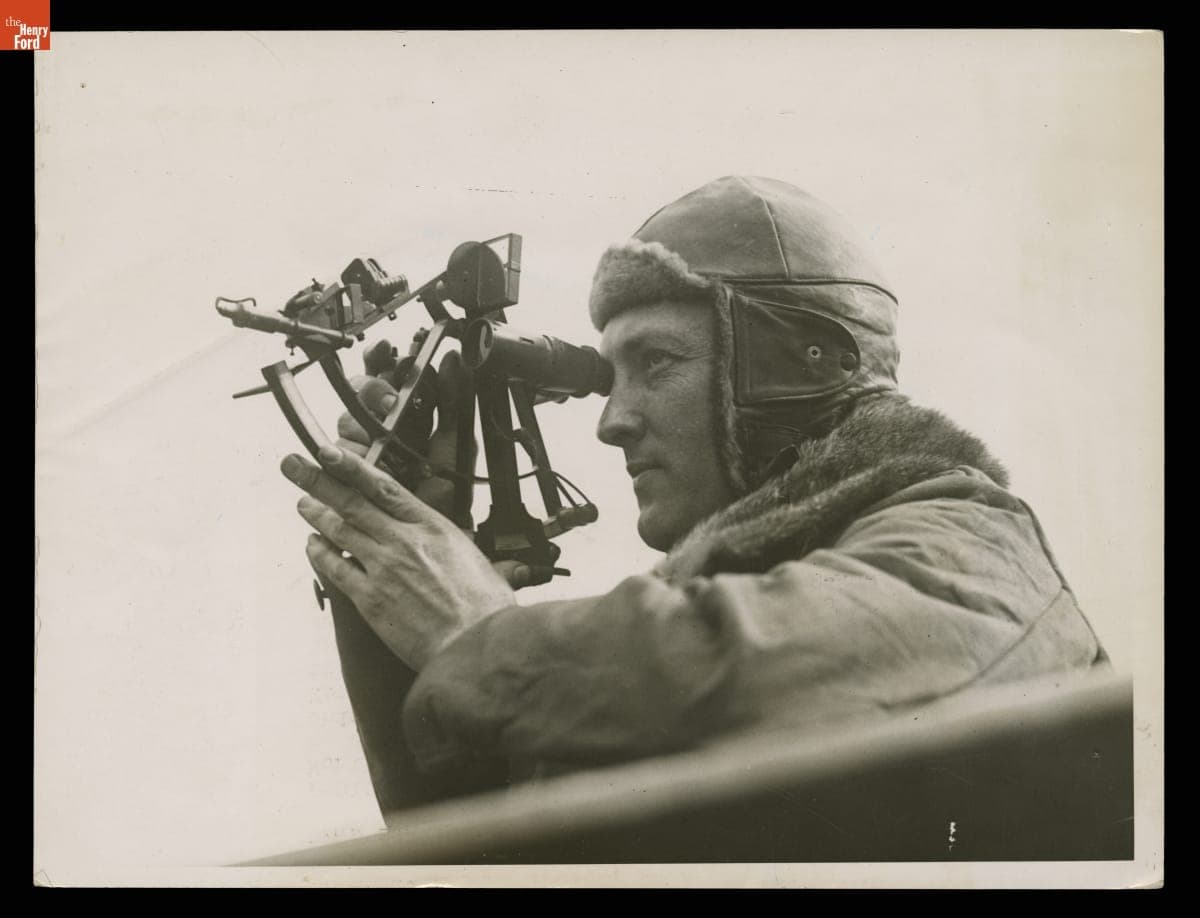
Richard E. Byrd Using a Sextant, circa 1927
In 1900, the Northwest Passage was unnavigated, the vast Antarctic continent largely unstudied, and the Earth's Poles unconquered. But within the next forty years, intrepid polar pioneers--backed by wealthy patrons, governments, and scientific and civic organizations--opened these frozen worlds to continued discoveries by today's scientists, explorers, and adventurers.
View Artifact

