
Bicycles
Share
share
In the 19th century, bicycles introduced Americans to the power of personal transportation. Early two-wheel vehicles set the pattern. High-wheelers carried riders faster and farther. Chain-driven safety bikes fueled a late-century bicycle boom. When that boom went bust, children kept riding until adults rediscovered biking's benefits in the late 20th century. This set features highlights from The Henry Ford's collection of bicycles.
THF108100
Draisine, circa 1818
German Karl Drais invented the draisine in 1817. Operators of this human-powered vehicle sat astride the wooden rail and pushed off with their feet. The early velocipede caught the public's attention, but its novelty soon wore off. A number of substantial improvements, made many years later, were needed before this running machine would evolve into the modern bicycle.
View ArtifactTHF108101
Sargent & Co. Velocipede, 1866
The Boston, Massachusetts, firm of William P. Sargent and Company manufactured this velocipede under Pierre Lallement's 1866 American patent. A key feature was the rotary crank attached to the front wheel. This was an improvement over the draisine from the late 1810s, where the rider moved the vehicle by pushing off the ground.
View ArtifactTHF108104
High-Wheel Bicycle, circa 1878
This wood-wheeled bicycle from the 1870s is an example of an early high-wheel ordinary. The ordinary evolved from the velocipede of the late 1860s. Innovators enlarged the velocipede's front wheel, which made traveling great distances quicker. Future improvements such as steel-tube-frame construction, ball bearings, and wire wheels with rubber tires made the high wheeler a popular recreational and sporting vehicle.
View ArtifactTHF121009
Child's High-Wheel Bicycle, circa 1885
Adult bicycles have always presented a problem of size to child riders -- especially the high-wheel "ordinary" bikes popular in the 1870s and 1880s. This scaled-down child's bicycle was much easier for a young rider to manage. Built by the St. Nicholas Manufacturing Company of Chicago, Illinois, this wooden bike was more affordable than a comparable metal bicycle.
View ArtifactTHF108128
Rudge Rotary Tricycle, circa 1885
This chain-driven tricycle, made by Rudge Cycle Company in 1885, offered health and recreation options to those unable to mount high-wheel ordinaries. Tricycles provided an accessible seat and the stability of three wheels. And for many Victorian women, tricycles allowed them the chance to pedal down the street in dresses rather than in unconventional clothing like bloomers.
View ArtifactTHF108107
Kangaroo Bicycle, 1885
Cyclists in the early 1880s experienced a safer and faster ride on a British-made "Kangaroo." Its small 36-inch front wheel (compared to wheels over 50 inches on traditional bicycles) made the bicycle easier to mount -- and safer if the cyclist fell. Also, the innovative chain drive made the bicycle fast. A cyclist pedaling a "Kangaroo" traveled 100 miles in a little over seven hours -- a record in 1884.
View ArtifactTHF108112
Eagle Bicycle, 1891
The Eagle Bicycle Manufacturing Company built this high-wheel safety in 1891. The Connecticut company copied other manufacturers by placing the small wheel up front and the large drive wheel in back -- preventing the dreaded "header." Still, it was difficult to mount; cyclists had to swing their leg over the large wheel. Low-mount safeties with equal-sized wheels solved this problem.
View ArtifactTHF108113
Elliott Hickory Bicycle, circa 1890
Many women in the late 19th century wanted to ride bicycles. But mounting a high-wheel ordinary was difficult, especially in a period dress -- and donning athletic attire or bloomers for some was considered socially unacceptable. The safety bicycle changed that. This drop-frame safety allowed women to mount the bicycle easily and accommodated the dresses worn by riders.
View ArtifactTHF108114
Rambler Bicycle, 1892
Gormully and Jeffery Manufacturing Company created the successful and popular Rambler brand. This early 1890s Diamond Rambler with its nearly same-sized wheels could be easily mounted by men, women, young, and old. Its spring frame and cushion tires also provided a more comfortable ride. These and other features made cycling more accessible and enjoyable to a growing number of Americans.
View ArtifactTHF108116
Chilion Bicycle, 1897
M.D. Stebbins Manufacturing Company of Springfield, Massachusetts, was one of the largest makers of wood-frame safety bicycles. This 1897 Chilion bicycle used polished-hickory frame rods connected with aluminum-bronze lugs. The company claimed this distinctive bike would not buckle when riders hit obstructions, as metal rods would. And, of course, the bike would not rust.
View ArtifactTHF108117
Columbia Model 60 Women's Bicycle, 1898
Pope Manufacturing Company introduced its "chainless" bicycle in 1897. The driveshaft with bevel gears needed less maintenance than chain drives and was cleaner -- no greasy stains on your clothes. Unfortunately, a shaft drive was heavier and lost a bit of power. It was also more expensive -- not helpful when sales were lagging. Early shaft-driven, chainless bicycles failed to catch on with buyers.
View ArtifactTHF803955
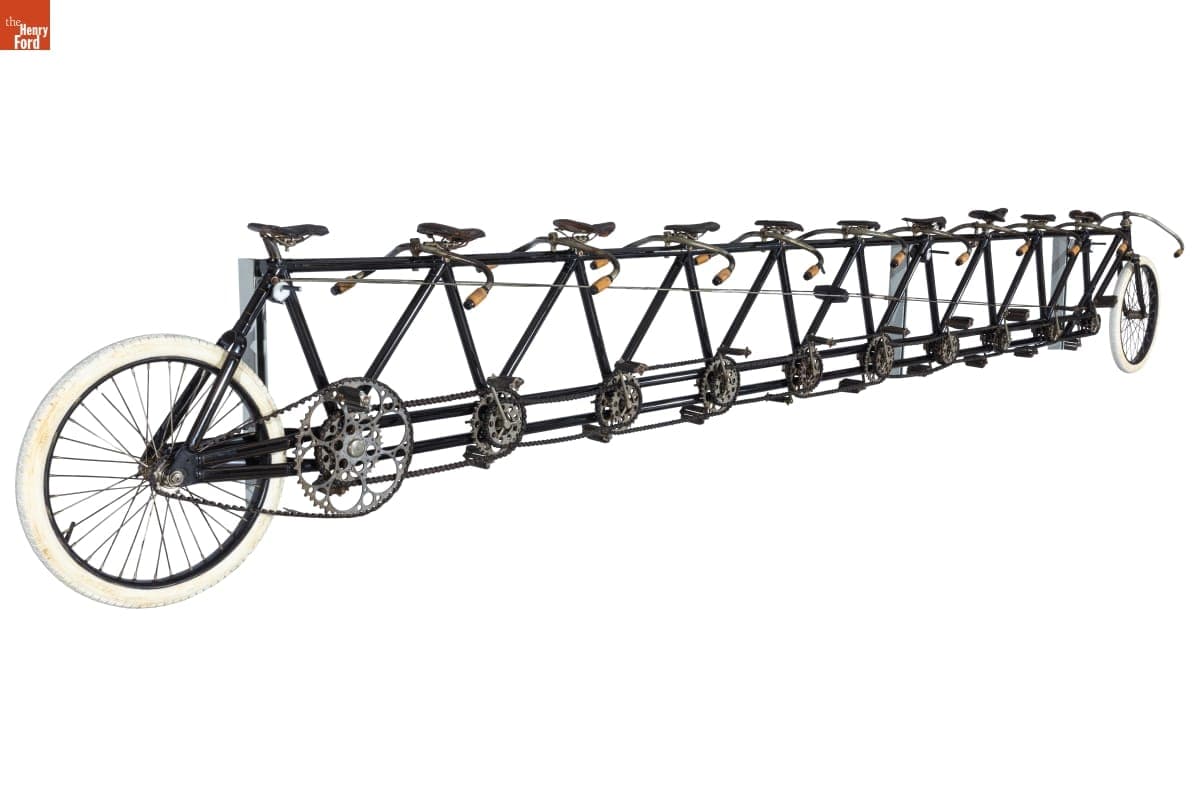
Ten-Person Oriten Bicycle, 1896
Charles Metz of Waltham, Massachusetts, built the Orient Oriten in 1896 as a way to promote his Orient line of bicycles. Metz featured this 23-foot-long, 305-pound ten-seater at bicycle meets and races throughout the country. Though difficult to ride, the vehicle could reach speeds of 45 miles per hour. The Henry Ford owns the only surviving Oriten.
View ArtifactTHF17497
St. Clair Bicycle Made by the Wright Brothers, 1897-1901
After their 1901 glider didn't perform as expected, Wilbur and Orville Wright modified a bicycle to test the data used to shape their wings. Riding the bike generated a breeze that simulated the air pressure against a wing in flight. Although this St. Clair bicycle was built by the Wrights, it is not the actual bike used in their experiments.
View ArtifactTHF108118
Tribune "Blue Streak" Bicycle, Used by Barney Oldfield, 1898
The sleek, light Tribune "Blue Streak," built by Black Manufacturing Company of Erie, Pennsylvania, was a racing favorite. Charles "Mile-a-Minute" Murphy used a Tribune "Blue Streak" to set the mile speed record in 1899. This 1898 model was used by another cyclist who later became America's first automobile racing hero: Barney Oldfield.
View ArtifactTHF189712
Briggs & Stratton Motorized Bicycle, 1920-1930
In the 1910s and 1920s cyclists could travel without pedaling. The Motor Wheel, a wheel fitted with a four-stroke, single-cylinder gasoline engine, could attach to a bicycle and propel it down the road. Briggs & Stratton Company of Milwaukee, Wisconsin, built this version. The company purchased the rights to produce the device in 1919 and continued production until 1924.
View ArtifactTHF108120
"Ingo-Bike" Scooter, circa 1935
Brothers Phillip and Prescott Huyssen patented their Ingo-Bike design in 1934. The scooter's rear wheel has an off-center hub. When a rider bounced up and down on the deck, the movement of the rear fork on that eccentric hub drove the scooter forward. Riding required rhythm -- you had to match your motions to the wheel's rotation.
View ArtifactTHF140431
Bicycle, Handmade by Henry V. Hemeyer, circa 1935
Henry V. Hemeyer's son, Frederick, wanted a bicycle, but the family couldn't afford one during the Great Depression. The resourceful father instead built a bike from galvanized water pipe and flat steel. The finished cycle is held together with nuts and bolts rather than welds, is driven by gears rather than a chain, and has wheels made from bent pipe.
View ArtifactTHF108122
Schwinn "Black Phantom" Bicycle, 1950
American bicycle manufacturers relied on the sale of children's bicycles during the mid-1900s. One of the most successful kids' bikes was the Schwinn Black Phantom. This 1950 model came with whitewall balloon tires, a faux gas tank, red and black trim, a front fender light, a rear light and reflector, and lots of chrome. What child wouldn't want a Black Phantom?
View ArtifactTHF250776
Moulton Bicycle, 1963
Dr. Alex Moulton took his knowledge of automobile shock absorbing systems (he worked on the suspension of the original Austin Mini) and applied it to a completely new bicycle design. The design integrated several innovative features -- a lightweight F-shaped frame, small wheels, high-pressure tires, advanced suspension -- with standard saddle, crank, pedals, and brakes.
View ArtifactTHF802200
Five Millionth Bicycle Made by Huffman Manufacturing Company, 1964
Huffman Manufacturing Company had its origins in the bicycle boom of the 1890s. The company thrived in the mid-20th century by making popularly priced children's bikes. Huffman built its five millionth bicycle in 1964. The special bike's sleek headlight, comfortable saddle, and rear rack provided everything a kid could want in pedal-powered transportation.
View ArtifactTHF168536
Schwinn Sting-Ray Lemon Peeler Bicycle, 1968
After seeing kids in southern California customize their bicycles with "longhorn" handlebars and "banana" seats, Schwinn introduced its Sting-Ray line in 1963. The sporty bikes were a smash, selling two million copies by 1968. Drag racing funny cars inspired this Lemon Peeler Sting-Ray with its small front tire, front drum brake, springer suspension fork, and five-speed stick shift.
View ArtifactTHF802196
Schwinn "Continental" Bicycle, 1969
European-style, multi-speed bicycles with light frames and thin tires reignited American adults' interest in cycling in the mid-1960s. Within ten years, a general physical fitness craze and an oil crisis fueled a second bicycle boom rivaling the 1890s original. This Schwinn Continental offered ten speeds to accommodate a variety of riding conditions. Its model name hints at the design's European origins.
View ArtifactTHF188696
Tricycle, Used by Kevin Degen
Kevin Degen raised hundreds of thousands of dollars cycling for charitable causes. Degen was born with cerebral palsy and rode using only his left leg and left arm. Toyota engineers designed this tricycle for him. The seat is offset to accommodate Degen's off-center riding posture, and the shift and brake controls are all on the left handlebar.
View ArtifactTHF150021
2008 Brompton M3L Folding Bicycle
The New York City cyclist who owned this bike appreciated its versatility -- he could fold it up to take on the subway, or to store under his desk after riding to work. Folding bicycles had been produced for niche markets throughout the 20th century, but new materials and manufacturing processes have made contemporary folding bikes lighter and more comfortable.
View ArtifactTHF172635
Ford "Mode: Flex" Functional Bicycle Prototype, 2015
Automakers increasingly considered themselves "mobility providers" in the 2010s. Ford Motor Company's MoDe:Flex bicycle prototype was born of that thinking. The power-assisted bike operated via an Apple iPhone app that controlled the electric motor, monitored the rider's speed and heart rate, and provided navigation assistance and traffic updates. When disassembled, the bike fit neatly into the trunk of a compact car.
View Artifact

