
Weaving in Greenfield Village
Share
share
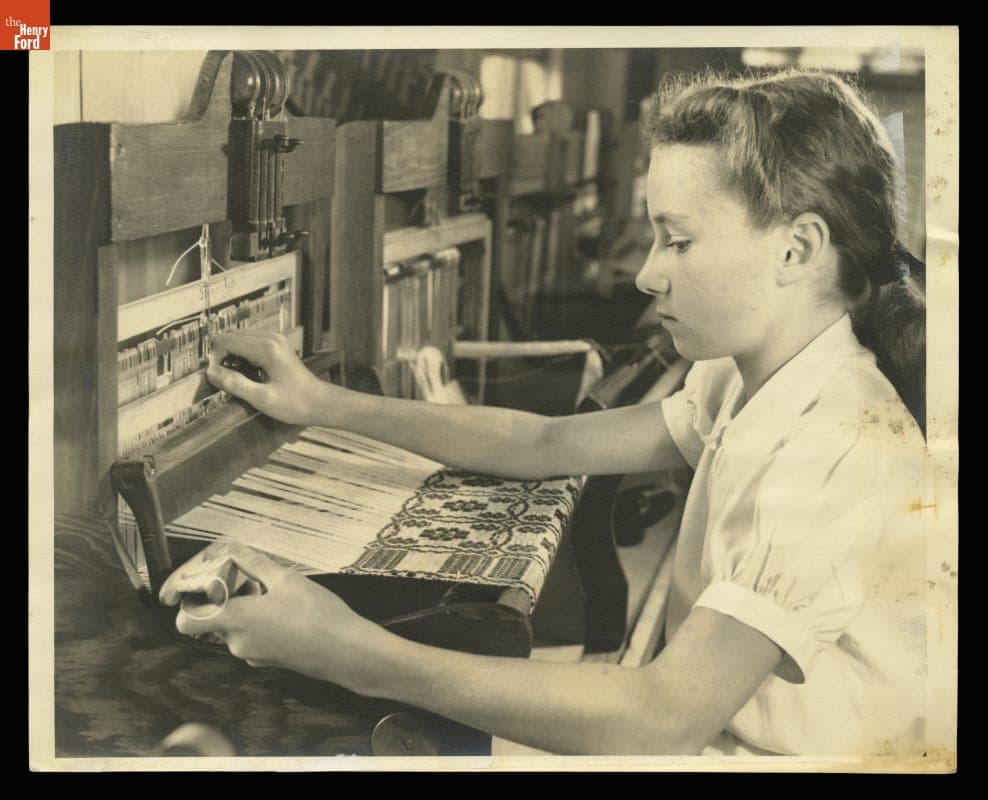
Students of Henry Ford’s Edison Institute Schools learned traditional crafts, including textile weaving. In Greenfield Village, presenters continue to practice and demonstrate the weaving process on a variety of looms.
THF118930
Children from Edison Institute Schools Weaving on Small Hand Looms, 1946-1947
Henry Ford believed in "learning by doing." Students enrolled in the Edison Institute Schools located on the grounds of Ford's Greenfield Village had ample opportunities for practical, hands-on training. Students, if they desired, could learn to weave. Beginners used small tabletop looms. As they progressed students created woven materials using larger looms located in Greenfield Village's Plymouth Carding Mill and Weaving Shed.
View ArtifactTHF2029
Weaving Shop
The Greenfield Village Weaving Shop demonstrates the evolution of textile production from the colonial home and craft shop, through the Industrial Revolution to commercial factory. Housed in a converted 1840s Georgia cotton mill, the Weaving Shop contains a number of working looms, including one of the few operating mechanical Jacquard looms in North America.
View ArtifactTHF124032
Edison Institute Schools Student Weaving, circa 1935
Henry Ford believed in "learning by doing." Students enrolled in the Edison Institute Schools located on the grounds of Ford's Greenfield Village had ample opportunities for practical, hands-on training. Students, if they desired, could learn to weave. Beginners used small tabletop looms. As they progressed students created woven materials using larger looms located in Greenfield Village's Plymouth Carding Mill and Weaving Shed.
View ArtifactTHF124038
Drawing of a Jacquard Loom Punched Card, by Sidney Holloway, 1934
THF124137
Sidney Holloway with Student at the Cotton Gin Mill (now the Weaving Shop), Greenfield Village, 1949
Sidney Holloway (1901-1960) was instrumental in establishing the weaving program at Greenfield Village. Holloway, once employed in the Ford Motor Company's Textile Department, began working with Henry Ford's textile-making collections in 1930. Through hands-on experience and self-study, he mastered the weaving craft. Holloway would engage Greenfield Village visitors for thirty years and pass on his skills to the next generation of artisans.
View ArtifactTHF124135
Carole Ashley at the Jacquard Loom, Plymouth Carding Mill (now Gunsolly Carding Mill), Greenfield Village, 1977
Craftspeople have presented weaving demonstrations at Greenfield Village since it opened to the public in 1933. Over the years, weavers have used several historic and refurbished looms located in the Plymouth Carding Mill (now Gunsolly Carding Mill) to create hand-crafted textiles. These presentations and resulting products help tell the story of textile production in America.
View ArtifactTHF124133
Student Weavers in Plymouth Carding Mill (now Gunsolly Carding Mill), Greenfield Village, 1930
Henry Ford believed in "learning by doing." Students enrolled in the Edison Institute Schools located on the grounds of Ford's Greenfield Village had ample opportunities for practical, hands-on training. Students, if they desired, could learn to weave. Beginners used small tabletop looms. As they progressed students created woven materials using larger looms located in Greenfield Village's Plymouth Carding Mill and Weaving Shed.
View ArtifactTHF124139
Weaving Demonstration by Ida Gustafson in Plymouth Carding Mill (now Gunsolly Carding Mill), Greenfield Village, 1954
Craftspeople have presented weaving demonstrations at Greenfield Village since it opened to the public in 1933. Over the years, weavers have used several historic and refurbished looms located in the Plymouth Carding Mill (now Gunsolly Carding Mill) to create hand-crafted textiles. These presentations and resulting products help tell the story of textile production in America.
View ArtifactTHF124142
Weaving Demonstration in Plymouth Carding Mill (now Gunsolly Carding Mill), Greenfield Village, 1935
Craftspeople have presented weaving demonstrations at Greenfield Village since it opened to the public in 1933. Over the years, weavers have used several historic and refurbished looms located in the Plymouth Carding Mill (now Gunsolly Carding Mill) to create hand-crafted textiles. These presentations and resulting products help tell the story of textile production in America.
View ArtifactTHF124036
Edison Institute Schools Students Weaving, circa 1935
Henry Ford believed in "learning by doing." Students enrolled in the Edison Institute Schools located on the grounds of Ford's Greenfield Village had ample opportunities for practical, hands-on training. Students, if they desired, could learn to weave. Beginners used small tabletop looms. As they progressed students created woven materials using larger looms located in Greenfield Village's Plymouth Carding Mill and Weaving Shed.
View ArtifactTHF243136
Young Man at Power Loom in Plymouth Carding Mill (now Gunsolly Carding Mill), Greenfield Village, circa 1935
Craftspeople have presented weaving demonstrations at Greenfield Village since it opened to the public in 1933. Over the years, weavers have used several historic and refurbished looms located in the Plymouth Carding Mill (now Gunsolly Carding Mill) to create hand-crafted textiles. These presentations and resulting products help tell the story of textile production in America.
View ArtifactTHF242746
Looms inside the Weaving Shed near Plymouth Carding Mill, Greenfield Village, April 1, 1940
Henry Ford believed in "learning by doing." Students enrolled in the Edison Institute Schools located on the grounds of Ford's Greenfield Village had ample opportunities for practical, hands-on training. Students, if they desired, could learn to weave. Beginners used small tabletop looms. As they progressed students created woven materials using larger looms located in Greenfield Village's Plymouth Carding Mill and Weaving Shed.
View ArtifactTHF243120
Weaving Demonstration in Plymouth Carding Mill (now Gunsolly Carding Mill), Greenfield Village, circa 1935
Craftspeople have presented weaving demonstrations at Greenfield Village since it opened to the public in 1933. Over the years, weavers have used several historic and refurbished looms located in the Plymouth Carding Mill (now Gunsolly Carding Mill) to create hand-crafted textiles. These presentations and resulting products help tell the story of textile production in America.
View ArtifactTHF243140
Student Weavers in Plymouth Carding Mill (now Gunsolly Carding Mill), Greenfield Village, 1930
Henry Ford believed in "learning by doing." Students enrolled in the Edison Institute Schools located on the grounds of Ford's Greenfield Village had ample opportunities for practical, hands-on training. Students, if they desired, could learn to weave. Beginners used small tabletop looms. As they progressed students created woven materials using larger looms located in Greenfield Village's Plymouth Carding Mill and Weaving Shed.
View ArtifactTHF243152
"Carding Mill, Greenfield Village, Dearborn, Michigan," Published 1954
Craftspeople have presented weaving demonstrations at Greenfield Village since it opened to the public in 1933. Over the years, weavers have used several historic and refurbished looms located in the Plymouth Carding Mill (now Gunsolly Carding Mill) to create hand-crafted textiles. These presentations and resulting products help tell the story of textile production in America.
View ArtifactTHF243156
Joanna Reader at a Loom in Plymouth Carding Mill (now Gunsolly Carding Mill), Greenfield Village, circa 1944
Henry Ford believed in "learning by doing." Students enrolled in the Edison Institute Schools located on the grounds of Ford's Greenfield Village had ample opportunities for practical, hands-on training. Students, if they desired, could learn to weave. Beginners used small tabletop looms. As they progressed students created woven materials using larger looms located in Greenfield Village's Plymouth Carding Mill and Weaving Shed.
View ArtifactTHF243134
Frank Caddy at the Power Loom in Plymouth Carding Mill (now Gunsolly Carding Mill), Greenfield Village, 1935
Craftspeople have presented weaving demonstrations at Greenfield Village since it opened to the public in 1933. Weavers have used several historic and refurbished looms to create a variety of hand-crafted textiles and to tell the story of textile production in America. This photograph shows Frank Caddy, future Henry Ford Museum and Greenfield Village president, at a power loom in 1935.
View ArtifactTHF243154
Bob Kaiser Using the Jacquard Loom in Gunsolly Carding Mill, Greenfield Village, 1954
Craftspeople have presented weaving demonstrations at Greenfield Village since it opened to the public in 1933. Over the years, weavers have used several historic and refurbished looms located in the Plymouth Carding Mill (now Gunsolly Carding Mill) to create hand-crafted textiles. These presentations and resulting products help tell the story of textile production in America.
View ArtifactTHF243106
Draw Loom inside Gunsolly Carding Mill in Greenfield Village, April 1, 1940
THF45133
Jacquard Loom, 1934
Joseph-Marie Jacquard's loom, first developed in 1801, is programmable. It used a series of punched cards to control the lifting of each individual warp thread to weave a figured fabric. With this loom, weavers could create intricate patterns more easily, faster, and with better accuracy. Punch card technology became the basis for computer data storage during the 20th century.
View Artifact

