
Day of Courage: Segregation
Share
share
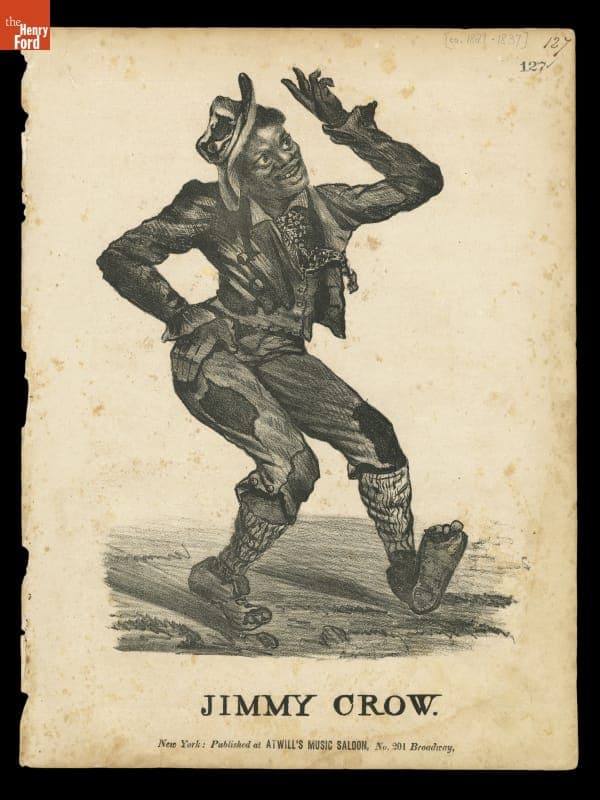
Music Sheet, "Jimmy Crow," 1834-1837 - 1
This sheet music includes the music and lyrics for a minstrel show and the image of a blackface character. Minstrel shows generally featured white actors wearing black makeup (known as blackface) who portrayed racist stereotypes of African Americans through singing and dancing. American audiences considered these shows comical and attended minstrel shows for over a century, from the live theater of the early 1800s to the films of the early-20th century. They even appeared in mid-20th century children's cartoons. The lyrics on this sheet are attributed to Thomas Dartmouth Rice (1808-1860), who introduced the character "Jim Crow", a stereotypical African American, in 1832. The cover image may also depict Rice, an American singer, dancer, and composer, one of the first well-known blackface performers. The "Jimmy Crow" song made Rice internationally famous. The song's popularity first brought the term into the American language as derogatory slang referring to African Americans. "Jim Crow" eventually referred to the two separate societies - one black, one white - followed throughout the United States. This system was formalized in the South by state laws passed in the late-19th century. Blacks and whites could not sit in the same waiting rooms, use the same bathrooms or eat in the same restaurants, for example. Not until the Civil Rights movement of the 1950s and 1960s was segregation outlawed.
View Artifact"Negro Motorist Green Book, An International Travel Guide," 1949 - 2
Before the 1964 Civil Rights Act, African Americans faced persistent racial discrimination when traveling. It could be difficult to find restaurants, hotels, or other amenities. The Negro Motorist Green Book, begun in 1936, became a guide for the African American traveler. This 1949 edition listed travel information that would keep the traveler "from running into difficulties [and] embarrassments," and would "make his trips more enjoyable."
View ArtifactLouisville and Nashville Railroad Restroom Sign, 1929 - 1
From the late 19th through the mid-20th centuries, segregation laws in Southern states separated African Americans and whites in almost every aspect of public life -- from railroad cars and schools to restrooms and drinking fountains. Varying from state to state, these laws were supposed to establish facilities that were "separate but equal." In reality, these were almost never equal.
View Artifact"Segregation: The Inner Conflict in the South," 1956
Robert Penn Warren reveals southern attitudes towards race in the aftermath of the Brown v. Board of Education decision in his 1956 book, Segregation. Through informal conversations, Warren, a Kentucky native, explores the Southerner's -- and his own -- internal conflict about black-white relation.
View ArtifactMagazine, "Our Sports, The Negro's Own Sports Magazine," June 1953
This magazine, billed as the "Negro's Own Sports Magazine," ran for five issues in 1953. Jackie Robinson, the first African American to play major league baseball, was ostensibly the editor. At this time, African-American athletes were becoming involved in every major spectator sport. The cover article features baseball great Monte Irvin, who had signed with the New York Giants in 1949.
View Artifact"Segregation or Death," circa 1957
White supremacists agitated for continued segregation after the 1954 Brown v. Board of Education decision. This pamphlet laid out their racist view arguing for the continued separation of whites and blacks. Civil Rights activists urged Americans to reject this mindset and to continue the march toward equality.
View Artifact"Whites Only" Drinking Fountain, 1954
From the late 19th through the mid-20th centuries, segregation laws in Southern states separated African Americans and whites in almost every aspect of public life -- from railroad cars and schools to restrooms and drinking fountains. Varying from state to state, these laws were supposed to establish facilities that were "separate but equal." In reality, these were almost never equal.
View Artifact"Colored" Drinking Fountain, 1954
From the late 19th through the mid-20th centuries, segregation laws in Southern states separated African Americans and whites in almost every aspect of public life -- from railroad cars and schools to restrooms and drinking fountains. Varying from state to state, these laws were supposed to establish facilities that were "separate but equal." In reality, these were almost never equal.
View Artifact"A. G. Gaston Motel, Birmingham's Most Comfortable Relaxing Center," Birmingham, Alabama, 1954 - 1
A. G. Gaston founded this motel in 1954 to provide African-American travelers a place to stay while in Birmingham, Alabama. Modeled after the groundbreaking Holiday Inns that had recently opened in Memphis, Tennessee, this motel included 32 rooms, each with their own air-conditioning and telephone. In 1963, the motel became the epicenter of Birmingham's Civil Rights protests and demonstrations.
View ArtifactSign from Doctor's Office, "Colored Entrance in Rear," circa 1950
"Jim Crow" laws separated blacks from whites in all aspects of daily life. Favoring whites and repressing blacks, these become an institutionalized form of inequality. Through separate (and inferior) public facilities like building entrances, elevators, cashier windows, and drinking fountains, African Americans were reminded everywhere of their second-class status. These practices were finally outlawed by the 1964 Civil Rights Act.
View Artifact

