
Henry Ford: Post-Model T
Share
share
This Expert Set was compiled in 2013 to commemorate the 150th anniversary of Henry Ford’s birth.
THF91599
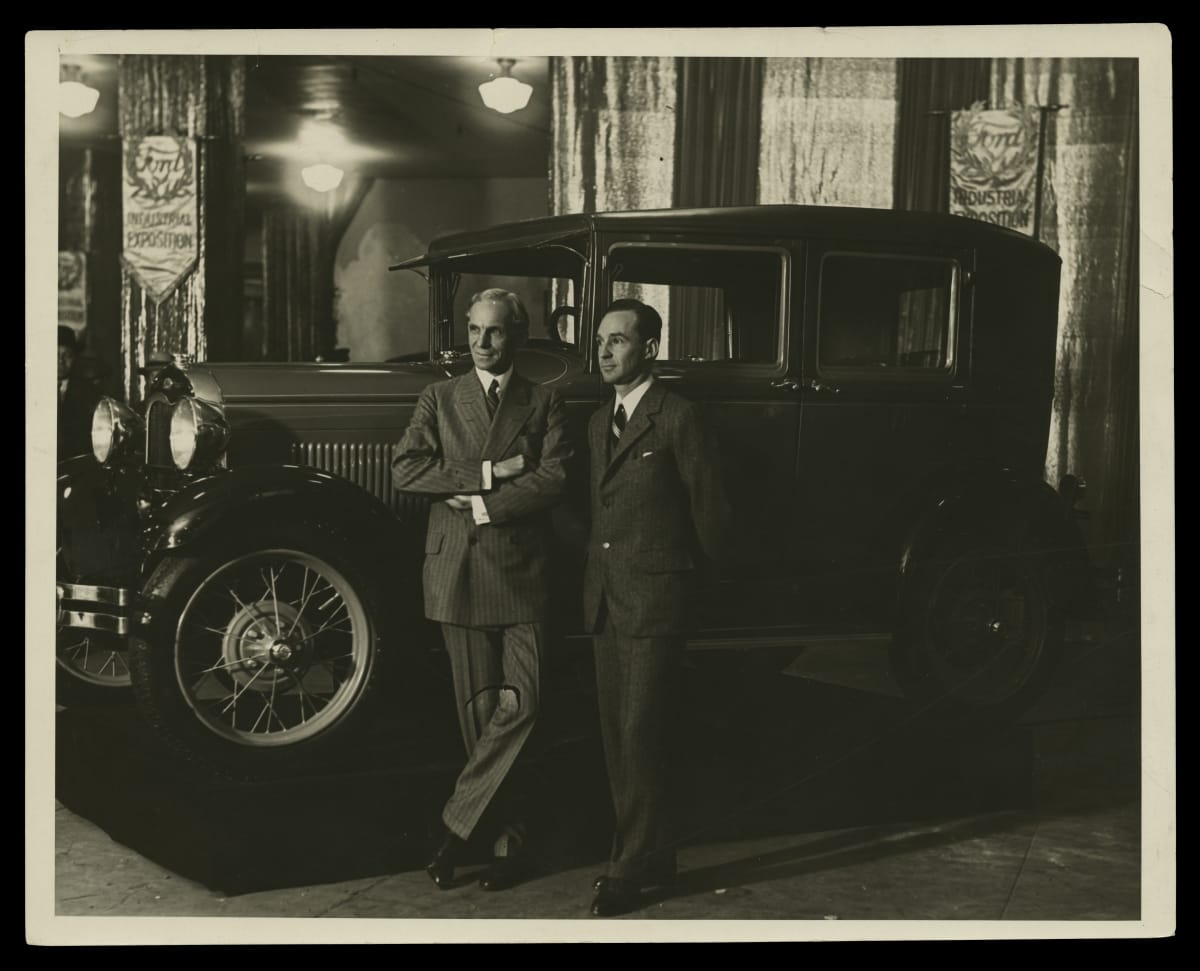
Henry Ford and Edsel Ford Introducing the 1928 Ford Model A at the Ford Industrial Exposition in New York City
Henry Ford and Edsel Ford introduced the Model A on December 2, 1927. After 19 years of Model T production, the public was eager for Ford Motor Company's new car. It took six months of intensive design work and plant retooling, but the Model A was a hit. Ford sold nearly five million cars over the Model A's four-year production run.
View ArtifactAerial View of Ford Rouge Plant, 1930
This aerial view shows Ford Motor Company's sprawling Rouge plant--the largest, most efficient manufacturing complex of its time. Ford established its administrative headquarters here in 1928, around the same time the company began manufacturing automobiles from start to finish at the plant. The Rouge became not only central to Ford's operation but an icon of modern industrial efficiency.
View ArtifactHenry Ford Stamping the First Ford V-8 Engine, 1932
Henry Ford and Ford Motor Company revolutionized the automobile market again in 1932 with the introduction of the company's V-8 engine. By casting the engine's block as single piece, Ford kept manufacturing costs down and made the engine affordable to more motorists. The venerable engine remained in production until 1953.
View ArtifactHenry Ford with the First Ford V-8 Engine, March 26, 1932
When the V-8 went into production in 1932, Henry Ford and Ford Motor Company once again revolutionized the automobile market. Although the Ford V-8 was not the first production V-8 in automotive history, it was the first compact (because of the V alignment of the eight cylinders) and powerful engine that was available to the general auto buying audience. Henry Ford personally oversaw the design and development of the V-8 with a selected team of engineers located not in the state-of-the-art Ford Engineering Laboratory, but in Thomas Edison's Fort Myers Laboratory recently relocated from Florida to Henry Ford's Greenfield Village. It is believed that Henry Ford used the building, tools, and machines that Thomas Edison had used to help inspire the engineers and designers.
View ArtifactAdvertisement for the 1932 Ford V-8 Car, "Announcing the New Ford V-8 Cylinder"
Henry Ford and Ford Motor Company revolutionized the automobile market again in 1932 with the introduction of the company's V-8 engine. By casting the engine's block as single piece, Ford kept manufacturing costs down and made the engine affordable to more motorists. The venerable engine remained in production until 1953.
View ArtifactHenry Ford and Edsel Ford with Ford V-8 Engines, circa 1935
Henry Ford and Ford Motor Company revolutionized the automobile market again in 1932 with the introduction of the company's V-8 engine. By casting the engine's block as single piece, Ford kept manufacturing costs down and made the engine affordable to more motorists. The venerable engine remained in production until 1953.
View ArtifactHenry Ford and Edsel Ford at Ford Rouge Plant, 1933
The world's largest integrated factory, the Ford River Rouge Complex, was completed in 1928. It quickly became an icon of modern industrial efficiency. The vast Rouge Plant serves as a backdrop for Henry Ford -- founder of Ford Motor Company -- and his son Edsel Ford -- Ford Motor Company president -- in this 1933 photograph.
View ArtifactHenry Ford and Edsel Ford with One Millionth Ford V-8 Automobile, 1934
Ford's low-priced V-8 engine, introduced in 1932, had a difficult start. In addition to problems perfecting the engine's one-piece cast block, the Ford V-8 debuted in one of the worst years of the Great Depression. While the company routinely built more than a million cars a year in the 1920s, it wasn't until 1934 that the one millionth V-8 appeared.
View ArtifactHenry Ford with 1935 Ford V-8 Engine, December 1934
In late 1934 Henry Ford admires his last great personal innovation, the Ford V-8 engine. Ford did not invent the V-8 configuration. His contribution was figuring out how to make a V-8 cheap enough and light enough to use in an inexpensive car like a Ford.
View ArtifactHenry Ford and Edsel Ford with One Millionth Ford V-8 Automobile on Assembly Line at Rouge Plant, 1934
Ford's low-priced V-8 engine, introduced in 1932, had a difficult start. In addition to problems perfecting the engine's one-piece cast block, the Ford V-8 debuted in one of the worst years of the Great Depression. While the company routinely built more than a million cars a year in the 1920s, it wasn't until 1934 that the one millionth V-8 appeared.
View ArtifactHenry Ford Watching Workers Riveting Center Wing Section at the Willow Run Bomber Plant, 1942
At Willow Run, Ford Motor Company built B-24 bomber planes for World War II using automobile mass production techniques. Airplanes were much more complex than cars. They required constant design changes poorly suited to a standardized assembly line. Ford overcame these difficulties and, at the plant's peak, Willow Run crews produced an average of one bomber every 63 minutes.
View ArtifactAdvertisement for the 1929 Ford Model A Phaeton, "Consider the Unseen Values When You Buy a Motor Car"
Ford Motor Company shook the automotive world when, after building Model Ts for 19 years, it introduced the Model A in late 1927. Henry Ford knew that his reputation was at stake, so he insisted that the new car be of the highest quality. This advertisement for the 1929 Model A promotes the car's smooth and dependable bearings.
View ArtifactFord X-8 Engine, 1920-1925
This odd looking X-shaped engine has two banks of four cylinders arranged around a central crankshaft. This X-8 layout fascinated Henry Ford and in 1920 he launched a secret project to build such an engine. But the X-8 turned out to be a flawed concept, and Ford finally abandoned the project in 1926.
View Artifact1930 Ford Model A Touring Car
The Model A's two-year-old styling was refreshed for 1930 with new sweeping fenders, a new radiator, smaller wheels, and a longer hood. Ford sold nearly 1,160,000 Model As in 1930, but only 16,470 were open phaetons like this car. Most buyers preferred closed sedans or coupes, with permanent roofs and roll-up windows.
View Artifact1932 Ford V-8 Cabriolet
The 1932 Ford automobile combines the attractive facelift of the 1931 Model A with the world's first low-priced, cast-in-one-piece V-8 engine. Powered by Henry Ford's latest personal engineering triumph, his "en block", or one piece, V-8 engine, the 1932 Ford outperformed all other popular competitors. The vehicle's improved proportions and styling reflected Edsel Ford's, Henry's son, genius for design.
View Artifact1932 Ford V-8 Engine, No. 1
Henry Ford and Ford Motor Company revolutionized the auto industry once again in 1932 with the introduction of a low-priced V-8 engine. By casting the crankcase and cylinder banks as a single unit, Ford cut manufacturing costs and could offer its V-8 in a car starting under $500. Ford's original V-8 design remained in production, with modifications, until 1953.
View ArtifactFord V-8 Engine Block, 1930-1931
When Chevrolet introduced a six-cylinder engine in 1929, Ford's four-cylinder seemed outdated. So, Henry Ford decided to go Chevy two cylinders better and build a V-8. Ford engineers tried many different versions of the new engine. This experimental cylinder block was cast in 1930 or 1931.
View Artifact

