
The venues of The Henry Ford stand on the ancestral, traditional, and unceded homelands of the Three Fires Council—the Odawa, Ojibwe, and Potawatomi peoples. The Miami, Wyandot, and Fox Nations also called this land their home. The 1807 Treaty of Detroit led to the forcible removal of these First Peoples, and they dispersed throughout the United States to parts of current-day Michigan, Wisconsin, Oklahoma, Kansas, and into Canada. The Henry Ford acknowledges the impacts of settler colonialism and commits to deepening its relationship with Indigenous communities in the present — and future.
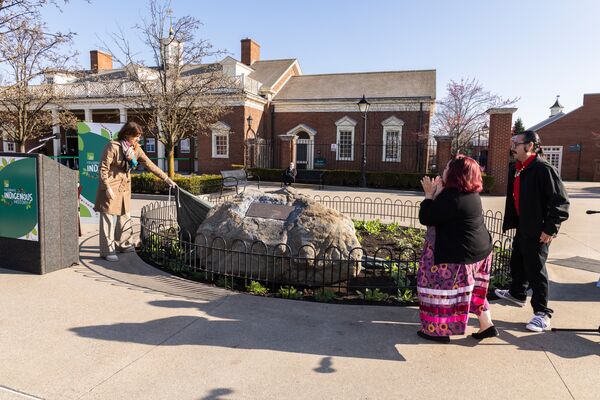
Land Acknowledgement unveiling with (left to right) CEO Patricia Mooradian, President of The Henry Ford; Heather Bruegl (Oneida/Stockbridge-Munsee), Curator of Political and Civic Engagement; and Travis Schuyler (Oneida/Ojibwe), Program Manager for the North American Indian Association of Detroit. / Photo by KMS Photography
With this statement, The Henry Ford acknowledges the presence and history of Indigenous people who originally stewarded the land upon which the institution was built. It is important, however, that this land acknowledgement be more than just words. It is a commitment that requires action.
On April 11, 2026 — coinciding with the opening of Greenfield Village for the season — The Henry Ford unveiled a new plaque in front of the Village ticket building, making this statement a permanent part of the environment.
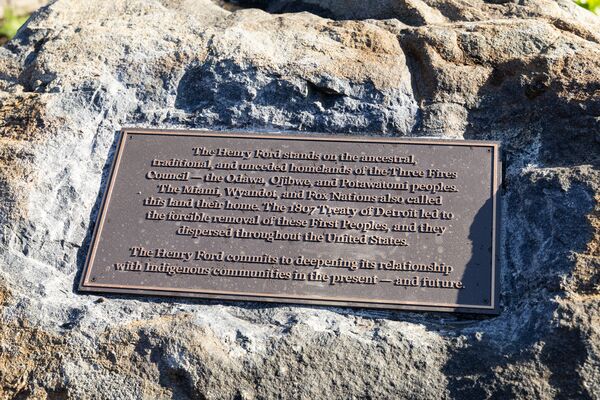
Land Acknowledgement Plaque / Photo by KMS Photography
Much work was put into writing our land acknowledgement statement, and that extended to the plaque itself.
The plaque is mounted to a rock chosen from our own property that had been here for several years. Previously situated in Walnut Grove, the rock is an “erratic gneiss.” Erratic gneiss (pronounced “nice”) boulders originated as metamorphic rock in the Canadian Shield— a large area surrounding Hudson Bay, and home to some of the oldest rocks on Earth — before being relocated by glaciers. Gneiss rocks— including the one holding the land acknowledgement plaque—feature alternating bands of light and dark color, created by different mineral deposits.
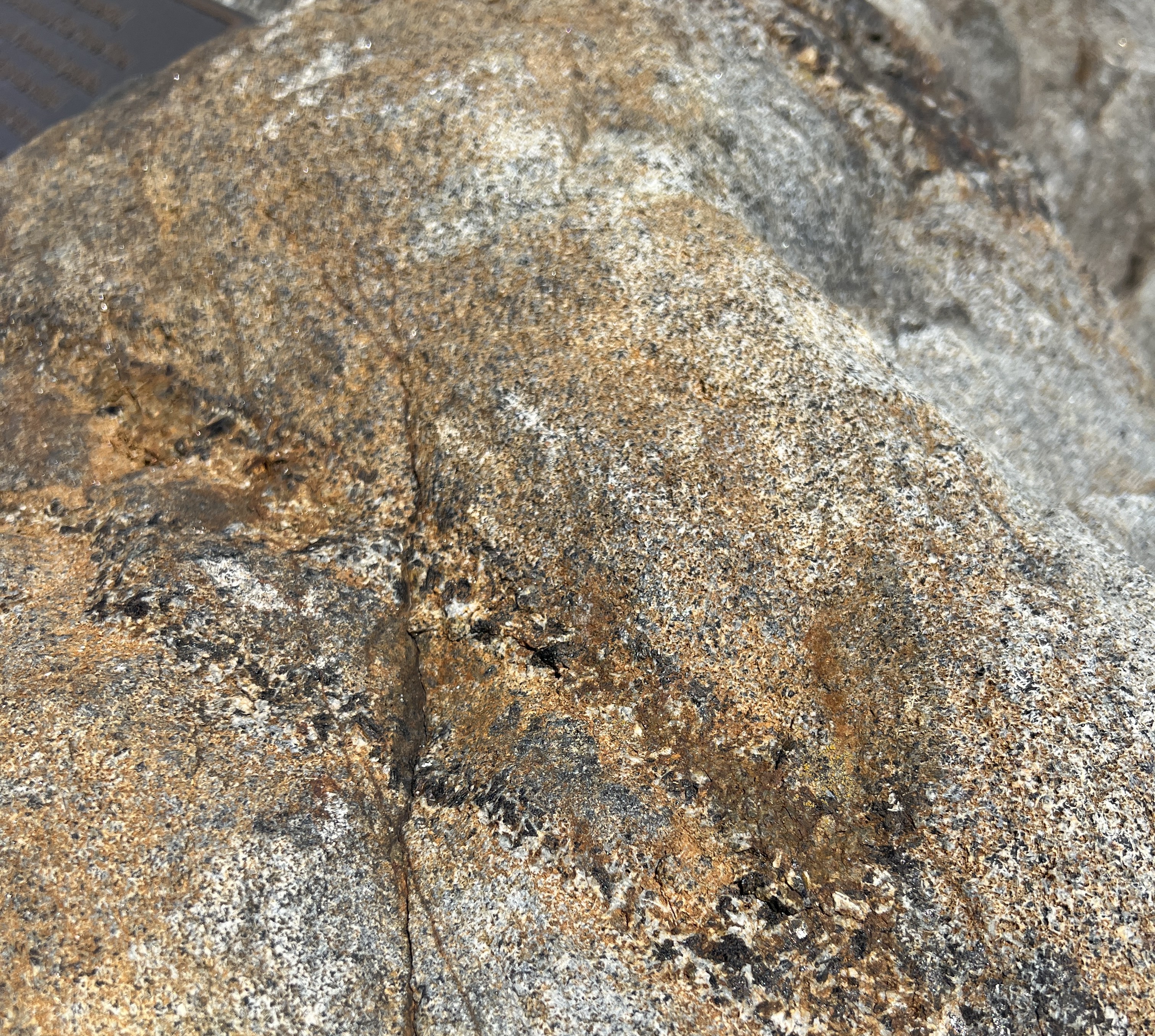 Close-up of the gneiss boulder used for the land acknowledgement plaque. The various colors – and bits of sparkle evident in person – are created by the different minerals in the stone. / Photo by staff of The Henry Ford
In thinking about the landscaping around the rock, several different factors were taken into consideration. First and foremost, it was important that the plants themselves be indigenous to this area. In addition to their symbolic importance—indigenous plants to pair with a statement honoring Indigenous ownership—choosing native plants helps support local wildlife and ecosystems, and they are well-suited for Michigan’s ever-changing environmental conditions.
In narrowing down the potential plants, the team considered:
- How to balance sun and moisture needs for various plants
- How high each plant would grow, and how to layer them for visual appeal
- Which plants might spread more aggressively, and how to ensure that less-aggressive-spreaders were protected
- Which plants might send up other, independent plants that would need to be controlled
- How well plants could tolerate salt, given their proximity to the walking path and driveway, both of which get salted for safety each winter
From an initial list of twenty-one possible plants, six were chosen and cultivated in our greenhouses.
Flowers Surrounding the Land Acknowledgement Plaque


Thoughtfully arranged, these plants will give the site a variety of colors and textures as they grow and fill the space around the plaque.
This land acknowledgement is an important part of the work we do at The Henry Ford, but it is not the only action the institution is taking to acknowledge Indigenous history. Enrolled tribal citizens of federally recognized tribal nations, as well as Canadian First Nations, Inuit, and Métis people, will now receive free admission year-round to Henry Ford Museum of American Innovation and Greenfield Village. In October 2025, The Henry Ford hosted Maggie Thompson (Fond du Lac Ojibwe) as our inaugural Indigenous Artist in Residence, and this year we will be hosting Jamie John (Anishinaabe/Korean). Each November, we offer Celebrate Indigenous History programming. We also continue to tell Indigenous stories through objects in our collection, including new acquisitions. Through this work, and work yet to come, The Henry Ford seeks to live up to its commitment to “deepening its relationship with Indigenous communities in the present — and future.”
Rachel Yerke-Osgood is an Associate Curator at The Henry Ford