
An Introduction to Fabric of America
| Written by | |
|---|---|
| Published | 5/27/2026 |
An Introduction to Fabric of America
| Written by | |
|---|---|
| Published | 5/27/2026 |
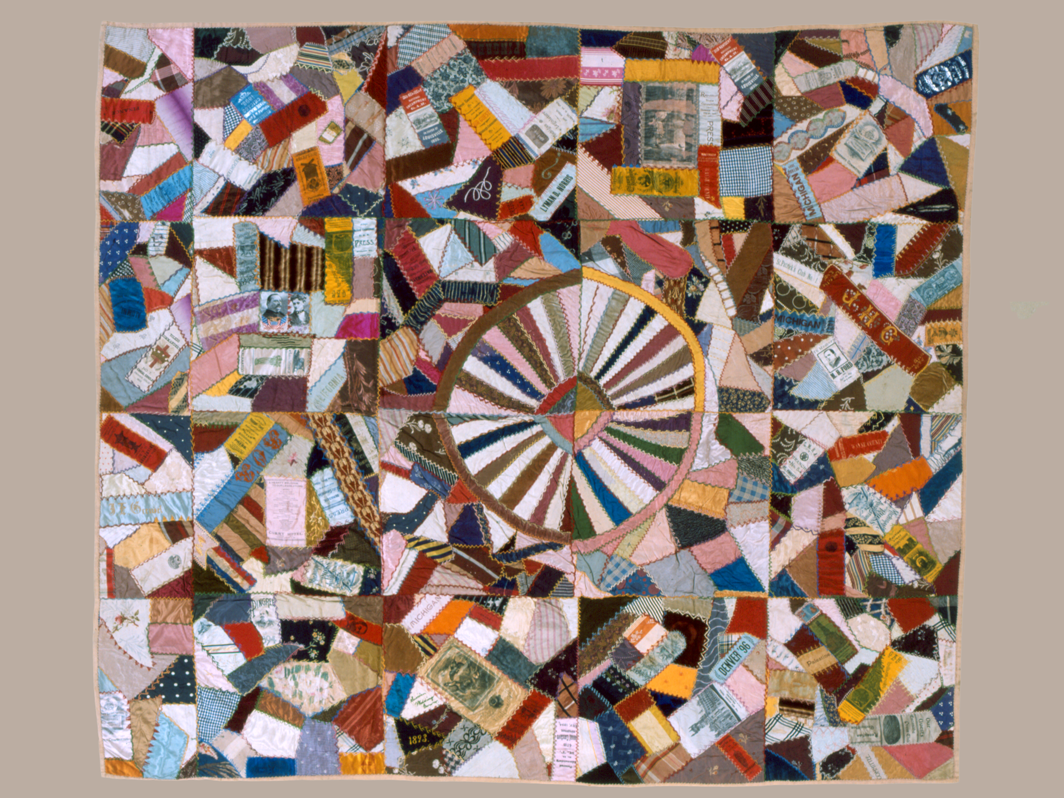
Crazy Quilt, Circa 1896 / THF114308
Fabric is many things: functional, decorative, protective, communicative. When we consider fabric, our minds often go first to clothing, but textiles are ubiquitous in our day-to-day lives, beyond the clothes on our bodies. Fabric is a comfortable upholstered chair, a banner crafted to proclaim a stance, an heirloom tablecloth, a quilt made from scraps, the patches we sew on a tote bag, as well as an haute couture garment, World War II-era women’s workwear, or a Girl Scout uniform. In all moments of life, fabric surrounds us—sometimes it is a quiet yet familiar companion in personal moments, and other times, it serves as a prominent actor in our lives and livelihoods. Newborns are swaddled moments after birth, sailcloth enabled global exploration, textile manufacturing catalyzed the Industrial Revolution, and T-shirts proclaim who we are to the world. Fabric is a witness, a tangible record of human experience, and it can be a compelling storyteller.
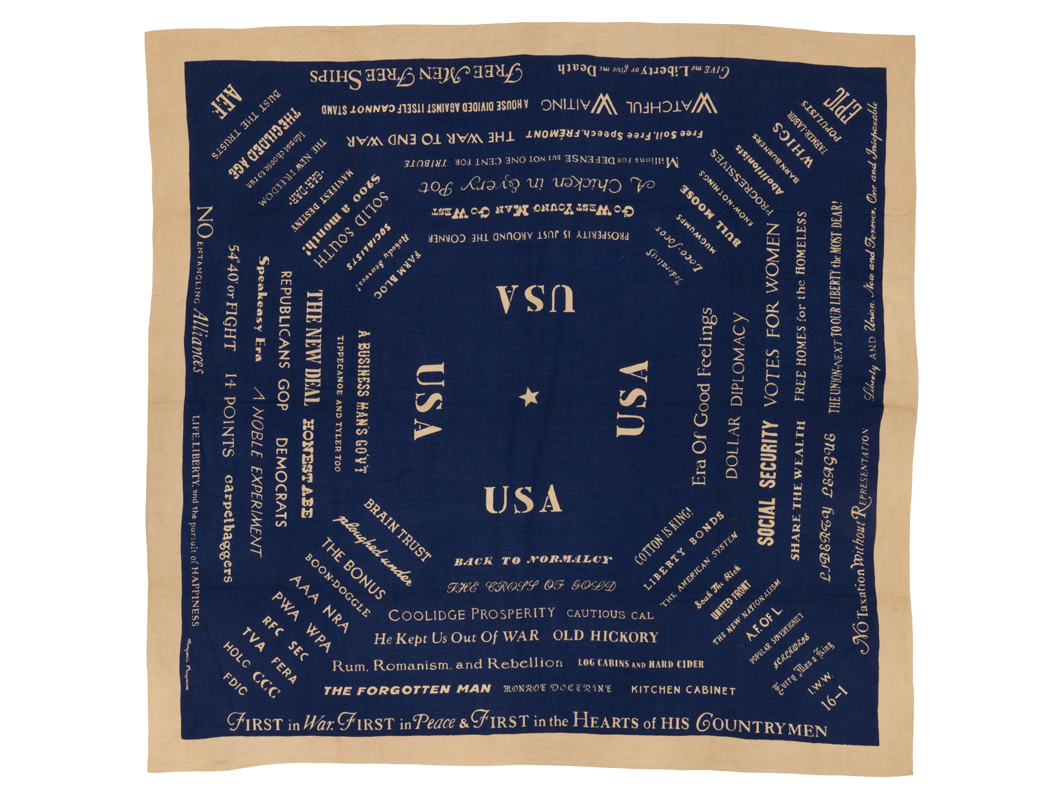
"Food for Thought" Tablecloth Designed by Marguerita Mergentime, 1936-1940 / THF373360
In recognition of textiles' omnipresence in our lives, as well as in The Henry Ford's collection, the Fabric of America exhibition uses fashion, textiles, and machinery as storytellers — as a lens through which to understand our shared history in 26 stories. Some of these stories are large, sweeping, and thematic, while others are personal, intimate, and targeted. Each individual story contributes an important perspective through the textiles Americans wore, designed, lived with, crafted, or used in their daily lives. But taken as a whole, these stories weave a rich tapestry of human experience that is greater when considered together. In this way, the exhibit is much like America itself.
The exhibit is organized by five enduring American values: liberty, abundance, practicality, individualism, and inventiveness. Americans are a dynamic set of individuals, a shifting group, and yet there are core American values that have persisted since the founding of the country 250 years ago. These values were created, adopted, assimilated, and transferred. They reflect the deep cultural knowledge of homelands near and far, as well as insight gained through hope and hardship. Values are generally aspirational and, at times in our history, America has fallen short of the values it proclaims. The humanizing nature of textiles offers us common ground and connection to encounter these histories anew.
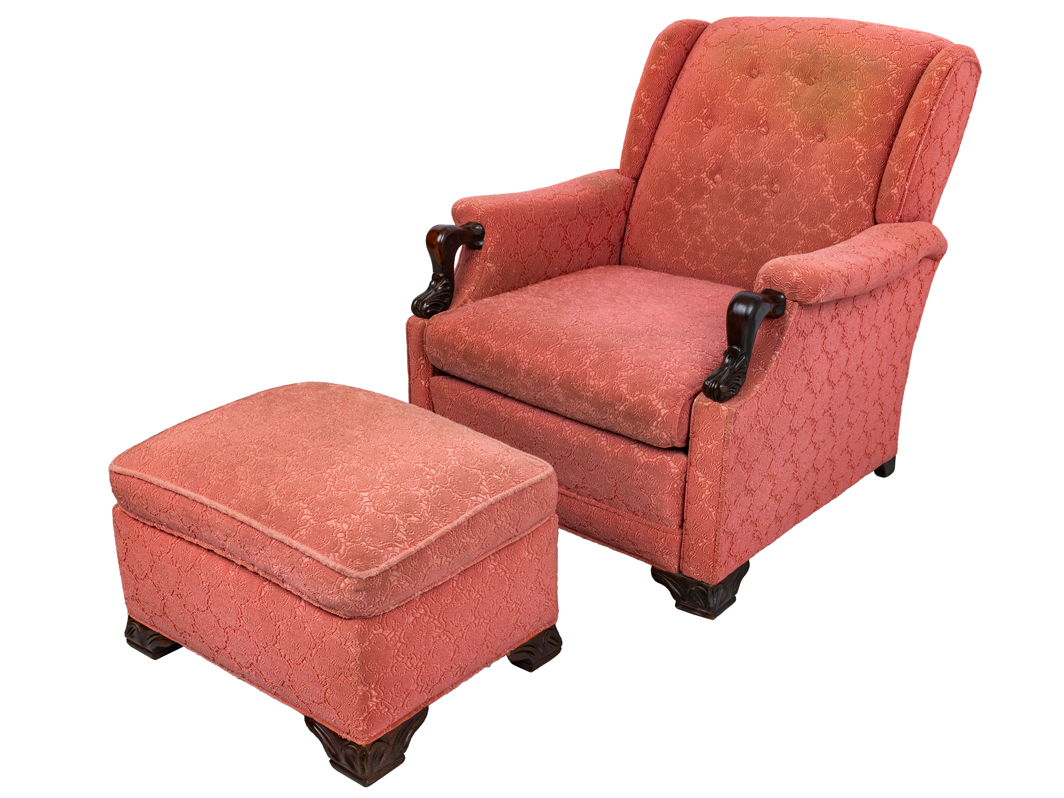
La-Z-Boy Chair Company Reclining Chair and Ottoman, 1941/ THF810310
As each guest walks into the gallery, a sculptural assemblage of artifacts greets them: the uniform of a Pullman Porter, a White Castle worker's cap, a contemporary Indigenous ribbon skirt, a 1970s leisure suit, a quilt retelling the story of Rosa Parks, a Sunday hat, a flax spinning wheel, and more. Arranged in the round, these artifacts present a kaleidoscopic, patchwork perspective of America through textile stand-ins for American people, movements, ideas, and eras. There is no prescribed route: Enter the exhibition through any pathway, beginning with any value, to explore the history of America with textiles and discover how we — the American people — are truly the fabric of America.
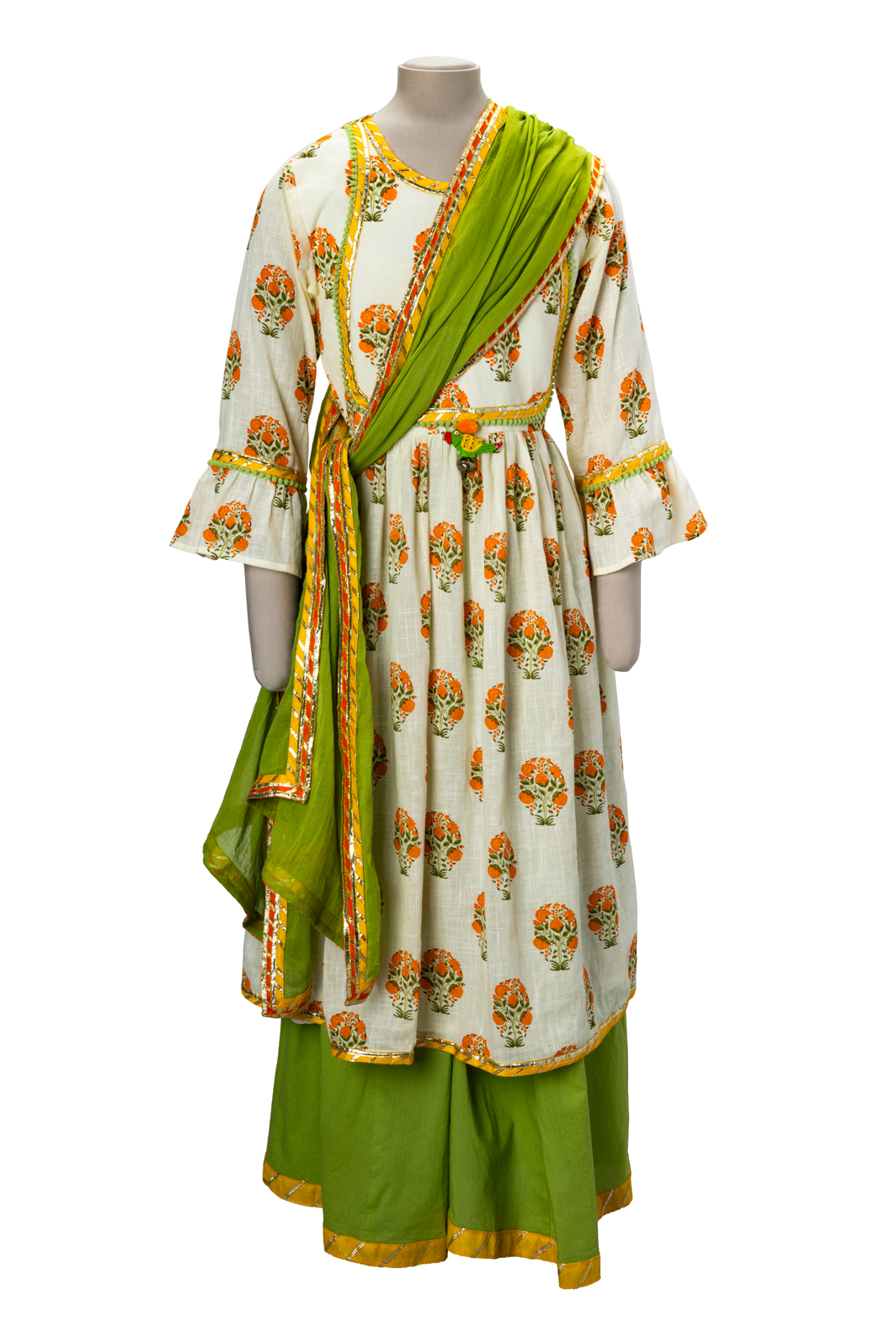
Anarkali Suit, 2019 / THF807554
The following lists each story represented in the exhibit, grouped into their respective value.
Liberty


- Wear it on Your Sleeve
- "Cotton is King"
- America's Great Promise & the Adler Family
- LGBTQ+ Americans
- Textiles on Campaign
Abundance


- Before Abundance
- Textiles & the Industrial Revolution
- Tradeoffs to Industrialization
- Legacy Industry: NYC's Garment District (Tom's Sons International Pleating)
- Fast Fashion
Practicality


- Practical Garments
- Reusing Textiles
- Green Burial
- Vera Maxwell: A Functional Fashion Designer
Individualism


- T-Shirts
- Individuality through High Fashion (Elizabeth Parke Firestone)
- Florine Mark
- Zoot Suit
- Patricia Moore, "Mother of Universal Design"
- Tien Chiu's Wedding Dress
- Hip Hop & Fashion (DJ Kool Herc)
Inventiveness


- Furnishing Color & Whimsy (Alexander Girard)
- Designing Americans
- Mechanizing Inventions
- Improvisational Quilts: An Inventive Journey
- Cultural Transfer: Inspiration or Appropriation?
Katherine White is Curator of Design at The Henry Ford and author of this article. This exhibit was an incredible team effort. She was honored to co-curate this exhibit with Marc Greuther, Chief Curator; Jeanine Head Miller, Curator of Domestic Life; and Kristen Gallerneaux, Curator of Communications and Information Technology. Associate Curators Aimee Burpee, Kayla Chenault, and Rachel Yerke-Osgood provided invaluable expertise and content creation.
None of this could have been done without our Collections Operations Teams, led by Josh Wojick. Associate Registrar Sarah Gee was vital — she kept us organized and ensured 700+ artifacts were accurately accounted. The Conservation Team, especially Kate Herron, Julia Fahling, Mary Fahey, Cuong Nguyen, Scott Powers, Marlene Gray, and Meghan McQuiston, heroically took on the conservation of a record number of artifacts, dressing of 60+ mannequins, and reassembly of textile machinery in an impressive timeline. Collections Management staff, especially Bernie Brooks, Jordan Taylor, Vicky Morris, and Christine Hejka, located and moved hundreds of artifacts — often numerous times! Jillian Ferraiuolo and Kevin McGorey took beautiful and technical photographs.
The Experience Design Team, including Wing Fong, Fern Linziger, Matthew Nielson, Justin Williams, and Yasmin Bajwa, transformed our curatorial vision into an extraordinary experience. The Exhibits Team, led by Bradley Hinken and including Jared Wylie, Steve Burdick, Ken Drogowski, Alex Bodnar, Kevin Nelson, and Julianna Sanroman, crafted a creative array of display methods and mounted this maximalist exhibition in impossibly few days. Colleagues in Creative Services, Marketing, and Programs continue to promote, facilitate, and integrate this work. We are grateful to many for their support of this exhibition, not least of which, for President Patricia Mooradian and the Executive Leadership team.
Keywords | |
|---|---|
Themes |