
Changing Faces: Nineteenth-century Political Metamorphic Cards
| Written by | |
|---|---|
| Published | 10/29/2026 |
Changing Faces: Nineteenth-century Political Metamorphic Cards
| Written by | |
|---|---|
| Published | 10/29/2026 |
In the second quarter of the nineteenth century, and especially beginning in 1840, presidential campaigning changed. In the early days of the American Republic, presidential candidates had little need to campaign. Presidential candidates were often viewed as virtuous leaders, respected gentlemen in society, and sons of the Revolution and the early Republic. Deference dictated that these men rise to the highest office in the land with little or no campaigning. By 1840, however, social hierarchies had begun to crumble before growing universal white male suffrage and the rise of political parties. Leaders of presidential campaigns actively encouraged voter engagement. Parades, barbecues, and raucous rallies—often enhanced with liberal amounts of alcohol—were prevalent. More and more devices designed to promote a certain party or its candidate—the material culture of presidential politics—flooded into campaigns: banners and broadsides, clothing buttons, brooches, badges and ribbons, almanacs and prints, tokens, crockery, flasks, thread boxes, canes, and a host of assorted novelties and ephemera. Among the latter political materials, innovative printers and entrepreneurs created inexpensive mechanical or metamorphic cards. In the years before the Civil War, these disposable devices poked fun at the opposition, transforming images of a party's candidate or his followers with a pull of the tab.
Cheers! — 1840
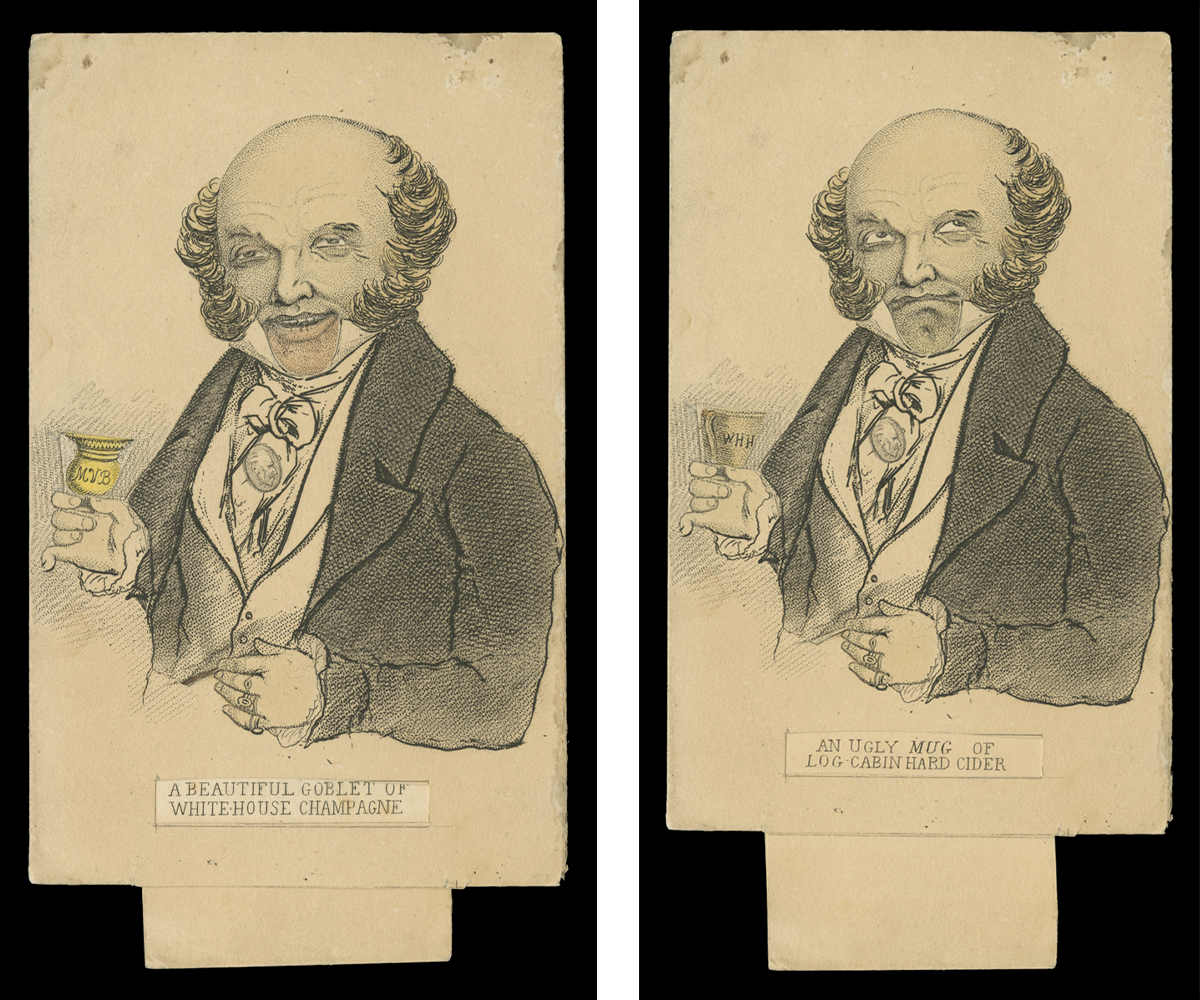 Martin Van Buren's expression changes when the viewer pulls the paper tab. Notice that the goblet also changes. / THF127346 and THF127345
In 1840, incumbent President Martin Van Buren, the Democratic nominee, faced off against the Whig standard-bearer William Henry Harrison. The Democrats constantly belittled the elderly, one-time war general, citing his age and what they perceived as his dubious battlefield victories. One newspaper even sarcastically suggested that, given a pension and a barrel of hard cider, Harrison should sit out his remaining days in a log cabin. The Whigs took up the gauntlet, turning the insult into a crusade for the common man—who were associated with living in log cabins and drinking hard cider. The Whig campaign became one of imagery rather than policy substance. Harrison became the hero of the virtuous, hardworking common man, while Van Buren became a symbol of the out-of-touch Washington elite. Oddly enough, Harrison came from a well-established Virginia family and, in 1840, lived in a spacious home in southern Ohio, while Van Buren came from humbler origins growing up in Kinderhook, New York.
This mechanical card epitomized the perceived social divide. It shows President Martin Van Buren sipping a goblet of White House champagne, but when you pull the tab, Van Buren's face sours when he finds out he is drinking log cabin hard cider.
Political Name Calling — 1848
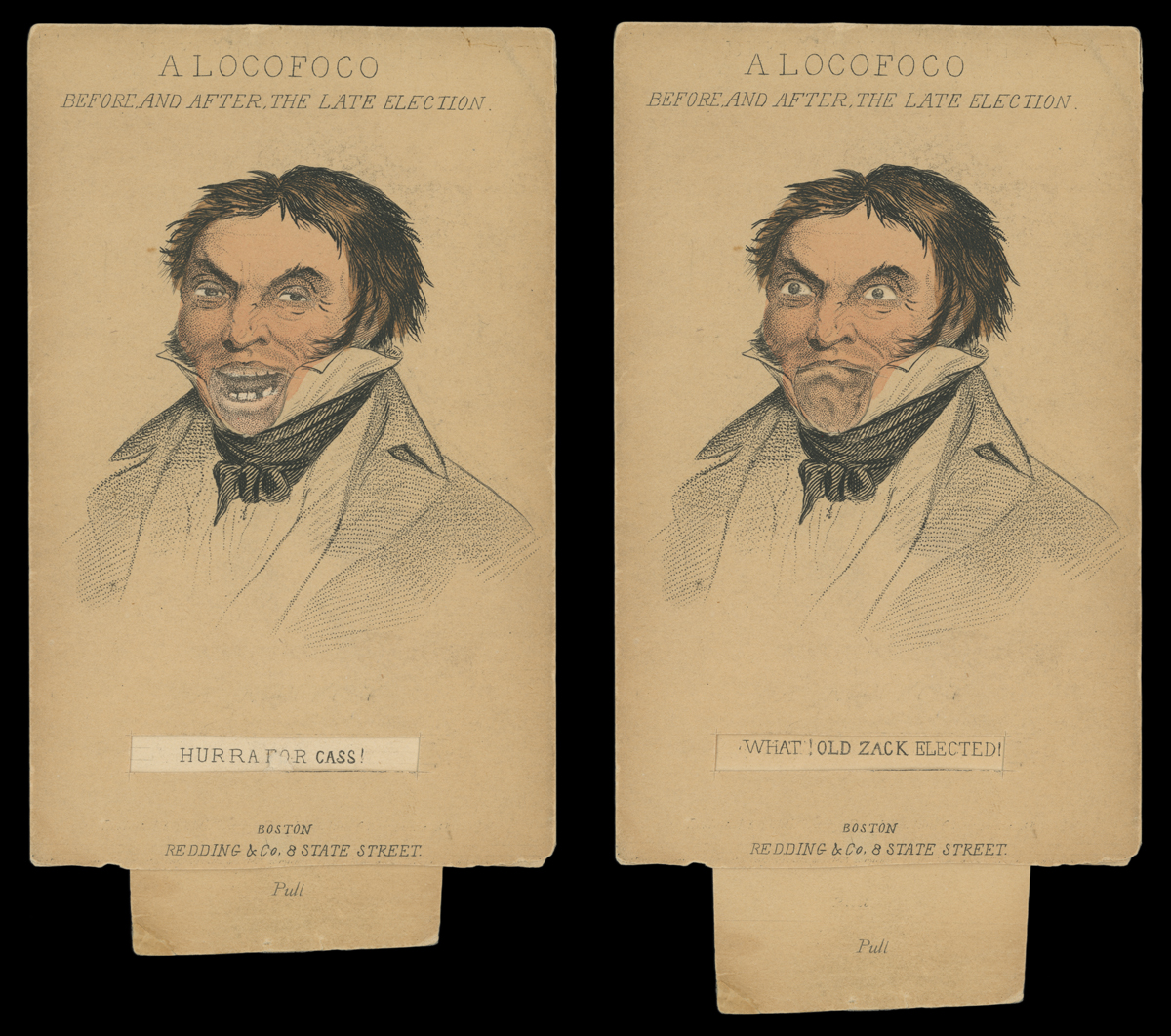 Pull the tab and the image of a supporter of Democratic presidential nominee Lewis Cass changes. / THF733516
The Whigs turned to another aged military leader, General Zachary Taylor, as their presidential candidate in 1848, while the Democrats chose Michigan Senator Lewis Cass. This pro-Whig metamorphic card derided Democrats' hopes and associated Cass supporters with the party's radical faction, the Locofocos. Locofoco was the name given to the pro-workingman and anti-monopoly wing of the Democratic Party (those opposed to state banks and paper money), which formed in New York City in the mid-1830s. The faction received its moniker when Democratic Party regulars tried to oust the group from a meeting in New York City's Tammany Hall by cutting off the gas lighting. Undeterred, the resourceful men lit candles using the new self-igniting friction matches, known as locofocos. The Locofocos then nominated their own slate of candidates.
The original Locofoco faction was not a major player in elections outside New York City, but Whig leaders saw an advantage. Whigs would associate the name Locofoco with any Democratic Party candidate or his supporters, painting Democrats with a broad brush of radicalism and branding them as brutish rubes, as depicted in this metamorphic card. The Locofoco is shown as happy and laughing at the mention of Lewis Cass. But pull the tab and his expression changes. He becomes disgruntled at hearing that Zachary Taylor, "Old Zack," was elected.
Before and After — 1856
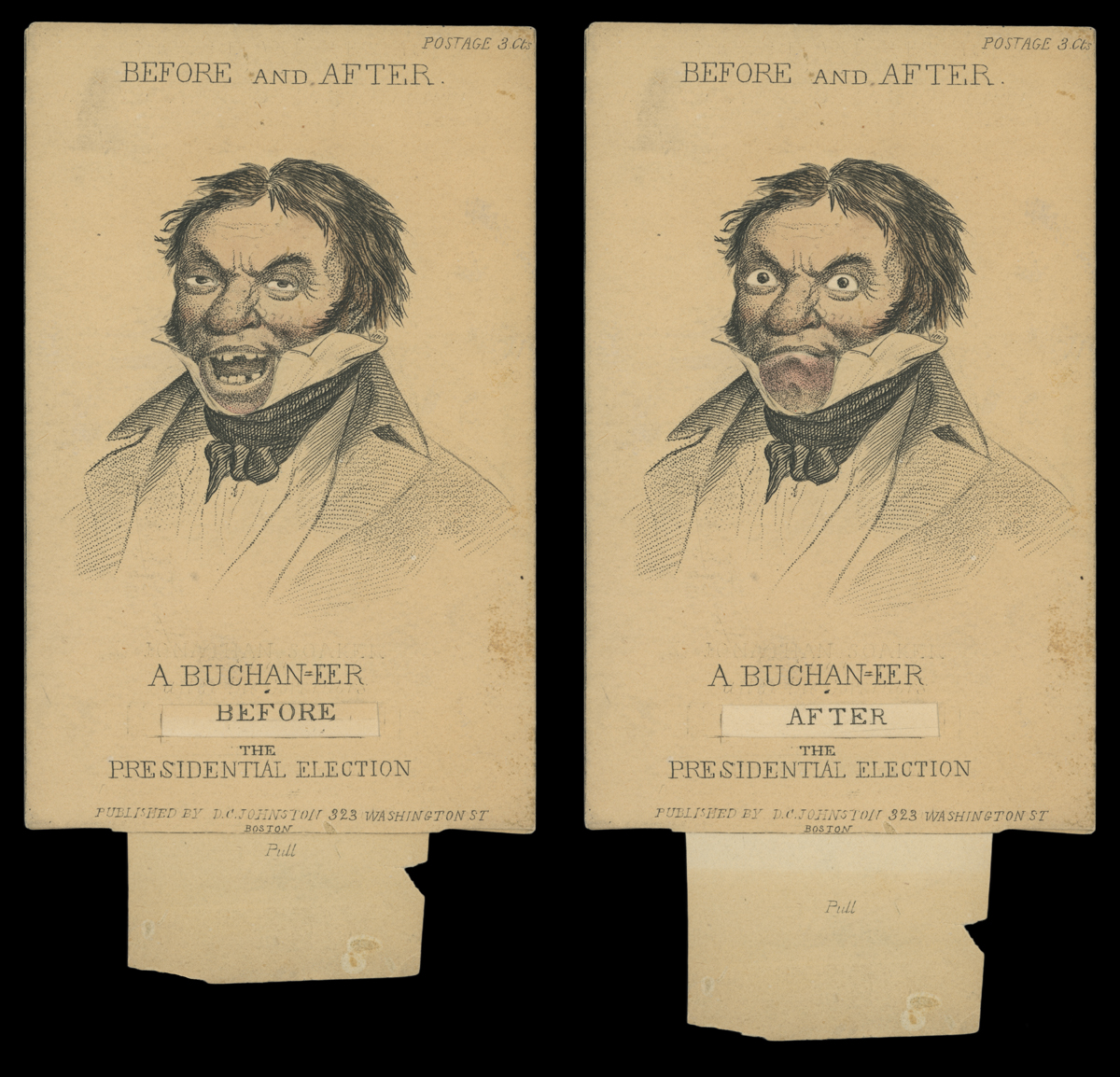 Pull the tab and the image of this "Buchan-eer," a supporter of Democratic presidential candidate James Buchanan, becomes grumpy. But he will have the last laugh—his candidate won. / THF733508
The 1850s marked a period of political turmoil. Political parties showed signs of fracturing over the issue of slavery. By 1856, the Whig Party had collapsed, failing to nominate a candidate, while its former supporters found refuge in new parties. Even the Democrats showed signs of regional splits, but unified behind their nominee, James Buchanan. Running against Buchanan were the American Party candidate, former President Millard Fillmore from the now-defunct Whig Party, and the nominee from the emerging Republican Party, John C. Fremont.
This mechanical card from the 1856 election incorporated imagery similar to that of the 1848 Locofoco card. The artist David Claypoole Johnston, who created both the 1840 Martin Van Buren card and the 1848 Locofoco card, repurposed his Locofoco card for this "Buchan-eer" card, depicting a hoped-for reaction of a Buchanan supporter after the election. The card, targeted for those opposed to a Buchanan presidency, lost its bite when Buchanan won the election.
Throwaway Politics
These throwaway campaign ephemera provide a glimpse into the growing political divide of mid-18th-century elections. The changing faces on the cards matched the changing nature of politics. Political elites and party factions had to face a growing voter base, where many new party devotees reveled in the humor in their opponent's shifting misfortunes, and a sure victory could be turned on its head with just a pull of the tab.
Discover more campaign materials with changing faces and images in The Henry Ford's collection. What do they say about the political climate of their time?
- "Come All You True Born Democrats... And All You Good Republicans," 1880
- Trade Card for Bicknell Brothers Clothing House, "Our Next President," 1880
- This group of lenticular "flasher" political campaign buttons
Andy Stupperich is an associate curator at The Henry Ford.