
Ralph Schugar's Aerial Hearse, a Ford Tri-Motor 4-AT-52 Airplane, Curtiss-Bettis Airport, Pittsburgh, Pennsylvania, 1931
THF717393 / Ralph Schugar's Aerial Hearse, a Ford Tri-Motor 4-AT-52 Airplane, Curtiss-Bettis Airport, Pittsburgh, Pennsylvania, 1931
01
Artifact Overview
Operators adapted Ford Tri-Motor airplanes for every imaginable use. Pittsburgh mortician Ralph Schugar earned a pilot's license and turned his Tri-Motor into an aerial hearse. The death of a loved one is never easy, particularly when it occurs far from home. Schugar's unusual service reduced wait time and worry for the survivors, at a cost comparable to railroad transport.
Artifact Details
Artifact
Photographic print
Date Made
09 June 1931
Subject Date
09 June 1931
Creators
Place of Creation
Collection Title
Location
By Request in the Benson Ford Research Center
Object ID
64.167.18.27
Credit
From the Collections of The Henry Ford. Gift of Ford Motor Company.
Material
Paper (Fiber product)
Technique
Gelatin silver process
Color
Black-and-white (Colors)
Dimensions
Height: 4.75 in
Width: 7.125 in
Inscriptions
Ink stamp on back of image:
Harry V. Campbell, / 573 Texas Ave. Annex / Duquesne, Pa.
Keywords |
|---|
02
Related Content
 Set
Set"Creepy" Artifacts
- 10 Artifacts
The artifacts in the collections of The Henry Ford all hold deep historical value. To modern viewers, though, some of them can be a bit... eerie. In this set, members of our staff nominate the artifact in our collections that gives them the chills, and explain their choice.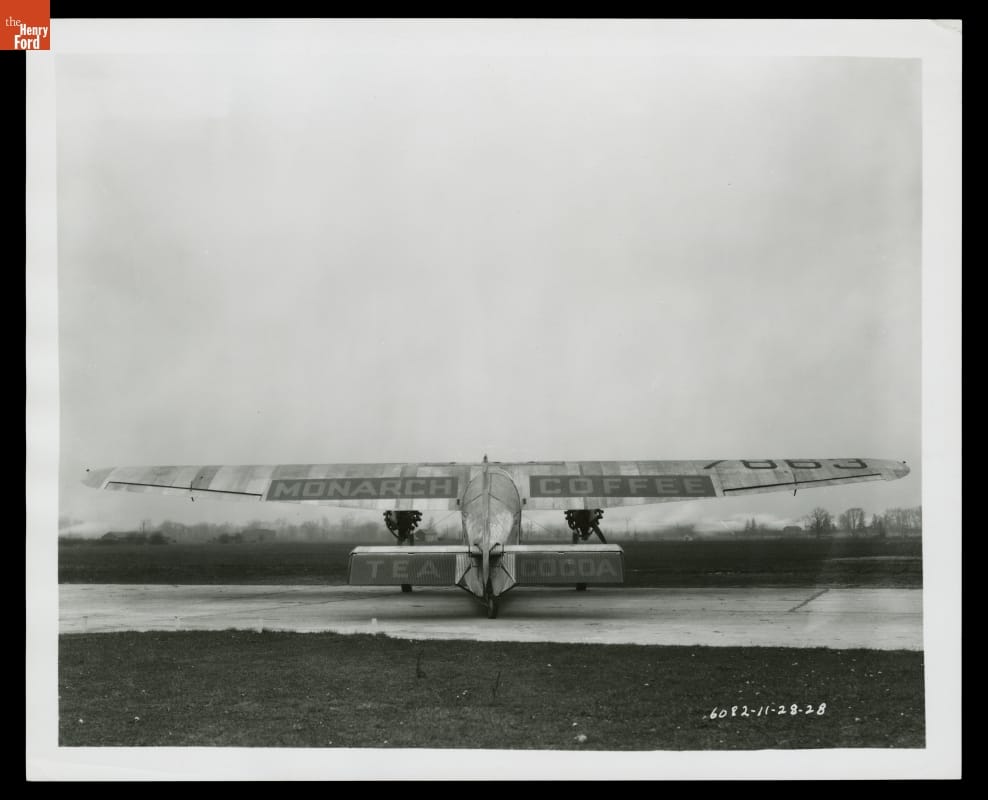 Set
SetFord Tri-Motor: Promotional Use
- 10 Artifacts
From 1928 to 1931, Reid, Murdoch & Company of Chicago used a Ford Tri-Motor to advertise its Monarch Foods brand. Named Independence, the modified plane served as a flying salesroom and carried samples of over 200 different food products to airports throughout the country. On occasion, Monarch's pint-sized advertising characters, "The Teenie Weenies," also accompanied the plane on its stops.