
Railroad Passenger Train, circa 1840
THF203195 / Railroad Passenger Train, circa 1840 / detail
01
Artifact Overview
The American railroad passenger car evolved quickly. The four-wheel models of the early 1830s, based on horse-drawn stagecoaches, gave way to longer eight-wheel coaches by 1840. Unlike European cars, which were sectioned into small compartments, American coaches had an open layout that was less expensive to build and more in keeping with the country's democratic ideals.
Artifact Details
Artifact
Print (Visual work)
Date Made
circa 1840
Subject Date
circa 1840
Creators
Place of Creation
Collection Title
Location
Not on exhibit to the public.
Object ID
82.129.1172
Credit
From the Collections of The Henry Ford.
Material
Paper (Fiber product)
Technique
Printing (Process)
Color
Black-and-white (Colors)
Dimensions
Height: 1.063 in
Width: 5.438 in
Inscriptions
Verso: Museum of Science and Industry (Founded by Julius Rosenwald) Chicago, Illinois
Keywords |
|---|
02
Related Content
 Set
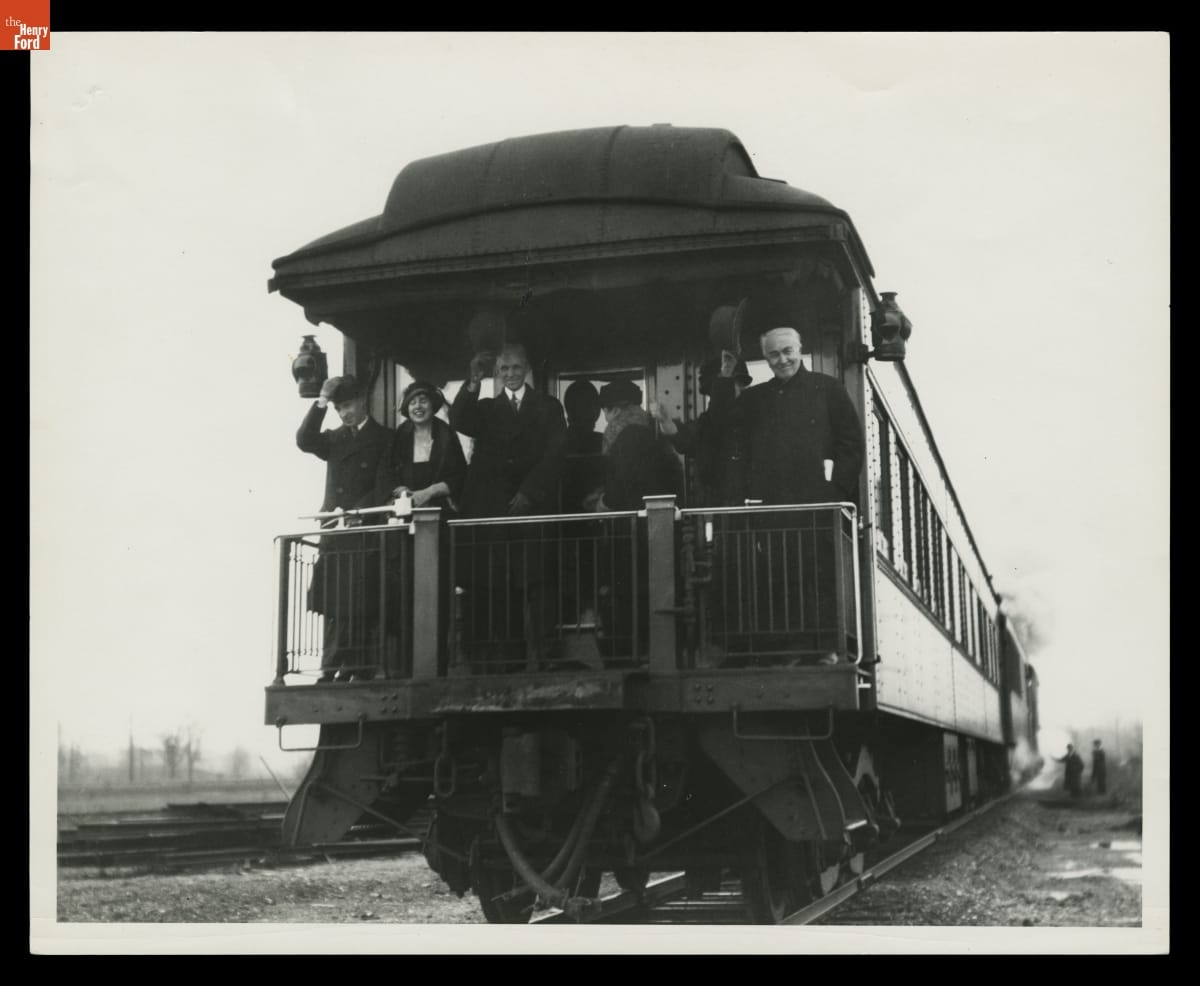
SetFair Lane: The Fords' Private Railroad Car
- 25 Artifacts
By 1920, Henry and Clara Ford found it difficult to travel by railroad. Henry Ford was widely recognized -- pestered by the public and hounded by reporters. The Fords purchased a private railroad car they called Fair Lane, so they could travel conveniently and quietly across the extensive American railroad network. The Fords made more than 400 trips with Fair Lane from 1921 to 1942.