
Hollerith Tabulating Machine, 1890
THF160301 / Hollerith Tabulating Machine, 1890
01
Artifact Overview
After seven years tabulating the 1880 census, the US Census Bureau ran a contest for a quicker method. Herman Hollerith won, and his "computer" was used for the 1890 census. Data was transferred to punched cards, which were pressed under a plate with pins in it. The pins went through punched holes into mercury-filled wells, completing a circuit and registering the data on the machine's dials.
Artifact Details
Artifact
Tabulating machine
Date Made
1890
Subject Date
1890
Creators
Place of Creation
Location
Not on exhibit to the public.
Object ID
36.282.1
Credit
From the Collections of The Henry Ford.
Material
Oak (Wood)
Metal
Glass (Material)
Dimensions
Height: 54.75 in
Width: 37.5 in
Depth: 28.5 in
Inscriptions
HOLLERITH ELECTRIC TABULATING SYSTEM / PATENTED 1889
Keywords |
|---|
02
Related Content
 Set
SetPunch Card Technology
- 10 Artifacts
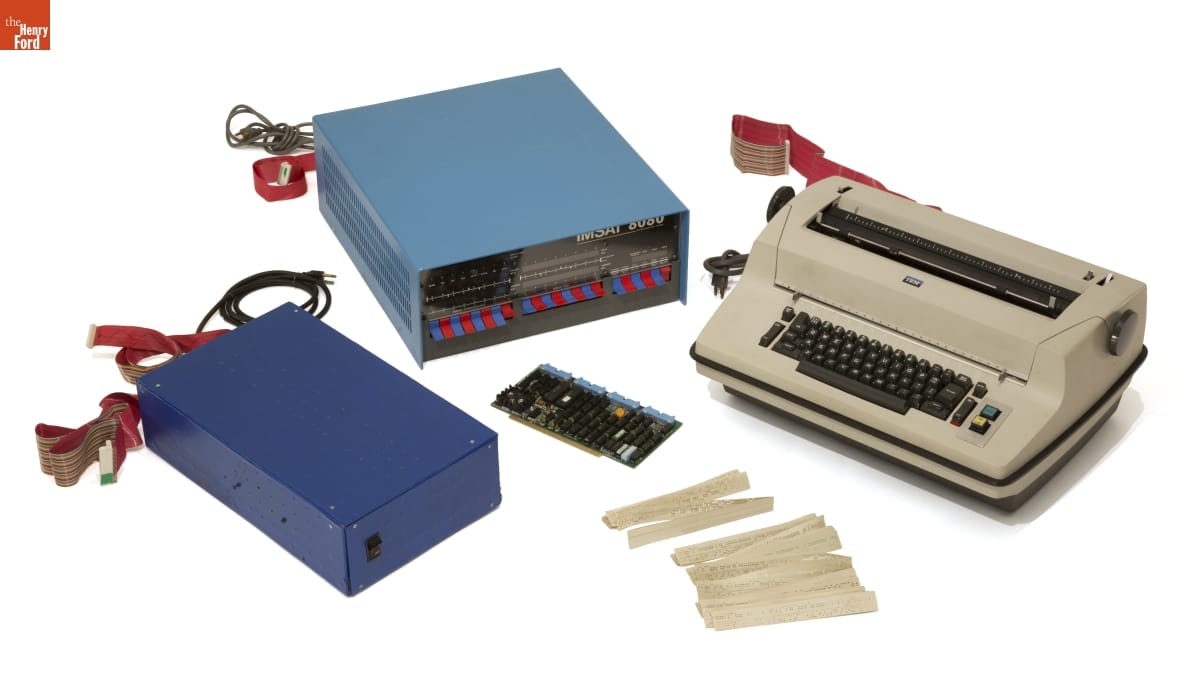
The IMSAI 8080 was a clone of the Altair 8800, the first mass marketed personal computer. It was a popular "kit computer," requiring assembly and programming. With no keyboard, toggle switches allowed input and LED lights signaled output. This could be modified using an IBM I/O typewriter. The donor, O.S. Narayanaswami, was a mechanical engineer interested in the educative power of computers. Set
SetCommunications and Information Technology
- 50 Artifacts
This is one of the first 50 Apple 1 computers. Apple 1s were the first pre-assembled personal computers; Steve Wozniak assembled this one in Steve Jobs's family home. Before the release of the Apple 1, owning a personal computer meant building it yourself. Wozniak's refined engineering skills, coupled with Jobs's bold marketing abilities, led to a revolutionary and affordable product--as well as a successful company. Set
SetCurators' Choice: Info Technology & Communications
- 25 Artifacts
Thomas Edison's electric pen, an ancestor of both the mimeograph and the tattoo needle, was a successful product in the mid-1870s. Users would write normally with the pen, which, instead of a nib, had a needle powered by an electric motor. The needle poked holes into a stencil, which was then used to copy the document. Many businesses found document duplication an attractive possibility.