
Texaco Service Station, circa 1960
THF101939 / Texaco Service Station, circa 1960
01
Artifact Overview
A combination of several design disciplines (styling, package design, product design, and graphic design), Walter Dorwin Teague's Texaco station suggested consistency, simplicity, and cleanliness -- a strong corporate identity that enabled Texaco to stand out in a highly competitive marketplace.
Artifact Details
Artifact
Service station
Date Made
circa 1960
Creators
Place of Creation
Creator Notes
Made in the United States for Texaco, inc.
Location
at Henry Ford Museum in Driving America
Object ID
87.213.1
Credit
From the Collections of The Henry Ford. Gift of Cumberland Farms, Inc.
Material
Porcelain enamel
Wood (Plant material)
Glass (Material)
Color
White (Color)
Green
Red
Inscriptions
Front in red: TEXACO / Star decal
Front right in green: MARFAK LUBRICATION
Left upper, in red: Two star decals
On left side door: LADIES / ASK ATTENDANT FOR KEY / THIS DOOR KEPT LOCKED / FOR CLEANLINESS / AND PROTECTION TO OUR PATRONS
Keywords |
|---|
02
Related Content
 Set
SetDesign and Making
- 50 Artifacts
This 1937 Sparton radio was designed by Walter Dorwin Teague, a designer renowned for his use of streamlined forms. A study in contrasts -- the blue mirrored finish and curved sled-like base suggest speed while the five jutting parallel panels appear almost architectural -- this expensive and glamorous radio had a limited market during the Great Depression. Set
SetArt Deco in Henry Ford Museum of American Innovation
- 14 Artifacts
24-year-old-artist Vilktor Schreckengost designed a punch bowl in 1930 depicting New Year's Eve festivities in New York City as a celebration of the Jazz Age. He was commissioned by Eleanor Roosevelt who was so pleased with it that she ordered two more copies. Three versions were produced; this is the third version, intended for mass-production, dubbed "The Poor Man's Jazz Bowl".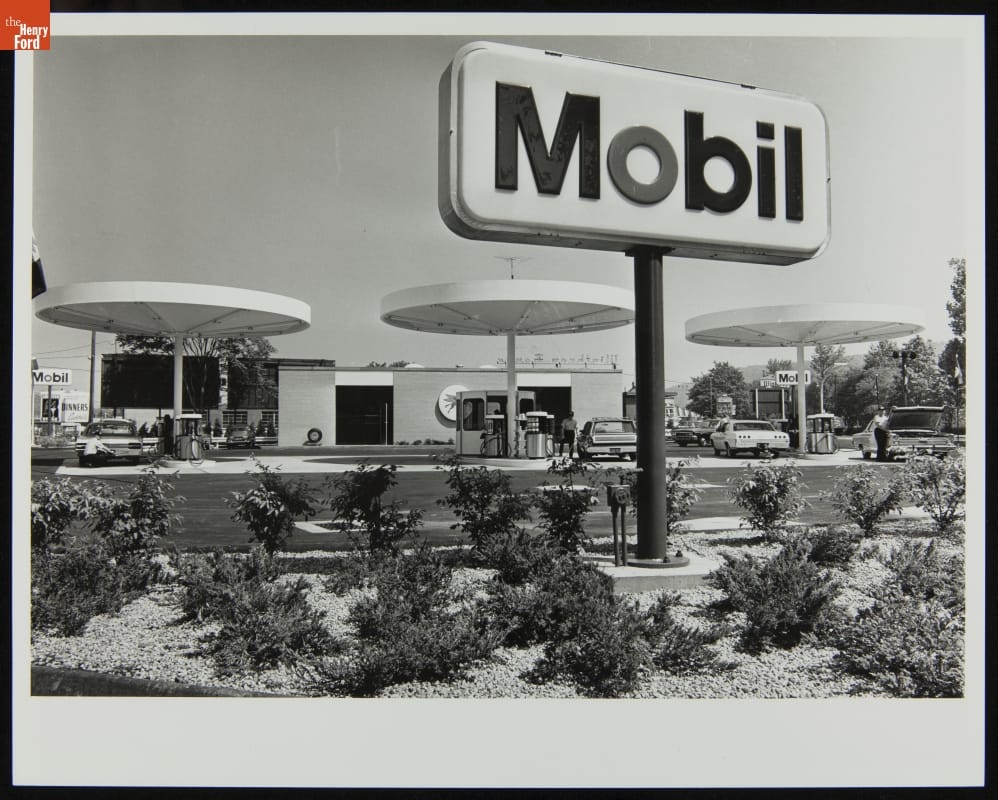 Set
SetGas Stations
- 25 Artifacts
After falling from favor in the mid-1930s due to their cost and complexity, canopy roofs reappeared over American gas stations three decades later. The transition to self-service pumps required that customers be protected from inclement weather. The mushroom-style canopies at this Mobil station also provided plenty of light for motorists filling up their cars at night.