
Henry Ford's 1896 Quadricycle on Display at New York World's Fair, 1939-1940
THF222372 / Henry Ford's 1896 Quadricycle on Display at New York World's Fair, 1939-1940
01
Artifact Overview
Ford Motor Company poured resources into the 1939-40 New York World's Fair, spending more than $5 million to construct and maintain its elaborate and well-attended exposition space. Ford's massive exhibition building attracted fairgoers with industrial demonstrations and informative displays. In the entrance hall, visitors could view Henry Ford's first automobile, the Quadricycle.
Artifact Details
Artifact
Photographic print
Subject Date
1939
Collection Title
Location
By Request in the Benson Ford Research Center
Object ID
P.O.10960
Credit
From the Collections of The Henry Ford. Gift of Ford Motor Company.
Material
Paper (Fiber product)
Technique
Gelatin silver process
Color
Black-and-white (Colors)
Dimensions
Height: 8.25 in
Width: 10 in
Inscriptions
Handwritten in image, lower right corner: NY-106
Keywords |
|---|
02
Related Content
 Set
SetHenry Ford’s First Car
- 25 Artifacts
The Quadricycle was Henry Ford's first attempt to build a gasoline-powered automobile. It utilized commonly available materials: angle iron for the frame, a leather belt and chain drive for the transmission, and a buggy seat. Ford had to devise his own ignition system. He sold his Quadricycle for $200, then used the money to build his second car.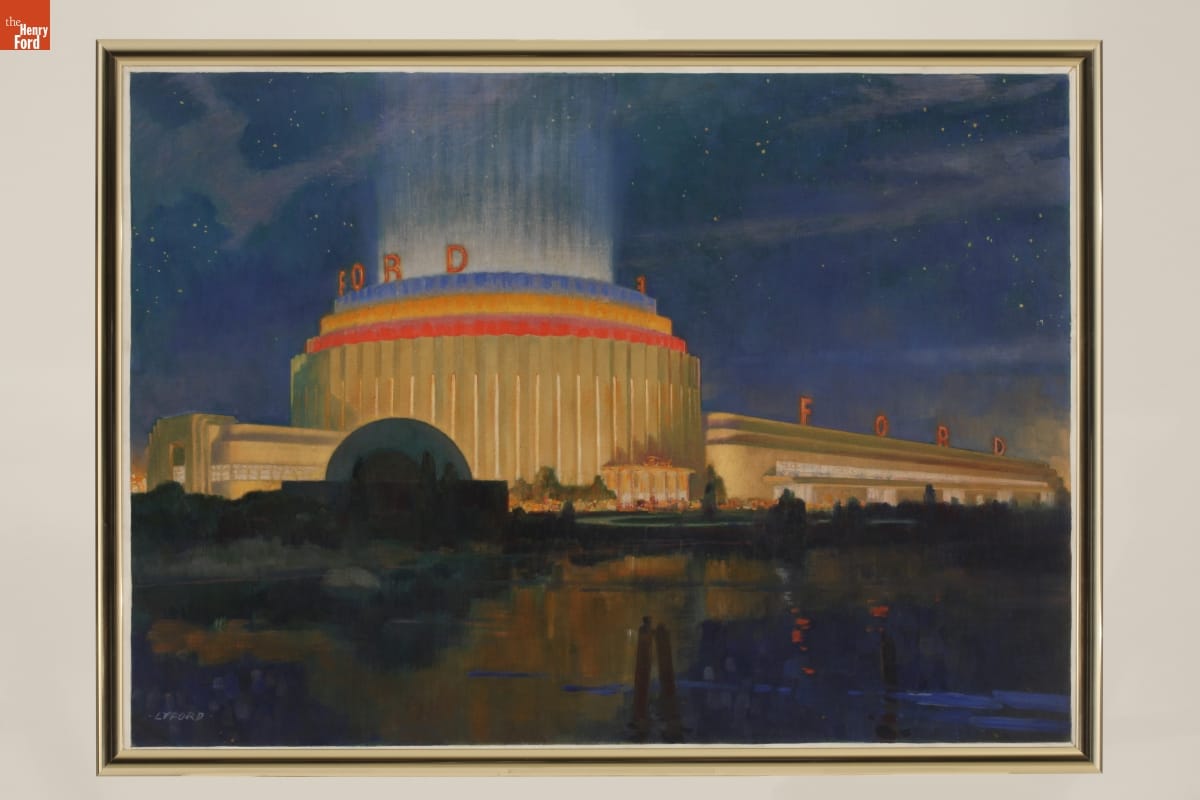 Set
SetFord at the Fair Exhibition
- 86 Artifacts
Chicago's 1933-34 Century of Progress Exposition used the theme of progress to encourage optimism during the Depression. The 11-acre Ford Motor Company exhibit became the most talked-about exhibit of 1934, featuring a central Rotunda designed to simulate graduated clusters of gears. After the fair, this building became an attraction at Ford headquarters in Dearborn, Michigan, until it burned down in 1962.