
Drop Box Used during the 1904 Vanderbilt Cup Race
THF155362 / Drop Box Used during the 1904 Vanderbilt Cup Race
01
Artifact Overview
Every car in the 1904 Vanderbilt Cup race carried one of these boxes. Cars stopped at two control points during each lap. Officials recorded a car's control point entrance and exit times on papers dropped into the box. At the end of the race, "control time" was subtracted from elapsed time to determine a car's actual racing time.
Artifact Details
Artifact
Box (Container)
Date Made
1904
Location
at Henry Ford Museum in Driven to Win: Racing in America
Object ID
36.623.1
Credit
From the Collections of The Henry Ford. Gift of the Long Island Automobile Club.
Material
Copper (Metal)
Leather
Metal
Dimensions
Height: 7.50 in
Width: 2.25 in
Length: 5.625 in
Inscriptions
Inscribed on plate mounted to lid:
WM. K. VANDERBILT JR. CUP
Keywords |
|---|
02
Related Content
 Set
SetThe Vanderbilt Cup
- 34 Artifacts
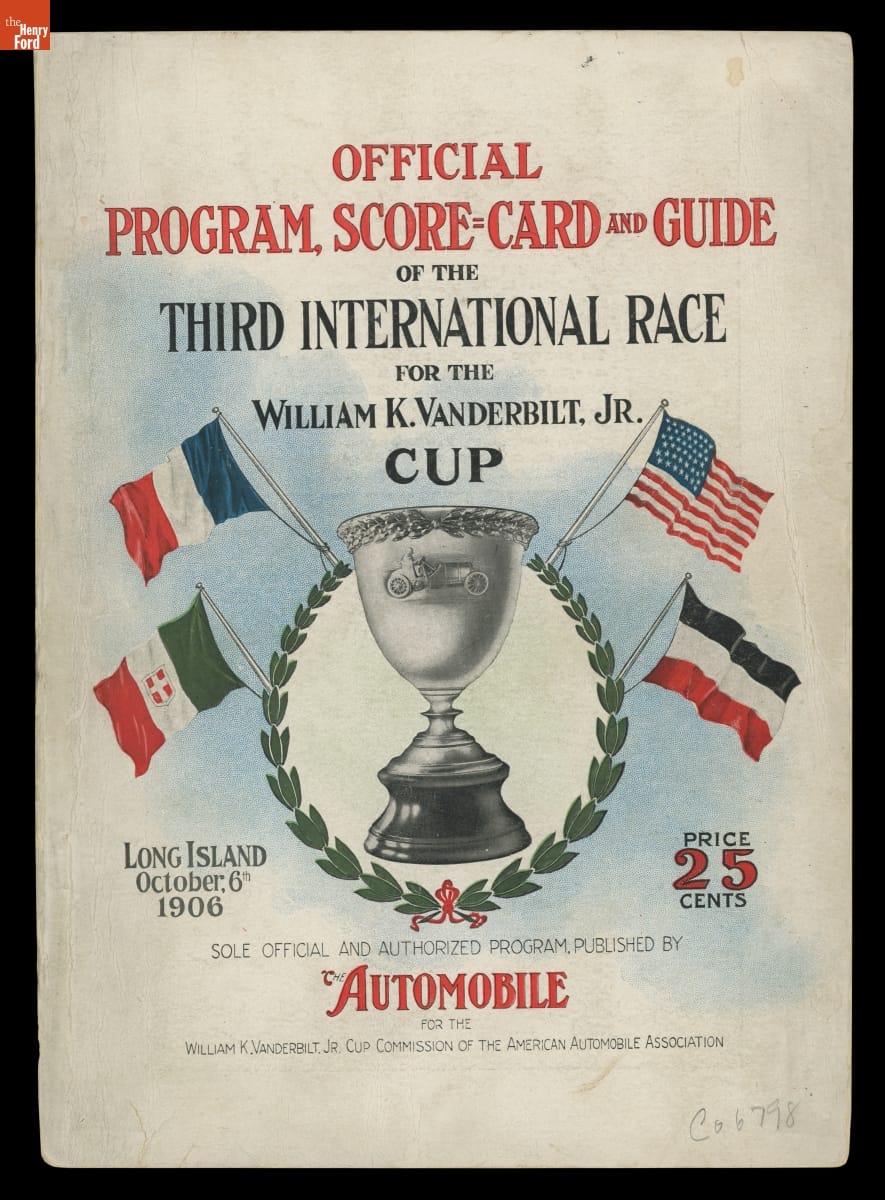
America's earliest auto races were small-time contests. Wealthy enthusiast William K. Vanderbilt, Jr., thought the United States needed a big, signature event. Starting in 1904, he organized an annual road race through Long Island, New York, that attracted top American and European drivers and manufacturers. When a Connecticut-built Locomobile won the Vanderbilt Cup in 1908, it helped prove that America's automotive industry had arrived.