
Automobile Seat Belt, 1964
THF103437 / Automobile Seat Belt, 1964
01
Artifact Overview
Until the mid-1960s seat belts were not standard equipment in American cars. Owners could purchase aftermarket safety belts like this one and have them installed. Continued education and growing acceptance for car occupants' safety have led most states to adopt seat belt laws.
Artifact Details
Artifact
Safety belt
Date Made
1964
Creators
Place of Creation
Location
at Henry Ford Museum in Driving America
Object ID
93.32.1
Credit
From the Collections of The Henry Ford. Gift of James C. Gallagher.
Material
Nylon
Cardboard
Metal
Color
Blue
Black (Color)
Silver (Color)
Dimensions
Width: 3.25 in (box)
Length: 8 in (box)
Depth: 2.75 in (box)
Inscriptions
Stamped on back of metal clasp: PAT. PENDING / THE GREENFIELD CO. / ELK GROVE VILLAGE, ILL. / MODEL NO. 707
Yellow label on back of belt: MODEL NO. / 707-40 / 100% HIGH TEST NYLON / 1964 / MEETS SAE SPEC. / THE GREENFIELD CO. / ELK GROVE VILLAGE, ILL.
Yellow tab on belt: THE GREENFIELD CO. NO. 707-40 / 1964
Printed on box sides: GREENFIELD AUTO SAFETY BELT/ APPROVED TO S.A.E. STANDARDS FOR SEAT BELTS
On side: GREENFIELD AUTO SAFETY BELT / "HI-TEST" 100% NYLON WEBBING
On box top: GREENFIELD AUTO SAFETY BELT / WITH QUICK RELEASE METAL-TO-METAL BUCKLE
On side: GREENFIELD AUTO SAFETY BELT / ASSURES SAFER, MORE RELAXED MOTORING /
On box end: GREENFIELD AUTO SAFETY BELT / APPROVED / AMERICAN / SEAT BELT COUNCIL / THE GREENFIELD CO. / ELK GROVE VILLAGE, ILL.
Keywords |
|---|
02
Related Content
 Set
SetBuckling Up
- 11 Artifacts
General Motors workers like Mary Ann Sanford spent each day making over 20 critical checks on seat belt systems in GM cars after they rolled off the line. Yet many Americans still didn't use these lifesaving devices -- "buckling up" wasn't yet mandatory in most states.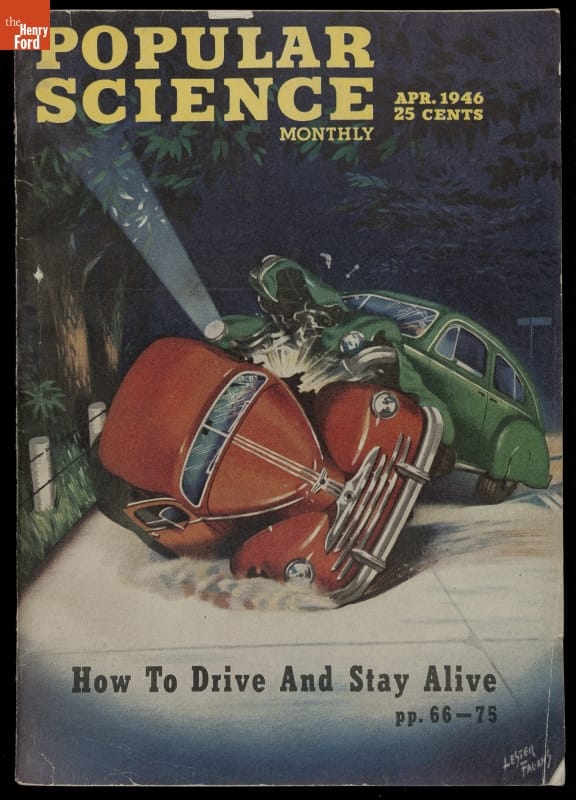 Set
SetSafety
- 31 Artifacts
Popular Science provided information about scientific and technological advancements. In the early 1900s articles about the automobile -- and its driver -- became commonplace in the monthly's pages. Editors included a series of articles on automobile safety in this April 1946 issue. In one article, readers could test their knowledge of safe driving.