
Stoneware Foot Warmer, 1840-1860
THF77282 / Stoneware Foot Warmer, 1840-1860
01
Artifact Overview
Foot warmers solved the problem of cold feet in past generations. Some warmers held charcoal, others held hot water. Pottery, tin, and soapstone were the favored materials to conduct the heat. The warmer was kept under the feet, then the legs and feet were tucked into a blanket, providing welcome warmth in a cold carriage or unheated church.
Artifact Details
Artifact
Foot warmer
Date Made
1840-1860
Creators
Place of Creation
Creator Notes
Possibly made by William E. Warner in Watervliet, New York.
Location
Not on exhibit to the public.
Object ID
57.65.11
Credit
From the Collections of The Henry Ford.
Material
Ceramic (Material)
Salt glaze
Technique
Glazing (Coating)
Color
Cobalt blue (Color)
Gray (Color)
Dimensions
Height: 4.25 in
Width: 12.5 in
Keywords |
|---|
02
Related Content
 Set
SetThe Artistry of Salt-Glazed Stoneware
- 16 Artifacts
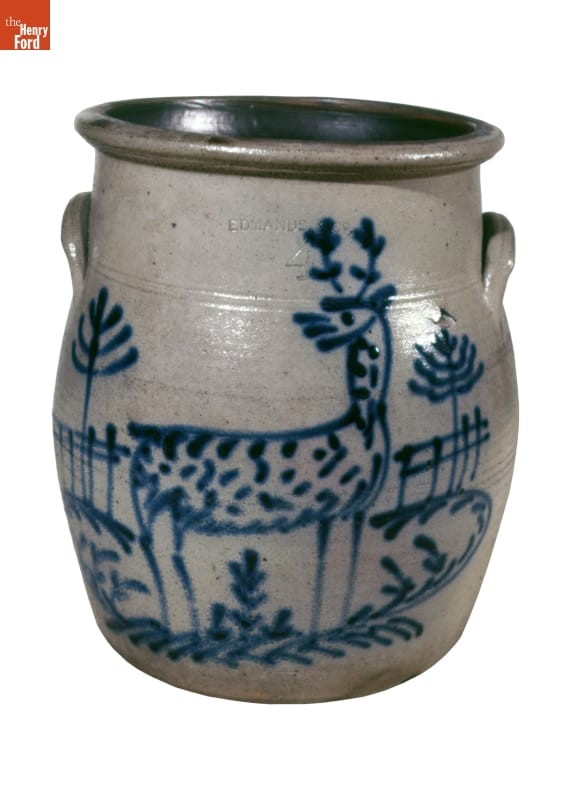
This jar was made of a durable, leak-proof pottery called stoneware, shaped on a potter's wheel. The orange-peel-like outer glaze was created when the potter threw handfuls of common rock salt into a white-hot kiln during the piece's firing. Salt-glazed stoneware pieces were decorated with an amazing array of designs, including the stag and landscape on this piece.