
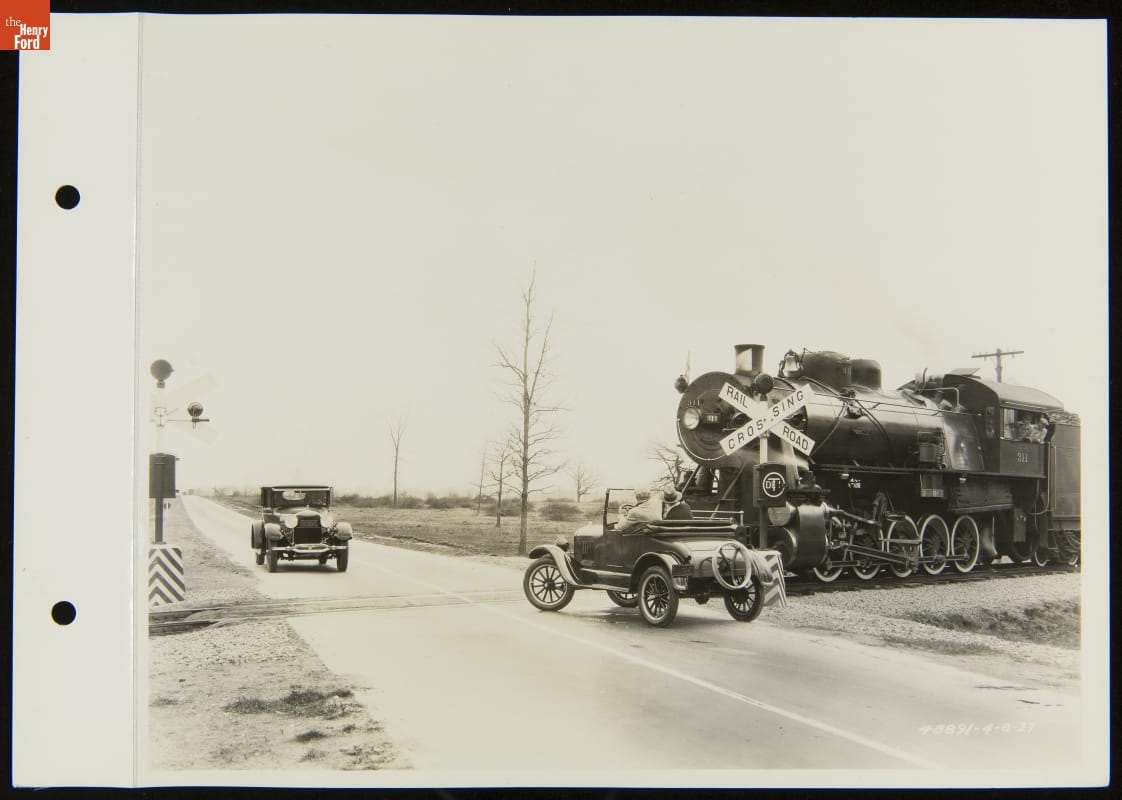
Railroad Crossing Signal, September 1924
THF286506 / Railroad Crossing Signal, September 1924
01
Artifact Overview
Wigwag railroad crossing signals, named for the way they swung back and forth when activated, first appeared around 1914. Their waving action simulated the motion of a lantern being swung back and forth -- long a signal for "stop" on American railroads. Typically, wigwags were driven by a pair of electromagnets that alternately pulled and released the pendulum.
Artifact Details
Artifact
Photographic print
Subject Date
16 September 1924
Collection Title
Location
By Request in the Benson Ford Research Center
Object ID
84.1.1660.P.189.2371
Credit
From the Collections of The Henry Ford. Gift of Ford Motor Company.
Material
Paper (Fiber product)
Technique
Gelatin silver process
Color
Black-and-white (Colors)
Dimensions
Height: 10.25 in
Width: 8.25 in
Keywords |
|---|
02
Related Content
 Set
SetRailroad Crossings
- 12 Artifacts
For as long as trains and automobiles have coexisted, some motorists have felt the need to "race" a train to the crossing. Some early magazine advertisements encouraged the practice, showing daring drivers outrunning speeding express trains. Few habits are so dangerous. A speeding train can take more than a mile to stop. Even in a tie, the motorist loses.