
"View of the Junction of the Northern and Western Canals," 1825
THF203983 / "View of the Junction of the Northern and Western Canals," 1825
01
Artifact Overview
Canals opened new lands to settlement and commerce in the first half of the 19th century. New York's Erie Canal, completed in 1825, connected Albany with Buffalo. It also joined with other canals to make more areas of the state accessible. This print shows the junction of the "Northern" (Champlain) and the "Western" (Erie) canals.
Artifact Details
Artifact
Print (Visual work)
Subject Date
1825
Creator Notes
Drawn by Charles Rhind, engraved by Felix Duponchel, lithographed by Anthony Imbert
Collection Title
Location
Not on exhibit to the public.
Object ID
82.129.184
Credit
From the Collections of The Henry Ford.
Material
Cardboard
Paper (Fiber product)
Technique
Lithography
Color
Black-and-white (Colors)
Dimensions
Height: 7.5 in
Width: 9.75 in
Inscriptions
Printed below the image on the left side:
Drawn on Stone by F. Duponchel from a sketch by C. Rhind / VIEW OF THE JUNCTION OF THE NORTHERN AND WESTERN CANALS. / Imbert's Lith, N.Y.
Typewritten on paper glued below lithograph:
Passengers on the roof of a packet boat to watch the locking of their craft. / Same as the preceding, but on plain paper. / Date: 1825
Handwritten in pencil on backing board front upper right corner: #184
Keywords |
|---|
02
Related Content
 Set
SetAmerica's Industrial Revolution
- 61 Artifacts
The Model T's distinction as a landmark car design can be traced in large part to machines like this -- a high capacity precision machine tool that performed just two production steps on the car engine's cylinder block. The Model T as a design achievement is inseparable from many hundreds of engineering, materials, and production innovations. Set
SetTransportation Networks
- 5 Artifacts
Canals opened new lands to settlement and commerce in the first half of the 19th century. New York's Erie Canal, completed in 1825, connected Albany with Buffalo. It also joined with other canals to make more areas of the state accessible. This print shows the junction of the "Northern" (Champlain) and the "Western" (Erie) canals.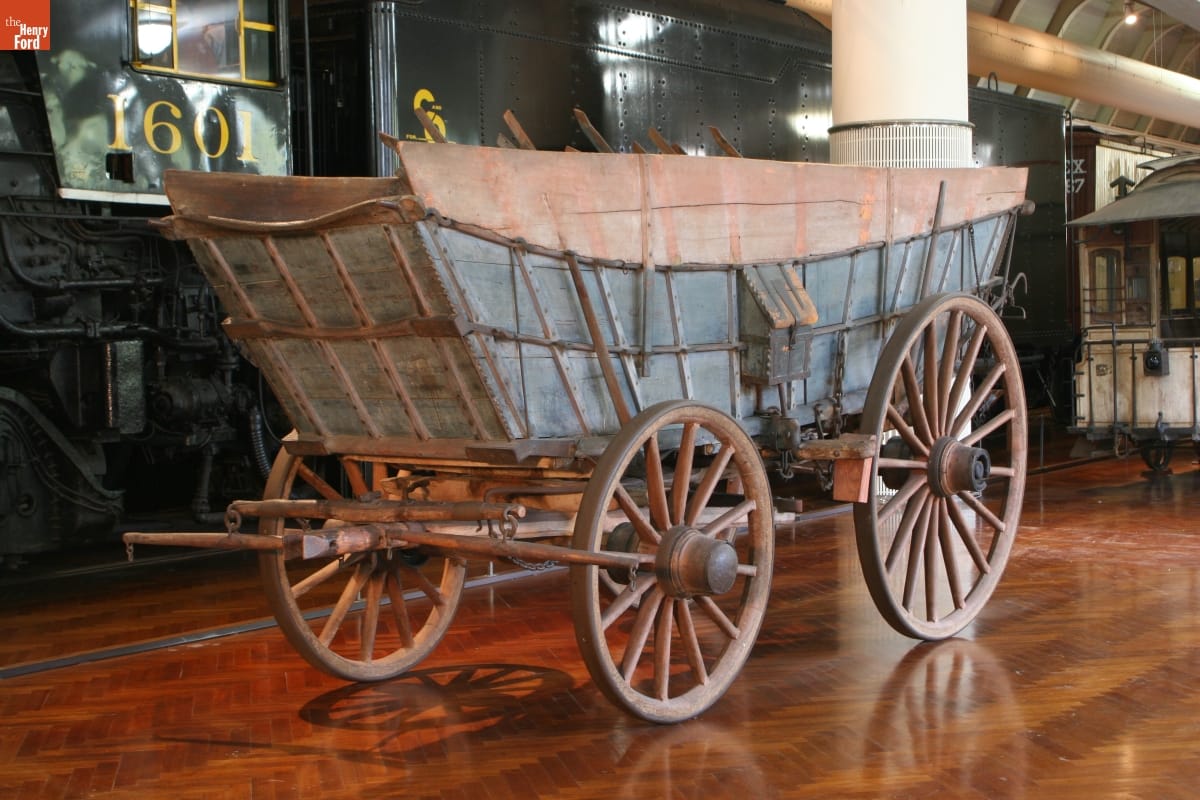 Set
SetLesson: Transportation of Goods and Consumption
- 8 Artifacts
Conestoga wagons first appeared in Pennsylvania's Conestoga River valley about 1750. Designed for freight, the Conestoga's curved body tended to keep the load in the center, rather than shifting it toward the rear. The Conestoga's popularity peaked in the first half of the 19th century -- before railroads replaced it for hauling agricultural products and manufactured goods.