
Engraving, "The Bloody Massacre Perpetrated in King-Street, Boston on March 5th, 1770"
THF8141 / Engraving, "The Bloody Massacre Perpetrated in King-Street, Boston on March 5th, 1770"
01
Artifact Overview
American patriot Paul Revere engraved, printed, and sold this graphic depiction. British troops were sent to Boston to regain control over the rebels. But townspeople resented their presence. One day, mischief-makers hurled insults and snowballs at the soldiers, who panicked and fired into the crowd. Five innocent people were killed, several others wounded. This widely publicized incident made colonists furious.
Artifact Details
Artifact
Print (Visual work)
Date Made
1770
Subject Date
1770
Place of Creation
Creator Notes
Artist Christian Remick; engraved by Paul Revere, Boston, Massachusetts.
Collection Title
Location
at Henry Ford Museum in With Liberty & Justice for All
Object ID
71.28.1
Credit
From the Collections of The Henry Ford.
Material
Paper (Fiber product)
Technique
Hand coloring
Engraving (Printing process)
Color
Multicolored
Dimensions
Height: 13 in
Width: 11.875 in
Inscriptions
Text at top:
The Bloody Massacre perpetrated in King-Street Boston on March 5th, 1770, by a party of the 29th Regt.
Printed towards right side below:
Engrav'd Printed & Sold by Paul Revere Boston.
At bottom right in pen and ink:
Col'd by C'n Remich [Remick].
Keywords |
|---|
02
Related Artifacts
 Artifact
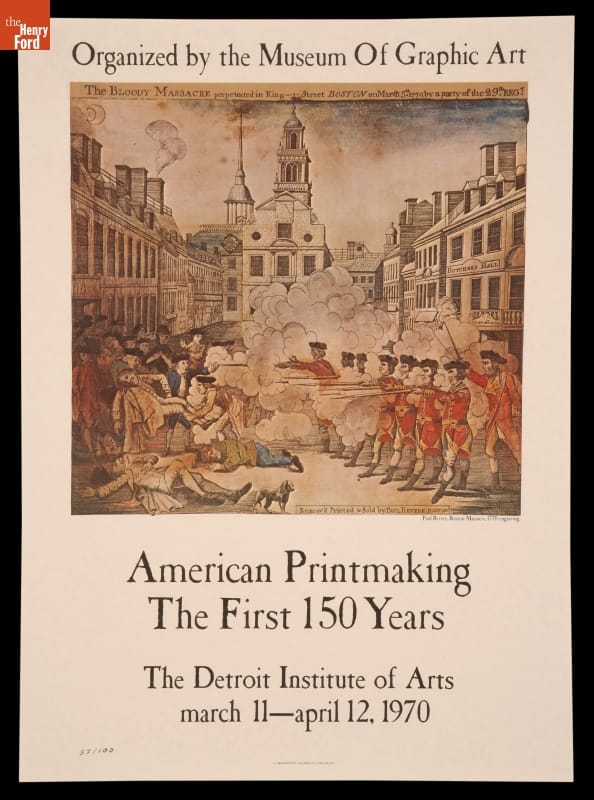
Exhibition Poster, "American Printmaking: The First 150 Years," 1970
03
Related Content
 Set
SetPaul Revere: A Revolutionary
- 12 Artifacts
Famed for his midnight ride, Paul Revere's contributions to the founding of America have been attributed to his participation in the Revolutionary War. Often overlooked is his role in establishing American industry. A talented artisan, but also an ingenious businessman, Revere's knack for observation and adaptability made him a revolutionary in early manufacturing. Set
SetCurators' Choice: American Democracy & Civil Rights
- 25 Artifacts
George Washington carried folding beds, tents, eating utensils, and other equipment to use while encamped on the field with his troops during the Revolutionary War. Washington likely used this bed when he traveled from his Newburgh, New York, headquarters in July 1783 -- as the war was winding down -- to tour upstate New York and the military installations located there.