
TWA Experimental Anti-Snow Static Loop Antenna, 1937
THF156754 / TWA Experimental Anti-Snow Static Loop Antenna, 1937
01
Artifact Overview
Airport radio navigation beacons required pilots to listen for Morse code patterns to hold the correct course--notoriously difficult during storms. In 1936, Transcontinental & Western Air introduced an anti-snow directional antenna which could be used, in high-static situations, to "home in" on airport radio signals. This loop was housed in a sleek metal enclosure, protecting it from the elements.
Artifact Details
Artifact
Radio antenna
Date Made
1937
Subject Date
1937-1938
Location
Not on exhibit to the public.
Object ID
00.622.30
Credit
From the Collections of The Henry Ford.
Material
Aluminum Alloy
Copper (Metal)
Wood (Plant material)
Wood composite
Dimensions
Height: 13 in
Width: 2.75 in
Length: 9 in
Inscriptions
handwritten:
#31
Keywords |
|---|
02
Related Content
 Set
SetTop Twenty: IMLS Communications Grant
- 20 Artifacts
A group of exceptional communications artifacts, conserved and digitized through a 2013-2015 grant from the Institute of Museum and Library Services. Set
SetAir-to-Ground Communication
- 10 Artifacts
During his polar expeditions, Richard E. Byrd relied on navigational instruments not much changed in 200 years. Byrd's sextant measured the angle between an astronomical object -- the Sun or a star -- and the horizon. Based on the time of day it was measured, this angle was used to determine Byrd's position on a navigational chart.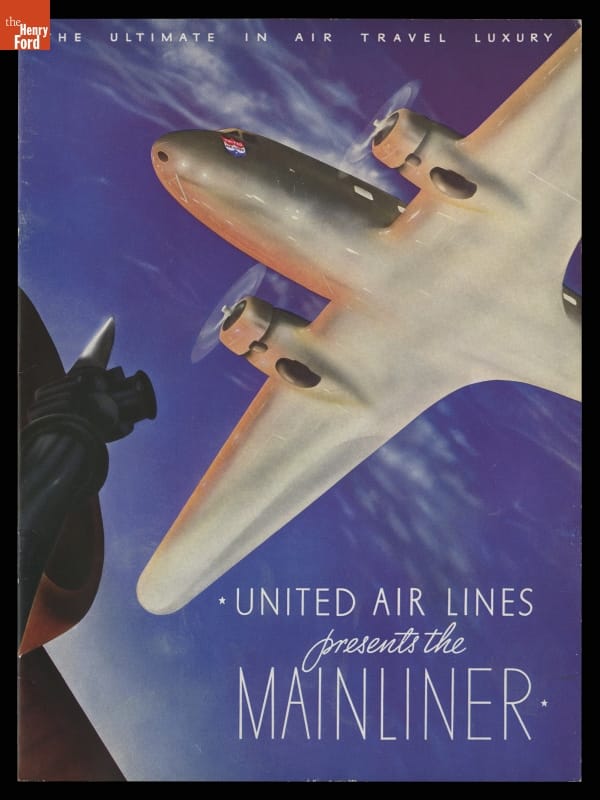 Set
SetThe DC-3: Changing Passengers’ Expectations
- 12 Artifacts
United Airlines promoted its new Douglas DC-3 "Mainliners" in this 1937 brochure. With a range of 1,500 miles, the Mainliners flew from New York to San Francisco in less than 16 hours with only three stops along the way. The planes came in three configurations: standard 21-passenger coaches, sleepers with folding berths for 14, and "Skylounges" with deluxe swiveling seats.