
"Fifth National Exhibition of Cycles, Automobiles and Accessories, Official Program," 1900
THF124095 / "Fifth National Exhibition of Cycles, Automobiles and Accessories, Official Program," 1900
01
Artifact Overview
Manufacturers and promoters of the bicycle displayed their products at this national exhibition held at Madison Square Garden in New York. By 1900, bicycle sales were lagging and interest in the automobile soon would surpass the pedal-powered vehicle.
Artifact Details
Artifact
Program (Document)
Date Made
1900
Subject Date
20 January 1900 - 27 January 1900
Creators
Place of Creation
Creator Notes
Artwork by Currier, printed by National Printing Co. in New York City, New York.
Collection Title
Location
By Request in the Benson Ford Research Center
Object ID
86.185.21
Credit
From the Collections of The Henry Ford. Gift of Henry Austin Clark, Jr.
Material
Paper (Fiber product)
Color
Multicolored
Dimensions
Height: 10.875 in
Width: 6.75 in
Thickness: 0.125 in
Keywords |
|---|
02
Related Content
 Set
SetAuto Shows
- 16 Artifacts
Auto shows serve many purposes. They provide automakers with a place to share their latest models with the press and the public. They allow aftermarket vendors to promote goods and services. And they give visitors a chance to research — or maybe just dream about — their next new car. Part trade show, part show business, the auto show is an institution nearly as old as the automobile itself.
 Set
SetLeague of American Wheelmen
- 15 Artifacts
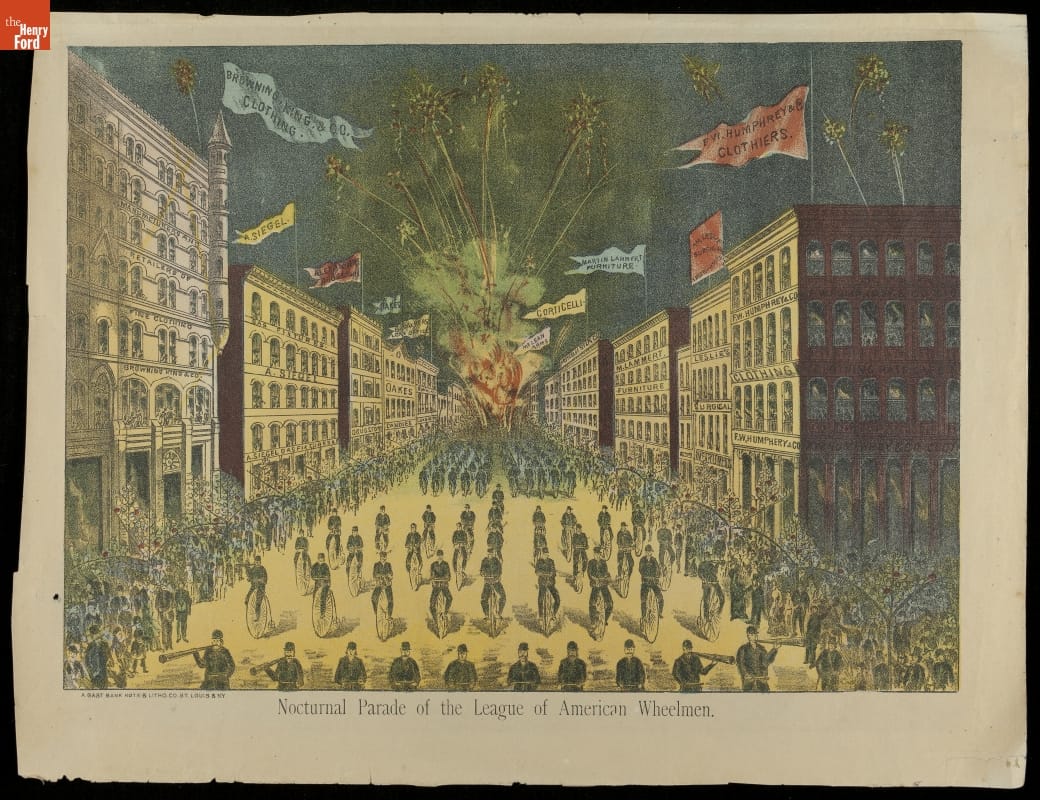
In the late 1800s, cyclists faced many challenges. Poor road conditions made travel difficult, and even on passable roads, cyclists found themselves unwanted. Wagon and carriage drivers thought bicycles and bicyclists frightened their horses, while others believed cyclists posed a danger to pedestrians. In 1880, several cycling clubs formed the League of American Wheelmen to advocate for bicyclists' rights.