
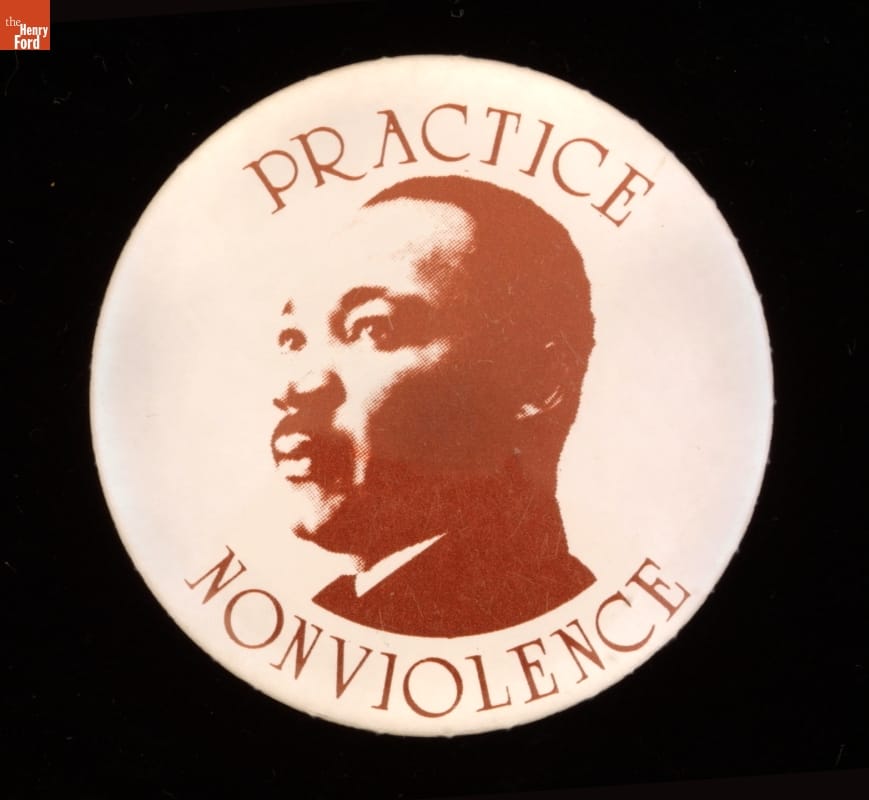
Button, "Practice Nonviolence," circa 1965
THF8434 / Button, "Practice Nonviolence," circa 1965
01
Artifact Overview
The Reverend Martin Luther King, Jr. led a non-violent campaign for civil rights. His leadership during the turbulent 1950s and 1960s urged on legislative and social change. The wearer of this button would have supported King's non-violent efforts. Tragically, King would die violently by an assassin's bullet in 1968.
Artifact Details
Artifact
Button (Information artifact)
Date Made
circa 1965
Subject Date
circa 1965
Place of Creation
Collection Title
Location
at Henry Ford Museum in With Liberty & Justice for All
Object ID
2004.84.2
Credit
From the Collections of The Henry Ford. Donated by Laura A. Young in Memory of Kathryn Emerson-Buntin.
Material
Metal
Plastic laminate
Dimensions
Diameter: 1.75 in
Inscriptions
front of button: PRACTICE NONVIOLENCE
Keywords |
|---|
02
Related Content
 Set
Set"How Long?": Revisiting Dr. Martin Luther King Jr. and His Legacy
- 19 Artifacts
The life and accomplishments of Dr. Martin Luther King Jr. are often hidden behind the replaying of a few memorable lines from his "I Have a Dream" speech. In fact, Dr. King's real story--from unknown Baptist minister to American civil rights leader to international human rights spokesperson--is deeper, more subtle, and more complex.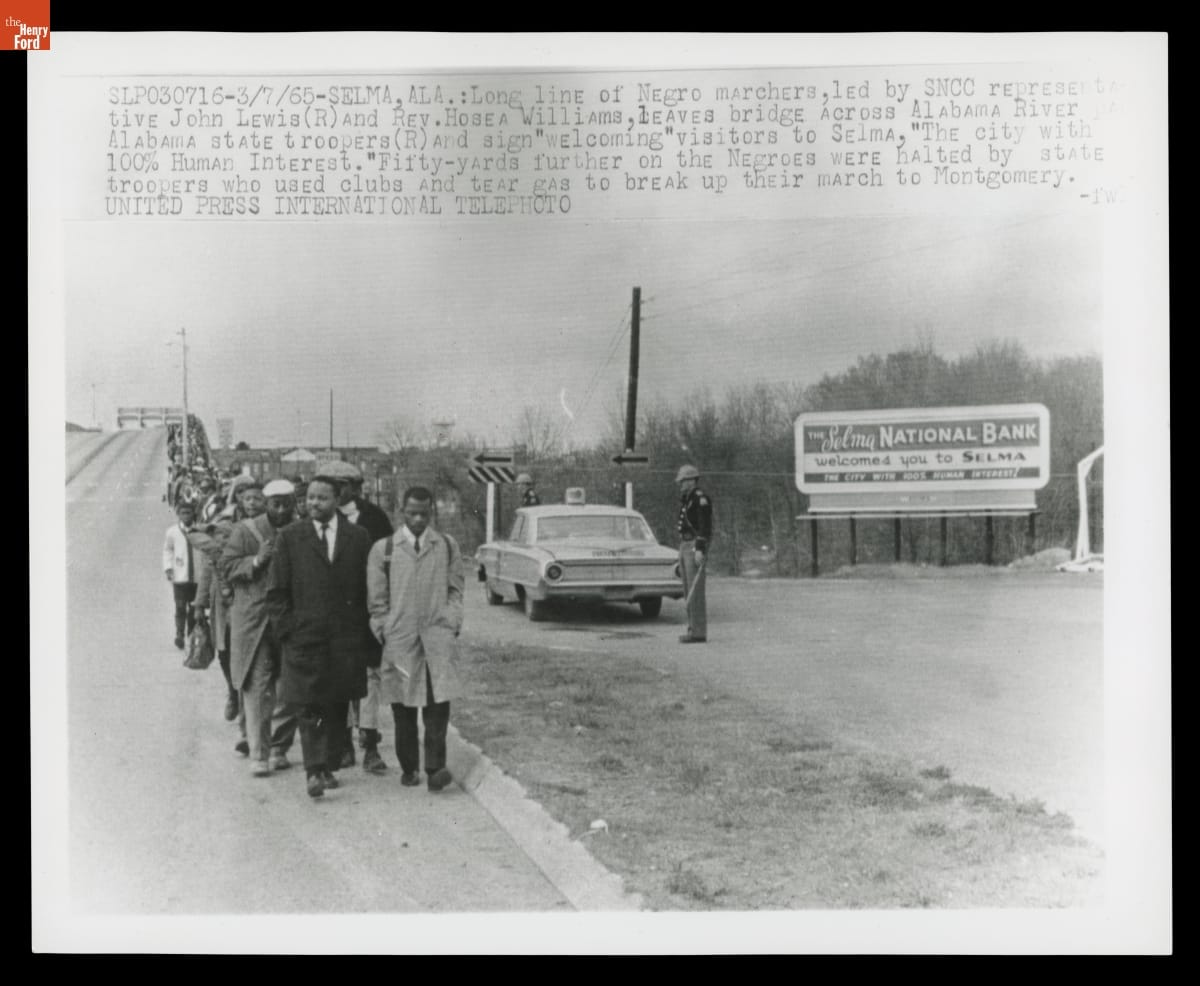 Set
SetThe Long March to Voting Rights
- 24 Artifacts
In 1965, all eyes turned to Selma, Alabama, as the next stage in the fight for civil rights. Dr. Martin Luther King, Jr., the Student Nonviolent Coordinating Committee, the Southern Christian Leadership Conference, and other activists planned a series of marches from Selma to Montgomery to draw attention to the continued struggle for voting rights for Black Americans. article
60th Anniversary of Rosa Parks’ Courageous Act
In honor of the 60th anniversary of Rosa Parks' courageous act, we take a moment to reflect on her legacy. Read more at The Henry Ford blog.