
Westinghouse Portable Steam Engine Powering Thresher at Gleason Farm, Redford Township, Michigan, October 3, 1923
THF700516 / Westinghouse Portable Steam Engine Powering Thresher at Gleason Farm, Redford Township, Michigan, October 3, 1923
01
Artifact Overview
Until reliable internal combustion engines became available, farmers depended on portable steam engines. They were efficient and affordable, and when mounted on wheels or skids, horses could pull them from farm to farm. The small engines powered agricultural machinery like sawmills, corn shellers, or -- as seen here -- grain threshers.
Artifact Details
Artifact
Photographic print
Date Made
03 October 1923
Subject Date
03 October 1923
Place of Creation
Collection Title
Location
By Request in the Benson Ford Research Center
Object ID
64.167.188.P.6424
Credit
From the Collections of The Henry Ford. Gift of Ford Motor Company.
Material
Linen (Material)
Paper (Fiber product)
Technique
Gelatin silver process
Color
Black-and-white (Colors)
Dimensions
Height: 10.313 in
Width: 10.75 in
Inscriptions
Inscribed in image, lower right corner: 6424
Keywords |
|---|
02
Related Artifacts
 Artifact
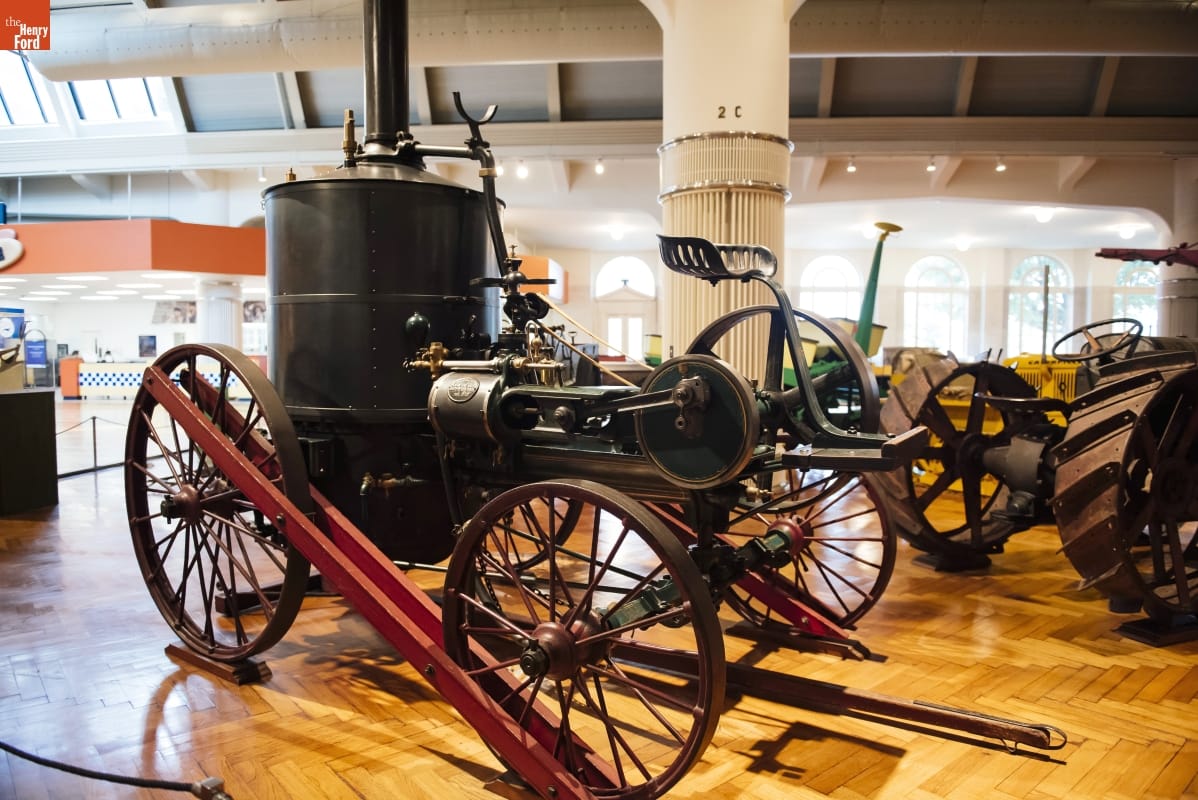
Westinghouse Portable Steam Engine No. 345, Used by Henry Ford
Portable steam engines like this powered grain threshers, sawmills, or corn shellers. Horses pulled them from farm to farm. In 1882, 19-year-old Henry Ford was able to make this engine run well when an older man could not; his first accomplishment in the adult world. Thirty years later Ford tracked down the engine, bought it, and returned it to operating condition.
03
Related Content
 Set
SetAmerica's Industrial Revolution
- 61 Artifacts
The Model T's distinction as a landmark car design can be traced in large part to machines like this -- a high capacity precision machine tool that performed just two production steps on the car engine's cylinder block. The Model T as a design achievement is inseparable from many hundreds of engineering, materials, and production innovations. article
Westinghouse Portable Steam Engine No. 345
Learn how a portable steam engine convinced Henry Ford that his future was in engineering, not farming — and how he tracked that same engine down 30 years later.