
"A. G. Gaston Motel, Birmingham's Most Comfortable Relaxing Center," Birmingham, Alabama, 1954
THF104700 / "A. G. Gaston Motel, Birmingham's Most Comfortable Relaxing Center," Birmingham, Alabama, 1954 / front
01
Artifact Overview
A. G. Gaston founded this motel in 1954 to provide African-American travelers a place to stay while in Birmingham, Alabama. Modeled after the groundbreaking Holiday Inns that had recently opened in Memphis, Tennessee, this motel included 32 rooms, each with their own air-conditioning and telephone. In 1963, the motel became the epicenter of Birmingham's Civil Rights protests and demonstrations.
Artifact Details
Artifact
Viewbook
Date Made
1954
Subject Date
1954
Creators
Place of Creation
Collection Title
Location
Not on exhibit to the public.
Object ID
2011.223.1
Credit
From the Collections of The Henry Ford.
Material
Paper (Fiber product)
Technique
Photomechanical processes
Color
Multicolored
Dimensions
Height: 3.5 in (13.875" when fully opened)
Width: 5.5 in
Inscriptions
Text under image on front:
A.G. Gaston Motel... Birmingham's most comfortable relaxing center /
On address side flap:
The / A.G. / GASTON / MOTEL / The nation's Newest & Finest Motel / 1510 FIFTH AVENUE NORTH / BIRMINGHAM 2, ALABAMA
Keywords |
|---|
02
Related Content
 Set
SetDay of Courage: Segregation
- 10 Artifacts
This sheet music includes the music and lyrics for a minstrel show and the image of a blackface character. Minstrel shows generally featured white actors wearing black makeup (known as blackface) who portrayed racist stereotypes of African Americans through singing and dancing. American audiences considered these shows comical and attended minstrel shows for over a century, from the live theater of the early 1800s to the films of the early-20th century. They even appeared in mid-20th century children's cartoons. The lyrics on this sheet are attributed to Thomas Dartmouth Rice (1808-1860), who introduced the character "Jim Crow", a stereotypical African American, in 1832. The cover image may also depict Rice, an American singer, dancer, and composer, one of the first well-known blackface performers. The "Jimmy Crow" song made Rice internationally famous. The song's popularity first brought the term into the American language as derogatory slang referring to African Americans. "Jim Crow" eventually referred to the two separate societies - one black, one white - followed throughout the United States. This system was formalized in the South by state laws passed in the late-19th century. Blacks and whites could not sit in the same waiting rooms, use the same bathrooms or eat in the same restaurants, for example. Not until the Civil Rights movement of the 1950s and 1960s was segregation outlawed.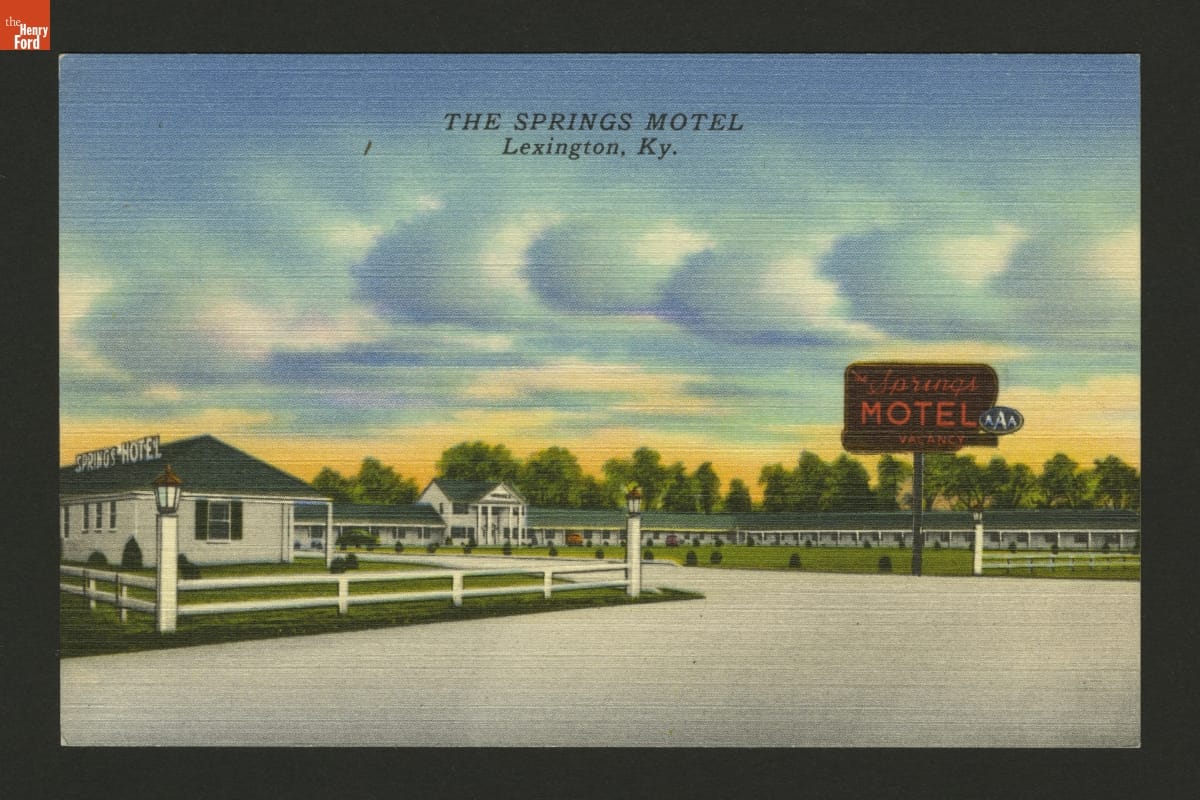 Set
SetThe Golden Age of Motels
- 19 Artifacts
Motel design often reflected regional architectural style. The Springs Motel in Lexington, Kentucky, as seen in this ca. 1955 postcard, reminds one of the numerous horse farms visible throughout the Bluegrass Region of Kentucky.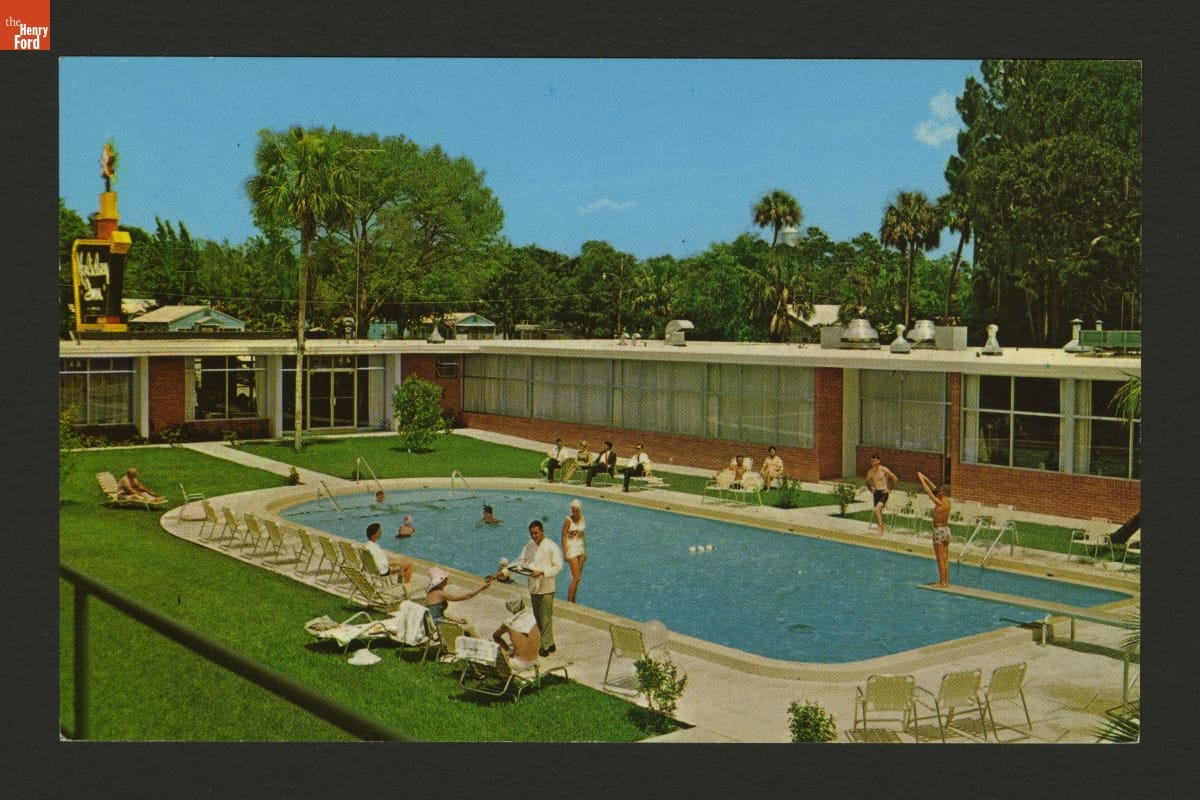 Set
SetHoliday Inns: Revolutionizing an Industry
- 18 Artifacts
On a family road trip in 1951, building developer Kemmons Wilson spent nights in motel rooms that he found to be overpriced and uncomfortable. When the entrepreneur returned home to Memphis, Tennessee, he decided to build his own motel that offered consistent, quality service and amenities at family-friendly prices. Within a few years, Wilson’s Holiday Inns had revolutionized industry standards and become the nation’s largest lodging chain. article
Black Entrepreneurs during the Jim Crow Era
The more that Jim Crow laws cut off Black communities, and the more that white businessmen refused to cater to Black customers, the more possible it became for enterprising African American entrepreneurs to create viable businesses of their own.