
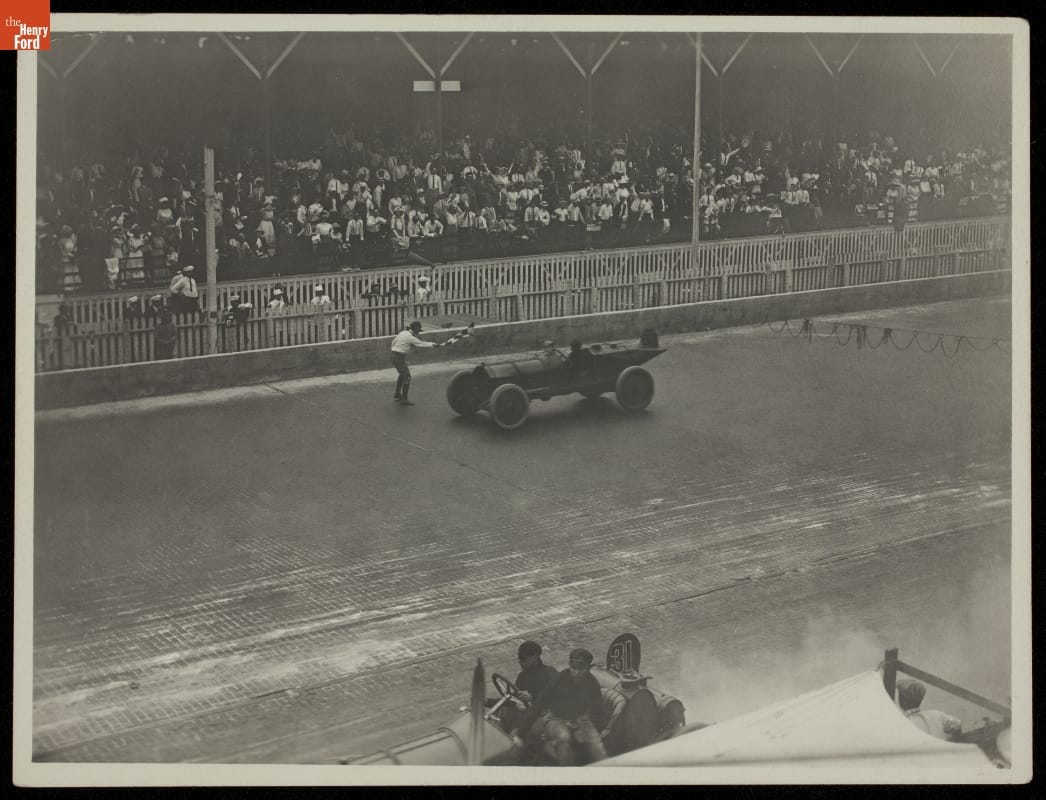
Herbert Lytle, #35 Apperson, 1911 Indianapolis 500
THF228723 / Herbert Lytle, #35 Apperson, 1911 Indianapolis 500
01
Artifact Overview
Indianapolis Motor Speedway opened in 1909 with multiple races each season. In 1911, track promoters decided instead to host just one spectacular event each Memorial Day. The inaugural Indianapolis 500-Mile Race, with $27,500 in prizes, drew 40 qualifying cars and 80,000 spectators. Ray Harroun won with the yellow #32 Marmon Wasp, and the Indianapolis 500 became an American institution.
Artifact Details
Artifact
Photographic print
Subject Date
30 May 1911
Collection Title
Location
By Request in the Benson Ford Research Center
Object ID
2009.103.P.794.11
Credit
From the Collections of The Henry Ford.
Color
Black-and-white (Colors)
Dimensions
Height: 8.00 in
Width: 10.00 in
Keywords |
|---|
02
Related Content
 Set
SetThe First Indianapolis 500, 1911
- 26 Artifacts
The Indianapolis 500 bills itself today as the "Greatest Spectacle in Racing." That description would have been just as accurate for the first race, held on May 30, 1911. Its 500-mile length and $27,000 prize purse were unlike anything seen in the auto racing world to that point. The first Indy 500 featured 40 qualifying cars. This set includes photos of 23 of them, presented in the order in which they finished the race. Set
SetThe Vanderbilt Cup
- 35 Artifacts
America's earliest auto races were small-time contests. Wealthy enthusiast William K. Vanderbilt, Jr., thought the United States needed a big, signature event. Starting in 1904, he organized an annual road race through Long Island, New York, that attracted top American and European drivers and manufacturers. When a Connecticut-built Locomobile won the Vanderbilt Cup in 1908, it helped prove that America's automotive industry had arrived.