
Korn "Indianapolis" Gas-Powered Racing Tether Car, 1940-1941
THF157064 / Korn "Indianapolis" Gas-Powered Racing Tether Car, 1940-1941
01
Artifact Overview
Tether cars, gas-powered model race cars, were popular in the 1930s and 1940s. They were raced individually while tethered to a central pivot, or against each other on a scaled-down board track. This magnesium-bodied model of an Indianapolis-style racer was built by Barney (B.B.) Korn. While Korn's models weren't particularly fast, they were exceptional in their fine detail and craftsmanship.
Artifact Details
Artifact
Model car
Date Made
1940-1941
Place of Creation
Creator Notes
Manufactured by B.B. (Barney) Korn and the B.B. Korn Specialty Manufacturing Co. in Los Angeles, California.
Location
at Henry Ford Museum in Driven to Win: Racing in America
Object ID
2013.47.1
Credit
From the Collections of The Henry Ford. Gift of Eric Zausner and the E-Z Spindizzy Foundation.
Material
Magnesium
Aluminum (Metal)
Bronze (Metal)
Rubber (Material)
Plexiglas (TM)
Vinyl
Paint (Coating)
Color
Red
Gray (Color)
Silver (Color)
Black (Color)
Dimensions
Height: 6.125 in
Width: 9.625 in
Length: 20.75 in
Keywords |
|---|
02
Related Content
 Set
SetBarney Korn: Tether Car Craftsman
- 14 Artifacts
Tether cars, gas-powered model race cars, were popular in the 1930s and 1940s. Few tether car makers matched the skill of Barney Korn. His remarkably detailed and largely hand-built models stood apart from mass produced units by larger manufacturers. Korn's models weren't big sellers — they were too slow for serious racers and too expensive for amateurs — but modern collectors value them for their beauty and rarity.
 Set
SetRacing
- 50 Artifacts
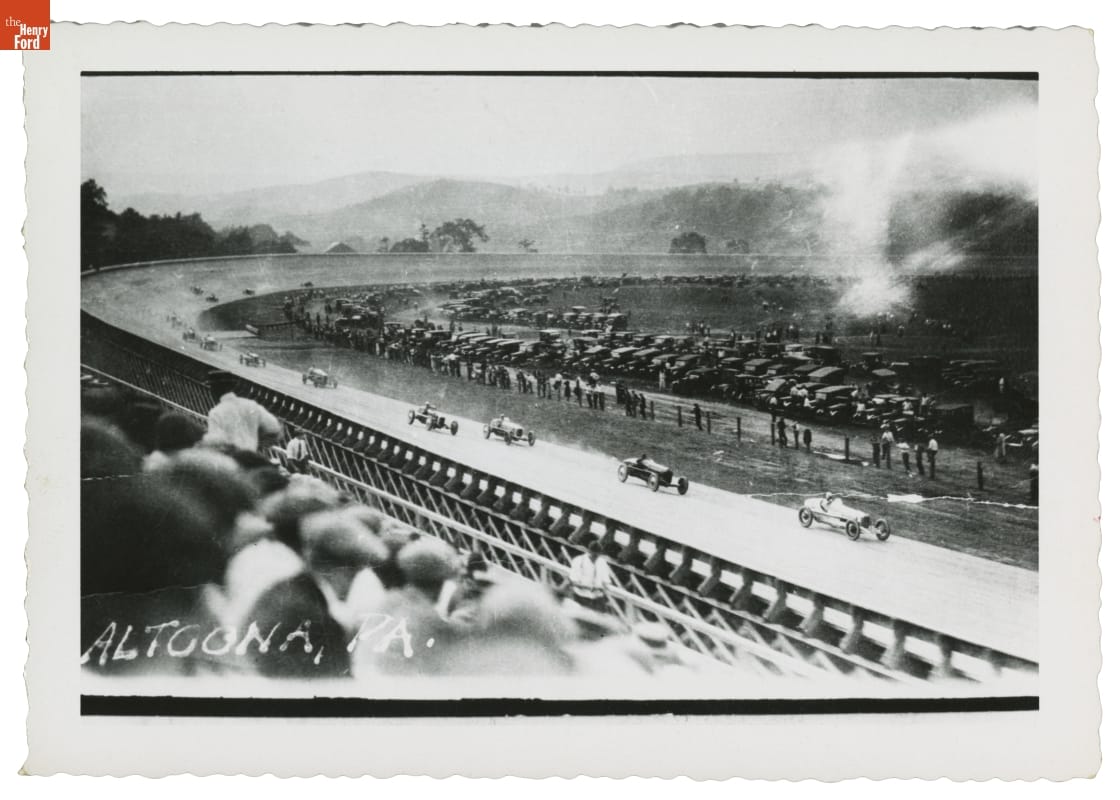
As automobile racing speeds increased, repurposed dirt horse tracks became inadequate. In the 1910s promoters turned to wooden boards, which provided a smooth road surface and were less expensive than bricks or concrete. But rotting wood required frequent replacement. Improvements in concrete and asphalt made board tracks obsolete in the 1930s. The 1.25-mile board track at Altoona, Pennsylvania, operated from 1923-1931. article
Barney Korn: Tether Car Craftsman
Explore the story of Barney Korn, the Leonardo da Vinci of the model cars known as tether cars or spindizzies, raced by adults in the 1930s and 1940s.