
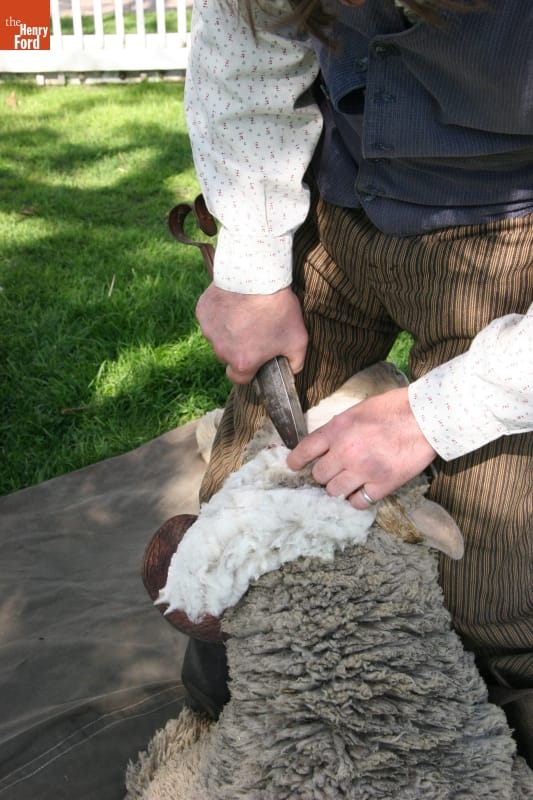
Skirting the Wool Fleece from Merino Sheep-Shearing Demonstration, Greenfield Village, April 2010
THF119199 / Skirting the Wool Fleece from Merino Sheep-Shearing Demonstration, Greenfield Village, April 2010
01
Artifact Overview
Heavy, yet fine fleeces made Merino sheep a popular breed among nineteenth-century wool producers. Every spring, after carefully navigating blade shears to cut away each sheep's thick fleece, farmers removed especially dirty or coarse sections of wool. This process, called skirting, helped maximize profit, as farmers and wool buyers negotiated a price per pound of wool based on fleece quality.
Artifact Details
Artifact
Digital image
Subject Date
30 April 2010
Collection Title
Location
By Request in the Benson Ford Research Center
Object ID
EI.1929.658
Credit
From the Collections of The Henry Ford.
Technique
Digital imaging
Color
Black-and-white (Colors)
Keywords |
|---|
02
Related Content
 Set
SetShearing the Merino Sheep of Firestone Farm
- 25 Artifacts
Heavy coats of fine wool made Merino sheep a popular breed among nineteenth-century wool producers. Every spring, shearers carefully navigated blade shears to remove each sheep's thick fleece -- a process that could take several hours. More than a century later, presenters demonstrate this labor-intensive blade-shearing process at Firestone Farm in Greenfield Village. article
The Henry Ford's Innovation Nation: Merino Sheep
On this week’s episode of The Henry Ford’s Innovation Nation, you’ll learn about Merino sheep. These resources will help you learn even more. article
Shearing Our Wrinkly Merino Sheep at Firestone Farm (with Video)
During your April or May visit to Greenfield Village, you just might catch our farmers shearing our special wrinkly Merino sheep with the same technology used in 1885. Check out this preview.