
Students and Teacher in a One-Room School near Richmond Hill, Georgia, circa 1940
THF98647 / Students and Teacher in a One-Room School near Richmond Hill, Georgia, circa 1940
01
Artifact Overview
Henry Ford purchased vast amounts of land around present-day Richmond Hill, Georgia, beginning in the 1920s. After acquiring the property, Ford became interested in the economic and civic improvement of the area. This photo shows the poor learning conditions faced by many students in the area. In 1940, Ford opened the new George Washington Carver School for the African-American community.
Artifact Details
Artifact
Photographic print
Subject Date
circa 1935
Creators
Place of Creation
Creator Notes
Reminiscence of Edward L. Bryant (1898-1984) typewritten on back of photograph.
Collection Title
Location
By Request in the Benson Ford Research Center
Object ID
P.B.35145
Credit
From the Collections of The Henry Ford.
Material
Paper (Fiber product)
Technique
Gelatin silver process
Color
Black-and-white (Colors)
Dimensions
Height: 8.125 in
Width: 10 in
Keywords |
|---|
02
Related Content
 Set
SetDesks in Context
- 30 Artifacts
In 1891, Henry Ford left his small lumber business to work for the Edison Illuminating Company in Detroit. He was hired on by the general manger, Charles Phelps Gilbert (pictured here). Ford's work impressed his superiors, and by early 1894 he was promoted to chief engineer. While working at the Edison Illuminating Company, Ford also built his first horseless carriage, the Quadricycle. Set
SetChildren and Desks
- 19 Artifacts
Henry Ford's original vision for his museum and "early American village" was to provide hands-on learning opportunities for students. Ford's educational philosophy was "learn to do by doing." In the experimental Edison Institute Schools he founded in 1929, students learned not only from books, but also from objects and hands-on experiences. Many attended classes in Greenfield Village's historic buildings.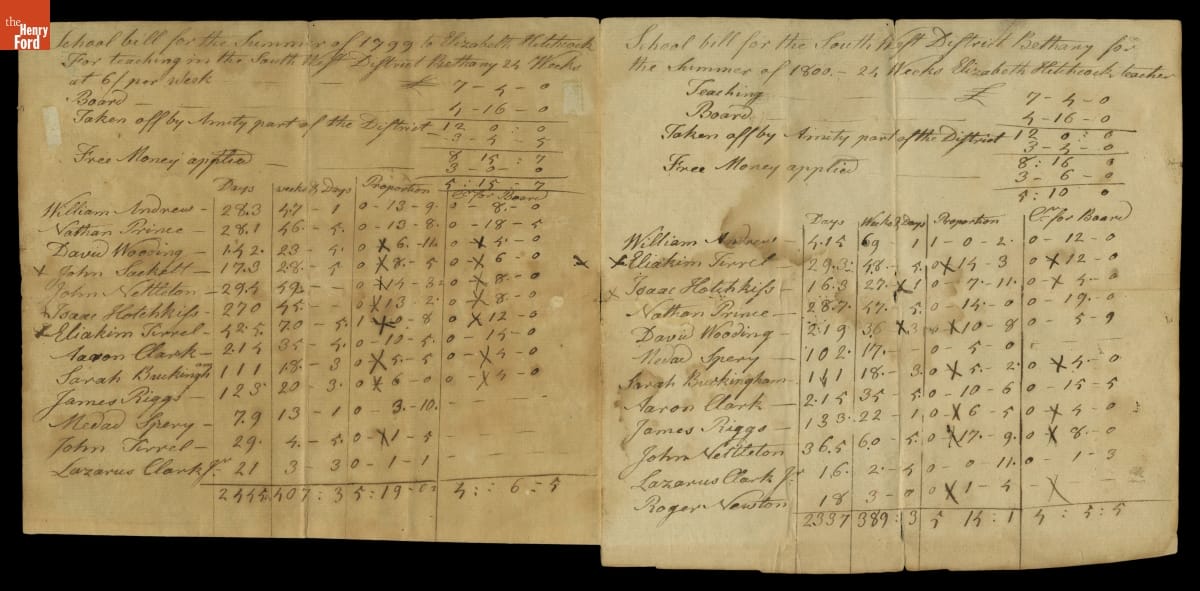 Set
SetOne-Room Schools
- 42 Artifacts
In the early United States, schools were organized if the local community desired them, and generally parents had to pay for their children to attend. This is a hand-written bill from a teacher in Bethany, Connecticut. Parents were billed for their children's education as well as the teacher's board (food and shelter).