
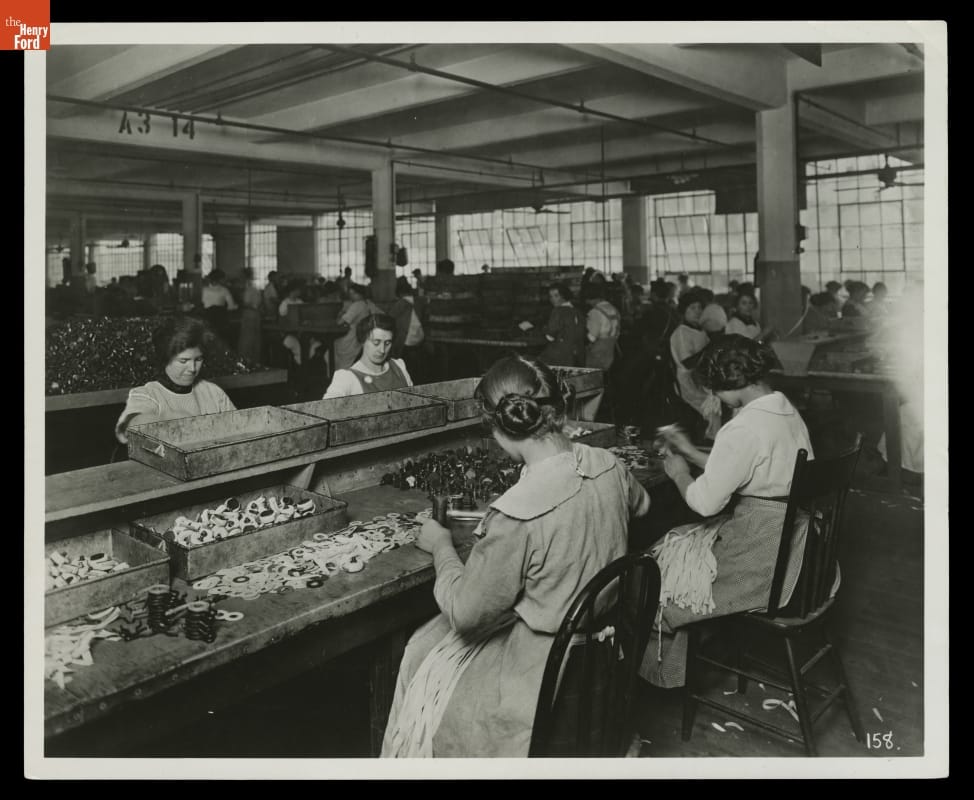
Women Workers Assembling Magnetos at the Highland Park Plant, circa 1913
THF99642 / Women Workers Assembling Magnetos at the Highland Park Plant, circa 1913
01
Artifact Overview
Ford's Model T flywheel magneto generated the electricity that ignited the gasoline-air mixture inside the engine's cylinders. At the Highland Park plant, the coil-manufacturing department employed some women for the assembly of magnetos. The workers wound wire around the iron cores and placed the assembled parts into wooden boxes.
Artifact Details
Artifact
Photographic print
Subject Date
circa 1913
Place of Creation
Creator Notes
Attributed to Ford Motor Company Photographic Department
Collection Title
Location
By Request in the Benson Ford Research Center
Object ID
84.1.1660.P.833.158
Credit
From the Collections of The Henry Ford. Gift of Ford Motor Company.
Material
Paper (Fiber product)
Technique
Gelatin silver process
Color
Black-and-white (Colors)
Dimensions
Height: 8.25 in
Width: 10 in
Inscriptions
On verso, stamped in ink:
Photo By FORD MOTOR CO. CENTRAL STAFF PHOTOGRAPHIC Dearborn, Michigan.
Keywords |
|---|
02
Related Content
 Set
SetLesson: Using Human Resources on the Assembly Line
- 4 Artifacts
Ford's Model T flywheel magneto generated the electricity that ignited the gasoline-air mixture inside the engine's cylinders. At the Highland Park plant, the coil-manufacturing department employed some women for the assembly of magnetos. The workers wound wire around the iron cores and placed the assembled parts into wooden boxes.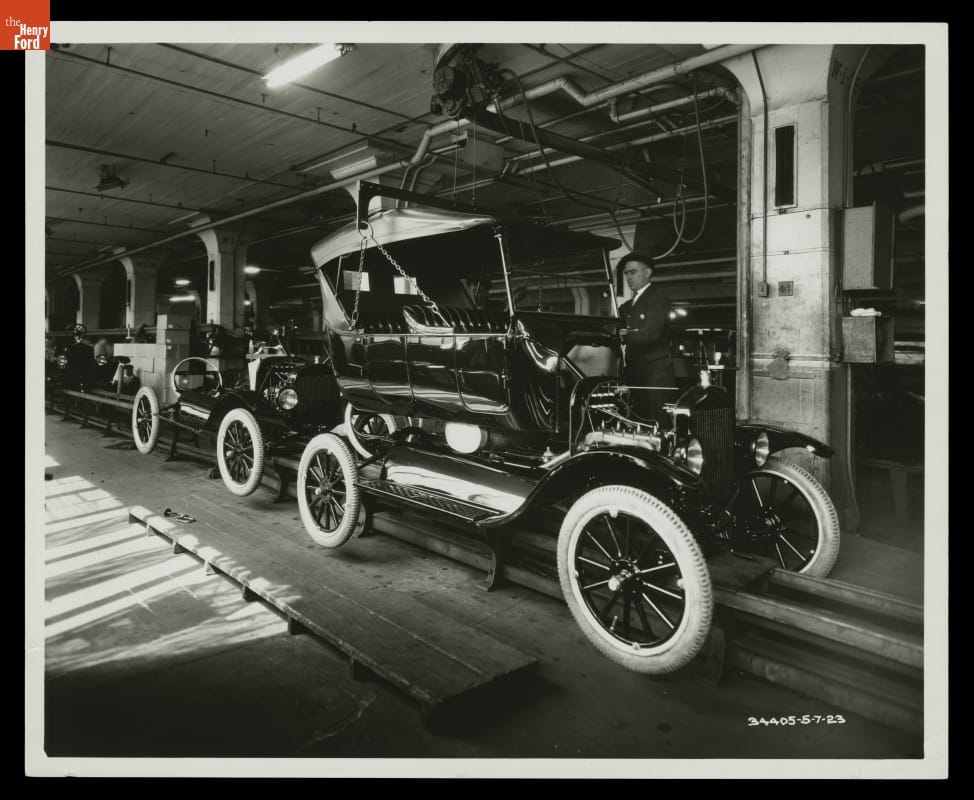 Set
SetLesson: Pulls
- 3 Artifacts
Henry Ford and his engineers constantly searched for ways to speed up car production and hold down costs. The integration of a moving assembly line in the Highland Park plant allowed Ford's company to do just that. From 1908-1927, Ford Motor Company produced over 15 million Model T cars and the price dropped from $850 to as little as $260.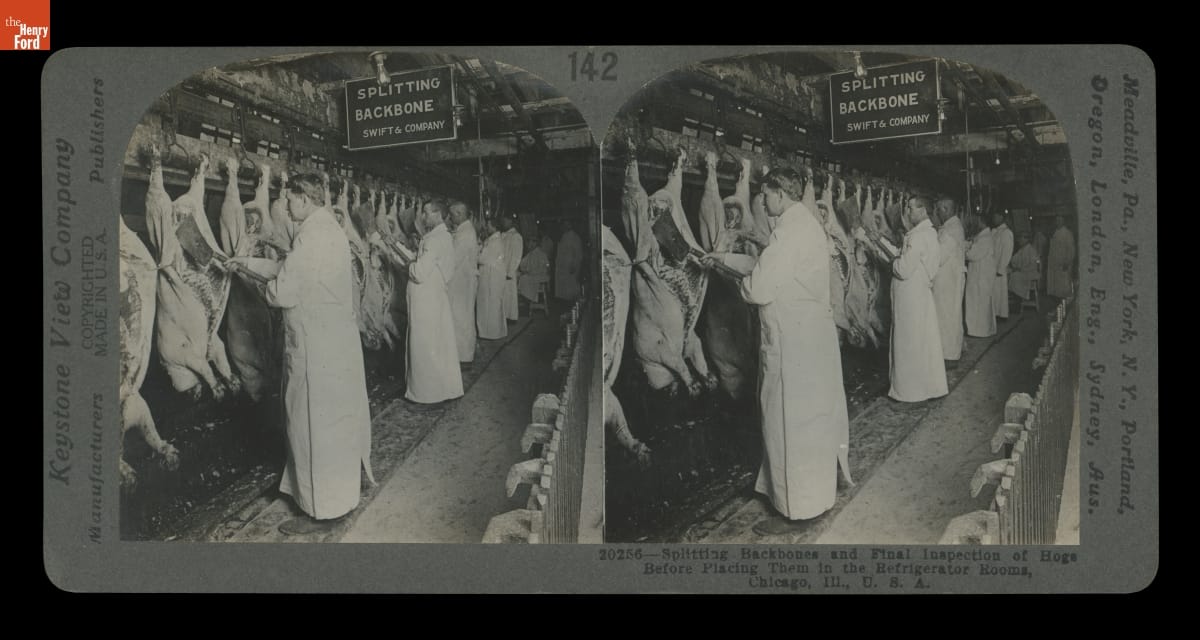 Set
SetLesson: The Moving Assembly Line and Work Force
- 5 Artifacts
At this meat packing operation, a conveyor moved hog carcasses past meat cutters, who then removed various pieces of the animal. To keep Model T production up with demand, Ford engineers borrowed ideas from other industries. Sometime in 1913 they realized that the "disassembly line" principle employed in slaughterhouses could be adapted to building automobiles -- on a moving assembly line.