
Wool Wheel, Made in the Shaker Community in Canterbury, New Hampshire, 1807-1847
THF171115 / Wool Wheel, Made in the Shaker Community in Canterbury, New Hampshire, 1807-1847
01
Artifact Overview
Spinning fibers into yarn for weaving into cloth was an important task in many households into the 19th century. Spinning, done by women and girls, was a skilled -- and labor-intensive -- task. The woman who operated this large wool wheel spent countless hours walking to and fro, alternately spinning the wool fibers into yarn and then winding it onto the spindle.
Artifact Details
Artifact
Spinning wheel
Date Made
1807-1847
Place of Creation
Creator Notes
Made in the Shaker Community in Canterbury, New Hampshire, of which Francis Winkley was Trustee. The accelerating head, which is not original to this wheel, was patented by Amos Miner.
Collection Title
Location
Not on exhibit to the public.
Object ID
2017.84.158
Credit
From the Collections of The Henry Ford. Gift of American Textile History Museum, donated to ATHM by North Andover Historical Society.
Material
Wood (Plant material)
Metal
Leather
Technique
Turning (Shaping process)
Dimensions
Height: 59.25 in
Width: 66 in
Length: 22 in
Inscriptions
end of table:
F. W.
Keywords |
|---|
02
Related Content
 Set
SetSpinning Highlights from the Collections of The Henry Ford
- 16 Artifacts
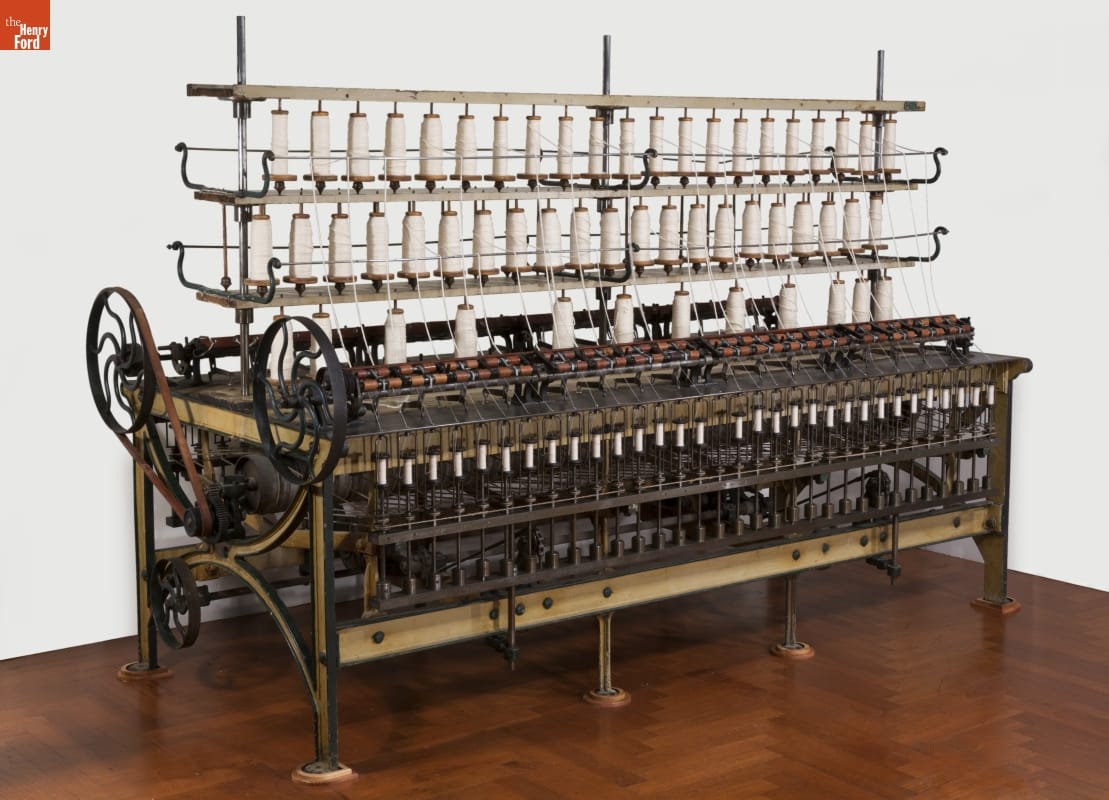
Spinning frames spin cotton fiber into yarn and then wind it onto a bobbin. This throstle spinning frame could simultaneously spin 64 strands of yarn. (Throstle -- an old name for a song thrush -- refers to the bird-like sounds the machine made.) Machines like this helped produce the large quantities of yarn that growing industrial weaving operations needed in the early and mid-1800s.-600x600%2F615-thf91531.png%3Fsfvrsn%3D55da3add_1&w=3840&q=75) article
articleThe Rise of the American Carding Mill
Carding mills transformed raw wool from sheep into straightened rolls of wool, called rovings—the first step to finished cloth. Find out how carding mills provided this service for farm families and home spinners. article
The Wool Carding Machine
Learn how wool carding machines transformed wool processing. Explore their impact on yarn preparation. Read more from The Henry Ford!