
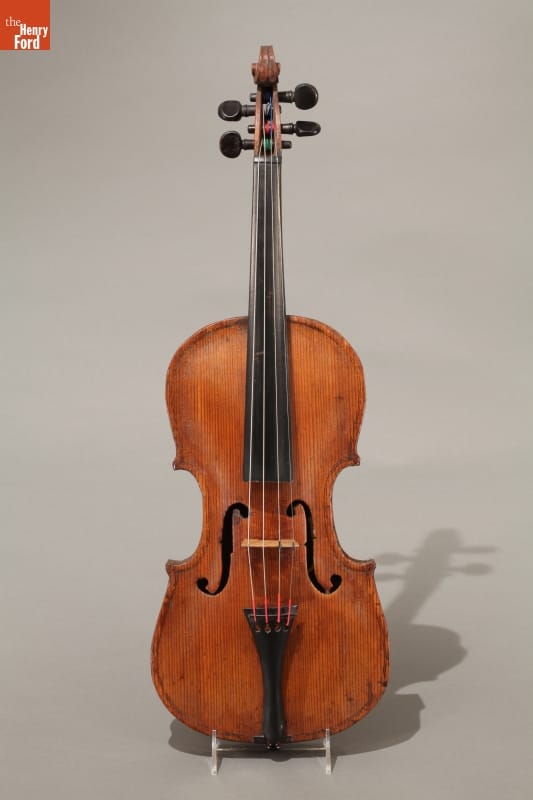
Violin, "The Rougemont," by Antonio Stradivari, 1703
THF107772 / Violin, "The Rougemont," by Antonio Stradivari, 1703
01
Artifact Overview
In the 1920s, Henry Ford purchased several exquisite Italian violins, including this 1703 Stradivari. From the 1680s until the 1730s, Antonio Stradivari was the leading stringed-instrument maker in Cremona, Italy--an important center of stringed instrument production. Henry Ford's 1703 Stradivari violin was made during Stradivari's "golden era." It is known as the "Rougemont" because it was thought to have been owned by a family of that name.
Artifact Details
Artifact
Violin
Date Made
1703
Creators
Place of Creation
Location
at Henry Ford Museum in Collections Platform
Object ID
33.250.2
Credit
From the Collections of The Henry Ford.
Material
Maple (Wood)
Spruce (Wood)
Dimensions
Width: 6.563 in
Length: 14 in
Inscriptions
Paper label under left F hole: ANTONIUS STRADIVARIUS CREMONENIUS / FACIEBAT ANNO 1703
Keywords |
|---|
02
Related Content
 Set
SetHenry Ford & His Violins
- 48 Artifacts
Henry Ford loved music-especially the fiddle tunes he enjoyed at the country dances of his youth. As a young man, Ford bought this inexpensive fiddle and learned to play it a bit. Though he was never able to play as well as he would have wished, Ford's love of the fiddle and rural dance music remained with him throughout his life. Set
SetHenry Ford
- 49 Artifacts
The Quadricycle was Henry Ford's first attempt to build a gasoline-powered automobile. It utilized commonly available materials: angle iron for the frame, a leather belt and chain drive for the transmission, and a buggy seat. Ford had to devise his own ignition system. He sold his Quadricycle for $200, then used the money to build his second car.