
Dogs & Puppies
Share
share
Dogs guard, guide, hunt and herd, but they also entertain, inspire and offer comfort. In exchange for their pets' loyalty, owners provide room, board, and affection. Owners convey love and respect for their working dogs in personal ways, through portraits and photographs. And businesses capitalize on public affection for dogs and puppies by featuring them in advertisements and showcasing them on consumable products from tableware to trinkets.
THF311684
"Dog" Dish, 1840-1860
The use of earthenware increased during the mid-nineteenth century as the price decreased. Decorative elements included transfer prints that depicted ordinary scenes that appealed to consumers. This small eight-sided earthenware dish, molded, with a rope and floral border, features "Dog" in word and image.
View ArtifactOil Painting, "Boy with Dog" by William Bartoll, 1840-1850
William Bartoll, like his father, uncle and brother, was a house painter, as well as a portraitist and mural painter in the seaside town of Marblehead, Massachusetts. This endearing portrait of an unknown little boy is meticulously painted to emphasize the boy's relationship to his faithful dog and his little book of ABCs.
View ArtifactSchool Reward of Merit Given to James Grattan by His Teacher, Miss Carman, circa 1870
This hand-colored reward of merit features a popular image – a working dog pulling a vehicle with a child in the passenger seat. A boy or young man holds the lines that guide the dog, and he has a carriage driving whip in hand. The girl and her doll ride in the carriage, a phaeton with a collapsible top, folded down.
View ArtifactEngraving, "Triumph of Patriotism, Washington Entering New York, 25th November 1783"
Three dogs appear front and center in this engraving commemorating the 75th anniversary of "Evacuation Day." Two appear to be joyful as they run ahead of George Washington and the Continental Army. The third dog, with studded collar, appears to have stopped mid-flea-scratch to watch the action engulf him.
View ArtifactLithograph, "Mr. Lincoln, Residence and Horse as They Appeared on His Return from the Campaign with Senator Douglas," 1858
The Lincoln family had pets, including a dog named Fido. The dog in this lithograph could represent Fido, who outlived two of his masters, young Willie and President Lincoln. When Abraham Lincoln and family moved from Springfield, Illinois, to Washington, D.C., they left Fido with John Eddy Roll and family. One of the two men depicted with the dog in this lithograph could be Roll (with long beard).
View ArtifactPitcher, 1842-1851
Manufacturers often featured hunting scenes on decorative arts. The relief on the surface of this molded pitcher graphically depicts hunting dogs in action, a routine occurrence in the centuries before guns became common. Dog owners took pains to care for canines that hunted wild boar, rabbits, deer and other animals that helped put meat on their owners’ tables.
View ArtifactFlask, 1870-1890
Glass factories in America began producing inexpensive, mold-formed flasks in the early 1800s. These figured flasks often were decorated with symbols of national pride or political or cultural affiliation. This late-century flask with its image of a hunting dog on the reverse may have appealed to hunters and sportsmen.
View ArtifactSpeaking Dog Mechanical Bank, 1885-1895
Depressing a lever on the base near the dog causes the girl's right arm to move back, dropping the coin placed on the tray into the seat opening beside her, while the dog opens its mouth as if barking and wags its tail. The Shepard Hardware Company began producing these mechanical banks about 1882, but sold this line in 1892.
View ArtifactLyman Brown's Seven Barks Almanac, 1900
This Seven Barks almanac advertised an extract derived from seven layers (or "barks") of an hydrangea. Seven Barks purveyor Lyman Brown claimed it was a cure-all for diseases of the stomach, liver, kidneys, nerves, and blood. The front cover of the paid advertisement diverted customers' attention from their health concerns and focused their attention on dog breeds - hounds, pointers, pugs, pinschers, and a spaniel to name a few.
View ArtifactTrade Card for Incubators, Sure Hatch Incubator Co., circa 1910
A puppy can get into all sorts of trouble. The more puppies, the more trouble. The Sure Hatch Incubator Company catered to public interest in puppies and their antics with a trade card that featured little Dachshunds ganging up on a baby to steal its bottle. The advertising medium, blotter paper, added an extra dimension. Customers could use it to absorb spilt ink, but the puppies had no recourse but to lick up what they upset!
View ArtifactMechanical Valentine in the Shape of a Dog, "A Token of Affection," circa 1925
This mechanical valentine connected the dog's eyes and mouth to the collar tab. When the valentine’s recipient pulled on the collar, the eyes and mouth opened and closed, which conveyed the dog's excitement about delivering the Valentine’s Day message.
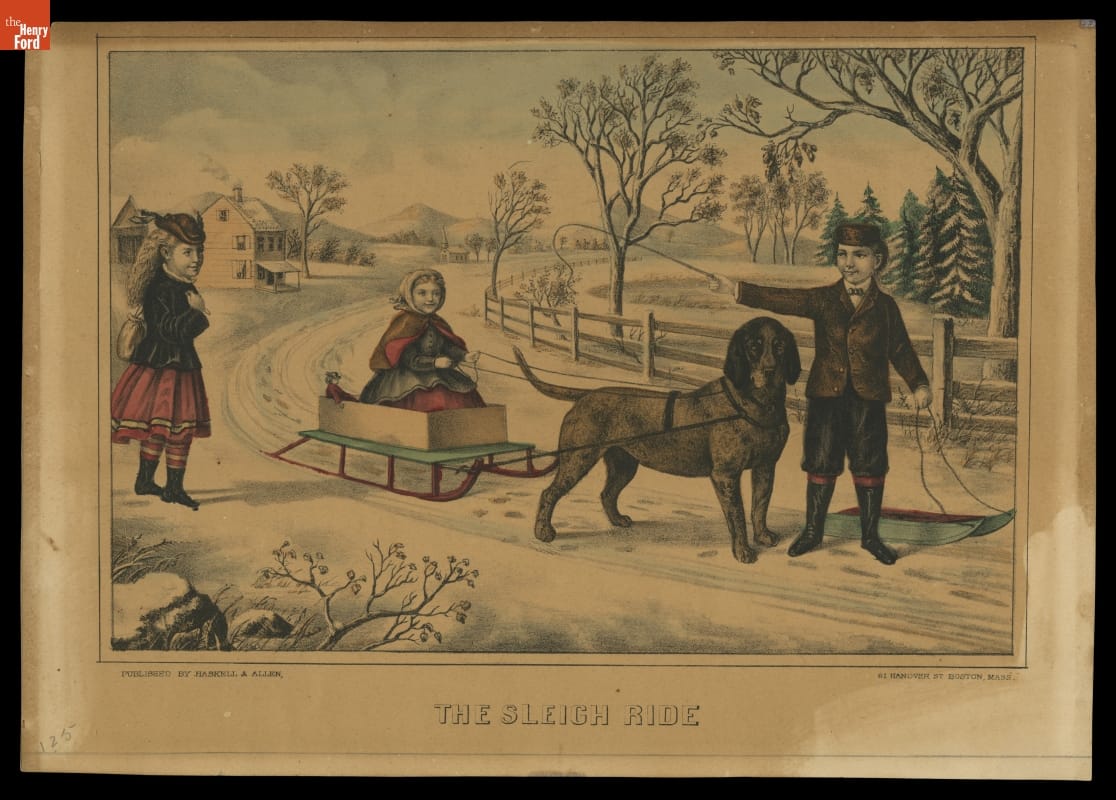
View ArtifactLithograph, "The Sleigh Ride," circa 1873
This chromolithograph featured a popular winter excursion for children during the 19th century – sledding with the family dog. The rural vista included details that viewers would expect to see – a white church, a farmhouse with full porch, a snow-covered roadway and fenced pond. The dog, a hound-type, looks ready to run.
View ArtifactEdsel Ford as a Child, Fishing, 1899
Edsel Ford stands on a wharf at “Orion Lake,” in the village of Lake Orion, north of Detroit, holding his first string of fish. The notation on the photograph's mount documents that fact, but fails to identify the name of the shaggy dog at Edsel's side.
View Artifact"Eager for Deer," Man and Dogs Ready for Hunting in the Woods, circa 1903
Working dogs had jobs to do, but they also bonded with their handlers. This photograph shows seven dogs waiting the hunter's command. Most of the dogs have collars and several are chained, but one is in the hunter's lap. Packs like this worked as a team flushing out deer or other game from heavily wooded areas.
View ArtifactFarmer and Dog on a Fordson Tractor, circa 1919
Dogs provided companionship and protection to farmers as they attended to duty on the farm. When farmers relied on draft horses for power, they had to rest their steeds regularly. This farmer and his dog practice that routine, but this time they both remain seated on a Fordson tractor.
View ArtifactProcess Photograph for 1966 Ford Mustang Advertising
This still photograph advertising the new pony car, the Ford Mustang, featured a gentleman farmer, not a cowboy, and his hunting dog. The imagery implied that the farmer-equestrian, instead of riding a high-bred hunting horse, could accomplish his goals behind the wheel of a Mustang.
View ArtifactHenry Ford with a Trained Dog, 1928
German Shepherd dogs worked at Ford Motor Company, accompanying FMC watchmen as they policed the grounds. Edsel Ford purchased a German Shepherd puppy from Holland in 1926 as a family pet. And in 1928, Pal, a German Shepard trained to do unusual stunts, posed with Henry Ford during a photography shoot.
View ArtifactMan with Seeing Eye Dog, 1941
Close relationships developed between working dogs and their masters. Despite the obvious bond between this dog and his master, seeing-eye dogs, or guide dogs, never lost sight of their purpose, to ensure the safety of their vision-impaired masters.
View ArtifactReceipt for Donation to The Seeing Eye Guide Dog School, February 17, 1939
Wealthy industrialists paid society back by donating hundreds of dollars to good causes. This receipt confirms Edsel B. and Eleanor Clay Ford as patrons of The Seeing Eye Guide Dog School.
View ArtifactLalique "Levrier" Greyhound Hood Ornament, circa 1930
Rene Lalique created some of the most striking automobile mascots, or hood ornaments. He picked the sleek and fast greyhound as the symbol for luxury automobiles.
View Artifact'Scottie' (Scottish Terrier) Pin, circa 1940
Already favored by many dog-lovers, Scottish Terriers increased in popularity in 1940 when President Franklin Delano Roosevelt received his Scottie, Fala, from a cousin. Roosevelt referenced Fala in a speech attacking his critics, and the dog soon became a favorite with the press and the public. This wooden pin was an inexpensive piece of jewelry perhaps worn by teenage girls or young ladies at the height of Fala's popularity.
View Artifact

