
Exploration
Share
share
The word "exploration" may make us think of a physical journey into unknown places--but it can also mean studying, documenting, and deepening our knowledge. In this set, staff from The Henry Ford suggest favorite artifacts from our collection related to both these senses of exploration.
THF169274
Edison Tasimeter, 1878
This tasimeter is a heat-measuring device, invented by Thomas Edison. In July 1878, Edison travelled to Wyoming with the “Draper Expedition” to study a solar eclipse along its path of totality. Mounting a tasimeter to a telescope, Edison’s experiments measured the energy levels of the sun’s corona, amplified by the eclipse. -- Kristen Gallerneaux, Curator of Communication & Information Technology
View ArtifactSecond or Sheeprock Canon of Weber River. April 6th at 1pm. View Looking East
Surveyors began documenting public lands in U.S. territories during the 1780s. By the 1850s, the work included charting the topography and features along the route of proposed transcontinental railway systems. Removal of obstructions hastened the connection of the east and west coasts, but threatened animals (bison) and cultures (American Indians) at an alarming rate. --Debra A. Reid, Curator of Agriculture and the Environment
View ArtifactGM 6-71 Diesel Engine, Used on Jacques Cousteau's Ship "Calypso"
You could argue that Jacques-Yves Cousteau (1910-1997), coinventor of the Aqua-Lung, helped enable intensive exploration beneath the ocean’s surface. His own expeditions aboard the Calypso, documented in books, films, and television programs, sparked the imaginations of people worldwide. Cousteau used this fame to bring attention to the importance of ocean conservation. –Ellice Engdahl, Digital Collections & Content Manager
View ArtifactTesting the Lunar Capsule Built by Ford Motor Company Aeronutronic Division, 1960
Ford Motor Company's Aeronutronic Division built "Lunar Capsules" containing the scientific instruments for NASA's unmanned Ranger 3, Ranger 4, and Ranger 5 spacecraft, launched in 1962 as a precursor to the manned lunar missions. In this photograph, an Aeronutronic engineer prepares the spherical capsule for a test simulating the extreme cold of lunar night. -- Jim Orr, Image Services Specialist
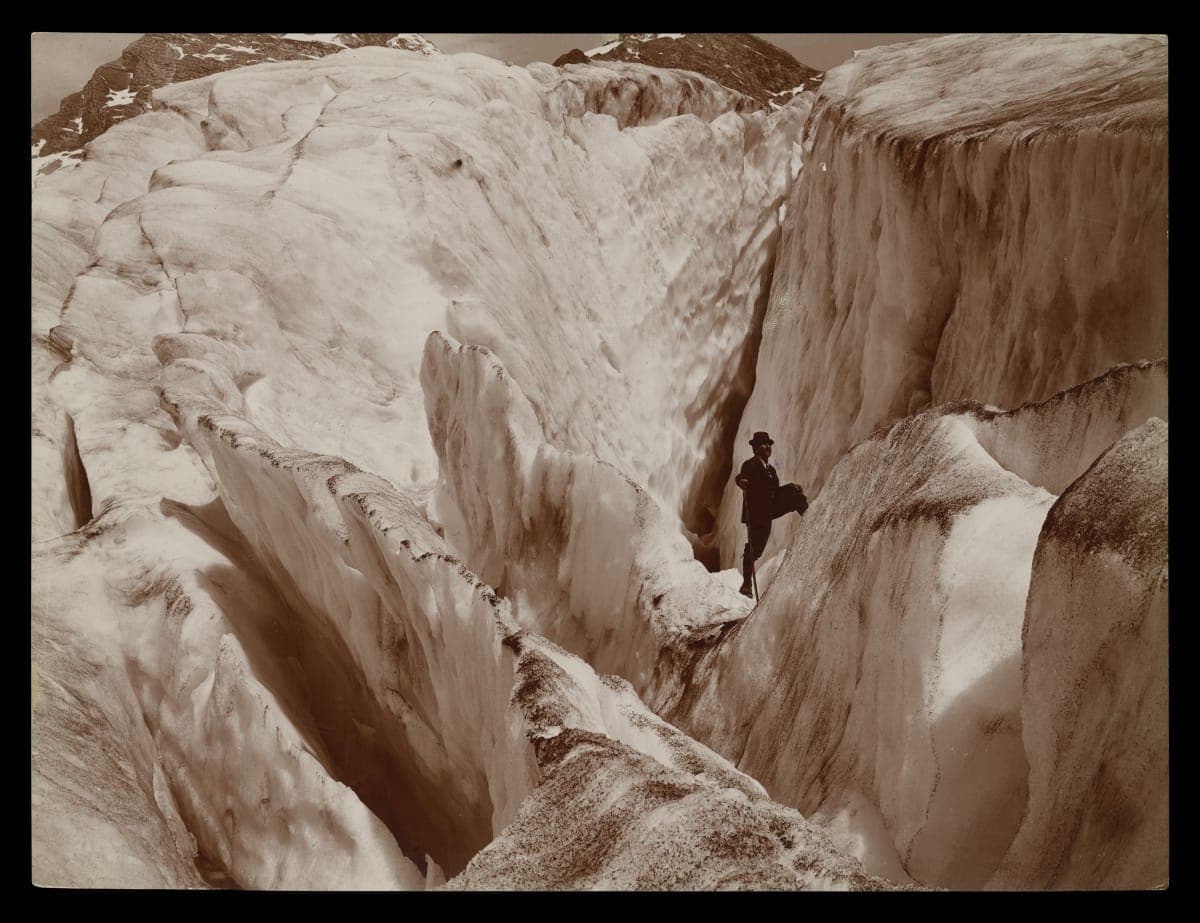
View Artifact"Crevasse Formation in Illecillewaet Glacier, Selkirk Mountains," British Columbia, Canada, circa 1902
This image, printed by the Detroit Publishing Co., depicts a man (in a top hat and suit) in a crevasse in the mountains in Canada--literally the picture of exploration. I like how he is proudly standing, nicely dressed, walking stick in hand, celebrating his journey. It makes me want to go exploring too! -- Jillian Ferraiuolo, Digital Imaging Specialist
View ArtifactAda Dewey Autograph Album, 1874-1875
Albert Bierstadt of the Hudson River School depicted the American West as a pristine and unspoilt environment. His paintings predated the work of conservationists and policy makers who designated Yellowstone and Yosemite as national parks so others could marvel at the natural landscapes. Click the 28th image in this album to see Bierstadt's photo and autograph. --Debra A. Reid, Curator of Agriculture and the Environment
View ArtifactRadio Receiver, Type SE-950, Used by Charles Francis Jenkins in Experiment Detecting Radio Signals from Mars
This SE950—a versatile field radio developed during WWI—was used in Charles Francis Jenkins’ laboratory. In 1924, he used it in a curious exploratory experiment as Mars drew near Earth's orbit. The SE950 was connected to a device that promised to photographically record "alien communication" broadcast during military-imposed radio silence. -- Kristen Gallerneaux, Curator of Communication & Information Technology
View Artifact1913 Cadillac Sales Brochure, "The Story of the Cadillac"
Henry Leland named Cadillac, his first automobile company, for Antoine de la Mothe Cadillac. The French explorer established Fort Pontchartrain du Detroit, which evolved into the city of Detroit, in 1701. Beyond automobiles, Monsieur Cadillac is commemorated by Cadillac Mountain in Maine, and by the city of Cadillac in Michigan's northern Lower Peninsula. – Matt Anderson, Curator of Transportation
View ArtifactJohn Burroughs' Album of Pressed Wildflowers Gathered during the Harriman Alaska Expedition, 1899
In 1899, a group of scientists, naturalists, & artists spent two months traveling 9,000 miles along the coast of Alaska. Landing in over 50 places, they took notes & photographs, created drawings, & collected specimens--like these wildflowers gathered by naturalist John Burroughs. The expedition's records document the increasing encroachments of civilization into the Alaskan "wilderness." –Ellice Engdahl, Digital Collections & Content Manager
View Artifact

