
Glenn Curtiss: Architect of American Aviation
Share
share
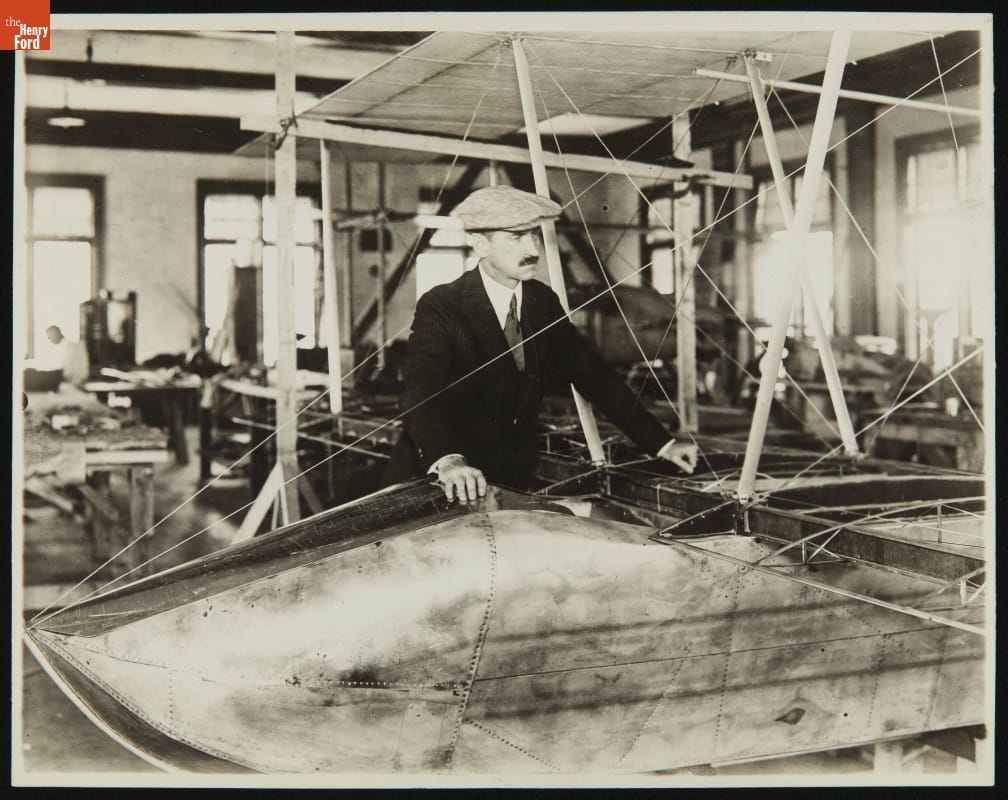
Already a pioneering builder and record-setting racer of motorcycles, Glenn Hammond Curtiss (1878-1930) was making a name for himself in the engine manufacturing business when he turned his eyes to the skies. Curtiss would continue developing innovative machines and setting records on his way to helping make aviation a practical industry.
THF189714
Curtiss Motorcycle, circa 1910
From a young age, Glenn Curtiss loved riding and racing bicycles. He repaired, sold, and even produced them in and around his native Hammondsport, situated on Keuka Lake in New York's Finger Lakes region. In 1901, Curtiss began to experiment with motorized bicycles. Disappointed with the mail order engines available at the time, he started to build his own and was soon manufacturing both motors and motorcycles for sale.
View ArtifactBefore the 319-Foot Flight of "Red Wing," Keuka Lake, New York, March 12, 1908
Curtiss's lightweight yet powerful engines attracted the attention of airship builders and other aviation pioneers, including Alexander Graham Bell. Bell recruited Curtiss for his elite Aerial Experiment Association (AEA). At Curtiss's Hammondsport facilities, the AEA produced a string of airplanes (starting with "Red Wing," pictured here) that ultimately achieved manned flight and contributed key developments to the fledgling field of aviation.
View ArtifactSheet Music, "Golden Flyer March Two-Step," 1910
Work with the AEA proved Curtiss’s talents, and the gentlemen of New York's Aeronautical Society took notice. They placed an order for the first airplane designed and built by Curtiss -- the "Golden Flyer," in which Curtiss set a new endurance record. This song celebrates the remarkable aircraft and its creator, who was becoming a well-known figure in American aviation and would soon make a name for himself abroad.
View ArtifactRacing Poster, "Coupe Gordon Bennett 1909, Curtiss le Gagnant"
Curtiss competed against the world’s best in 1909 at the first ever international aviation meet, held in Reims, France. Curtiss and his "Reims Racer" wowed crowds, set the world air speed record, and won the first Gordon Bennett Trophy for powered aircraft. These achievements--part of a European tour that made Curtiss a household name--aggravated the Wright brothers, who had just sued Curtiss and others for infringing on their airplane patent.
View ArtifactGlenn Curtiss Seated in an Airplane, circa 1911
Despite patent battles with the Wrights that would bog Curtiss down for years and mar his reputation, business took off. Though Curtiss had raced motorcycles and airplanes to promote his brand, and he was the (reluctant) face and name of his company, he was never a true solo act. Curtiss built a trusty team to develop, manufacture, and market Curtiss engines, motorcycles, and--increasingly--airplanes.
View ArtifactAdvertising Poster, "Glen H. Curtiss Aviation Meet," 1912
A team of exhibition pilots raced and performed stunts in Curtiss machines at air shows across the United States, generating revenue and teasing interest from the small pool of potential buyers both wealthy and brave enough to purchase a plane of their own. This freed Curtiss to address the practical future he envisioned for the aviation industry.
View ArtifactGlenn Curtiss with First Army and Navy Fliers at Curtiss' Flying School, San Diego, California, 1911
Glenn Curtiss believed aviation could be practical for both the military and civilians. He established flying schools--a shrewd move that generated income, helped sell planes, served as a recruiting arm for employees, and bolstered Curtiss's relationship with the United States military. It paid to instruct Army and Navy fliers, as Curtiss-trained pilots needed would need Curtiss planes to fly in the service.
View ArtifactGlenn Curtiss and His Hydroaeroplane Being Hoisted Aboard the Armored Cruiser Pennsylvania, February 17, 1911
Curtiss and his team developed the first practical version of what they termed "hydroaeroplanes" -- flying machines that could take off from and land on the water as needed. In 1911, Curtiss helped demonstrate amphibious airplanes' naval utility when he flew out to and was hoisted aboard the USS Pennsylvania in San Diego Bay. His team would also develop ship-based systems for direct takeoff and landing.
View ArtifactGlenn Curtiss with Flying Boat, circa 1912
Aircraft for use on water seemed logical to Glenn Curtiss. He had grown up fishing, swimming, skating, and boating on Keuka Lake. And as a pilot, it made sense. In aviation’s earliest days, with no reliable network of airfields, a calm body of water was often easier to locate than a flat, clear span of earth for a safe landing.
View ArtifactCurtiss Flying Boat, Hammondsport, New York, 1912
Curtiss's "hydroaeroplanes" had floats mounted under the fuselage. In 1912, he developed another type of seaplane with a boat-like hull -- the flying boat. For his pioneering work to advance these machines, Curtiss became known as the "Father of Naval Aviation."
View ArtifactGlenn Curtiss and William B. Atwater, 1912
Glenn Curtiss saw potential in a new, private market for airplanes. He recruited wealthy individuals to his flying schools and promoted planes for pleasure use. Curtiss-trained pilots William (pictured here) and Lillian Atwater are remembered as the first two people to purchase an airplane primarily for leisure.
View ArtifactHenry Ford and Glenn Curtiss with Curtiss Flying Boat, Hammondsport, New York, 1913
Curtiss's concept of "aerial yachting" -- the use of a flying boat instead of a private yacht for commutes and joyrides -- appealed to some wealthy customers. Harold McCormick of International Harvester Company bought one, as did Detroit publisher William Scripps. Henry Ford didn't make a purchase during this 1913 visit, but he was fascinated by Curtiss's work and sympathized with his protracted legal struggles.
View ArtifactCurtiss Aeroplane Co. Trade Catalog, "Curtiss Military Aeroplanes," 1916
Military demand for Curtiss aircraft skyrocketed after the start of World War I. Curtiss was virtually the only American manufacturer prepared to turn out aircraft in military quantities. Orders outpaced production capacity at Hammondsport, and Curtiss expanded, establishing new factory buildings and a corporate headquarters at Buffalo.
View ArtifactCurtiss JN "Jenny" Airplane, circa 1915
Despite not being a combat aircraft, the Curtiss Model JN-4--affectionately nicknamed the "Jenny" by pilots--became the iconic American airplane of World War I. Some 6,000 units were built, and nine of every ten U.S. military pilots learned to fly on a Jenny. Curtiss also filled orders from allied militaries overseas for Jennys and as many flying boats as the company could turn out.
View Artifact"Jersey" Ringel Performing a Stunt on an Airplane in Flight, circa 1921
Many American pilots returned from World War I equally desperate to keep flying and to earn a living. Barnstorming--performing death-defying aerial stunts for paying crowds--offered a way to do both. As surplus military Jennys were durable, reliable, and cheap, they became the quintessential barnstormer's plane and the first aircraft many civilian Americans encountered.
View ArtifactAdvertising Poster, "Curtiss Eagle - Last Word in Comfort and Speed," October 6, 1919
Following World War I, the Curtiss company introduced a string of aircraft that incorporated forward-thinking features and set new industry standards. The closed cabin, eight-seater Curtiss Eagle marked a departure from open cockpit designs and a move toward Glenn Curtiss's vision for practical commercial aviation.
View ArtifactAerial View, Opening of Curtiss-Reynolds Airport, Glenview, Illinois, 1929
Glenn Curtiss died in 1930, a wealthy man of 52. He was no longer a major player in the aviation industry, but the infrastructure he championed had taken firm root. This airfield near Chicago, one of several that bore his name, was established by the Curtiss Flying Service. Today, Curtiss is remembered as an architect of American aviation.
View Artifact

