
Lesson: Henry Ford
Share
share
Lesson 2 of "Impact of the Model T - Then and Now"
THF101679
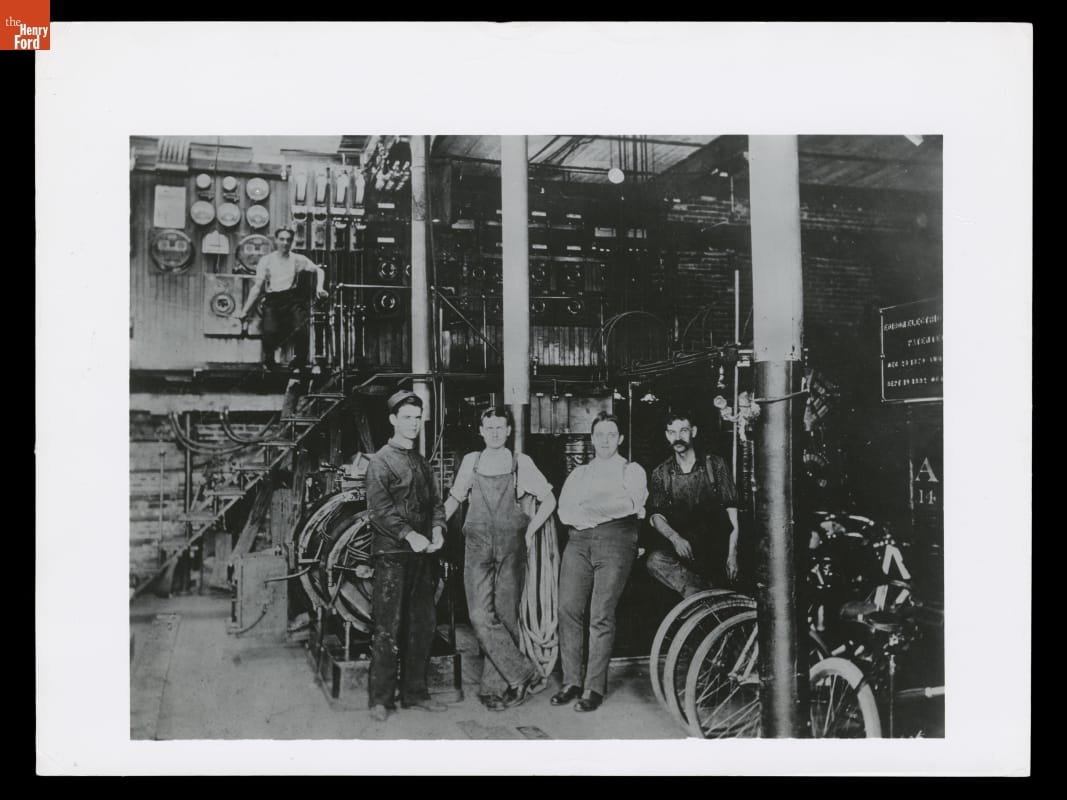
Employees at Edison Illuminating Company of Detroit, circa 1895
Henry Ford (far right) joined Edison Illuminating Company as a night engineer in September 1891. By mid-1894 he had been promoted to chief engineer. It was during his time here that Ford built his first automobile, the 1896 Quadricycle. Ford resigned from Edison Illuminating Company in August 1899 to devote himself full time to the budding automotive industry.
View Artifact1896 Ford Quadricycle Runabout, First Car Built by Henry Ford
The Quadricycle was Henry Ford's first attempt to build a gasoline-powered automobile. It utilized commonly available materials: angle iron for the frame, a leather belt and chain drive for the transmission, and a buggy seat. Ford had to devise his own ignition system. He sold his Quadricycle for $200, then used the money to build his second car.
View ArtifactDetroit Automobile Company Delivery Truck outside Factory, 1899-1900
If the name Detroit Automobile Company does not sound familiar it is because the company lasted no more than eighteen months. It was Henry Ford's first effort at building a motor vehicle and it was not successful. Here the company's first product, a delivery truck, parked in front of the factory on Cass Avenue in Detroit. Despite a glowing description in the Detroit News-Tribune, the truck was apparently not a very good vehicle and the Detroit Automobile Company went out of business in January 1901. It would take two more companies and three more years before Henry Ford would become a successful automobile manufacturer.
View ArtifactHenry Ford and Ed (Spider) Huff Driving the Ford Sweepstakes Racer at Grosse Pointe, Michigan, October 10, 1901
Henry Ford and Ed "Spider" Huff driving Sweepstakes, Ford's first race car, to victory over Alexander Winton at the Grosse Pointe Race Track, a horse racing track, Grosse Pointe, Michigan, October 10th, 1901. After several other cars dropped out, the race pitted the then unknown Ford against Alexander Winton who, in 1901, was one of the most well-known and successful automobile manufacturer in the country. After Winton's car developed mechanical problems, Henry Ford, with Ed Huff crouching on the side board manually lubricating and fueling the car, won the race. Ford used the notoriety from the race to gain financial investors who helped fund his second car company, the Henry Ford Company, in 1902.
View Artifact1901 Ford "Sweepstakes" Race Car
This is Henry Ford's first race car. After his first auto company failed, Ford turned to racing to restore his reputation. He raced "Sweepstakes" against Alexander Winton on October 10, 1901, and, to everyone's surprise, the novice Ford beat the established Winton. The victory and resulting publicity encouraged financiers to back Ford's second firm.
View ArtifactHenry Ford and Ford Motor Company Executives at Henry Ford Museum, 1933
One of the most important decisions that Henry Ford made early in his career was to identify talented individuals who could bring his vision for a universal car for the masses to reality. Each man pictured here was, in one way or another, directly responsible for Ford Motor Company's success, and failures, in the years leading up to World War II. P. E. Martin and Charles Sorensen were the hard-driving production and manufacturing heads that ensured Ford's plants operated at peak levels and achieved record production levels in the mid-1920s. B. J. Craig, as treasurer and secretary, was responsible for the hundreds of millions of dollars that funded all of Ford's operations. A. M. Wibel managed purchasing of everything from cotter pins and lubrication oil to coal mines and freighters at Ford's River Rouge plant, Highland Park, and ultimately for Ford operations worldwide. Raymond Dahlinger managed hundreds of thousands of acres of farmland for Henry Ford and Ford Motor Company. Left to right: P.E. (Peter Edmund) Martin, Vice President in charge of Manufacturing; B.J. (Burt John) Craig, Treasurer and Secretary; Charles E. Sorensen, Production Superintendent; Henry Ford; Raymond Dahlinger, Manager of Ford Farms; Edsel Ford; A.M. (Albert M.) Wibel, Vice President of Purchasing.
View Artifact1914 Ford Model T Touring Car, Given to John Burroughs by Henry Ford
This 1914 touring car is one of several Model T automobiles given to naturalist John Burroughs by his friend Henry Ford. Ford Motor Company experienced a milestone year in 1914. The automaker fully implemented the moving assembly line at its Highland Park plant, and it introduced the Five Dollar Day profit-sharing plan for its employees.
View ArtifactHenry Ford with the First Ford V-8 Engine, March 26, 1932
When the V-8 went into production in 1932, Henry Ford and Ford Motor Company once again revolutionized the automobile market. Although the Ford V-8 was not the first production V-8 in automotive history, it was the first compact (because of the V alignment of the eight cylinders) and powerful engine that was available to the general auto buying audience. Henry Ford personally oversaw the design and development of the V-8 with a selected team of engineers located not in the state-of-the-art Ford Engineering Laboratory, but in Thomas Edison's Fort Myers Laboratory recently relocated from Florida to Henry Ford's Greenfield Village. It is believed that Henry Ford used the building, tools, and machines that Thomas Edison had used to help inspire the engineers and designers.
View ArtifactWestinghouse Portable Steam Engine No. 345, Used by Henry Ford
Portable steam engines like this powered grain threshers, sawmills, or corn shellers. Horses pulled them from farm to farm. In 1882, 19-year-old Henry Ford was able to make this engine run well when an older man could not; his first accomplishment in the adult world. Thirty years later Ford tracked down the engine, bought it, and returned it to operating condition.
View Artifact

