
Online Auto Racing Collection
Share
share
From the Curators: Racing in America
THF90167
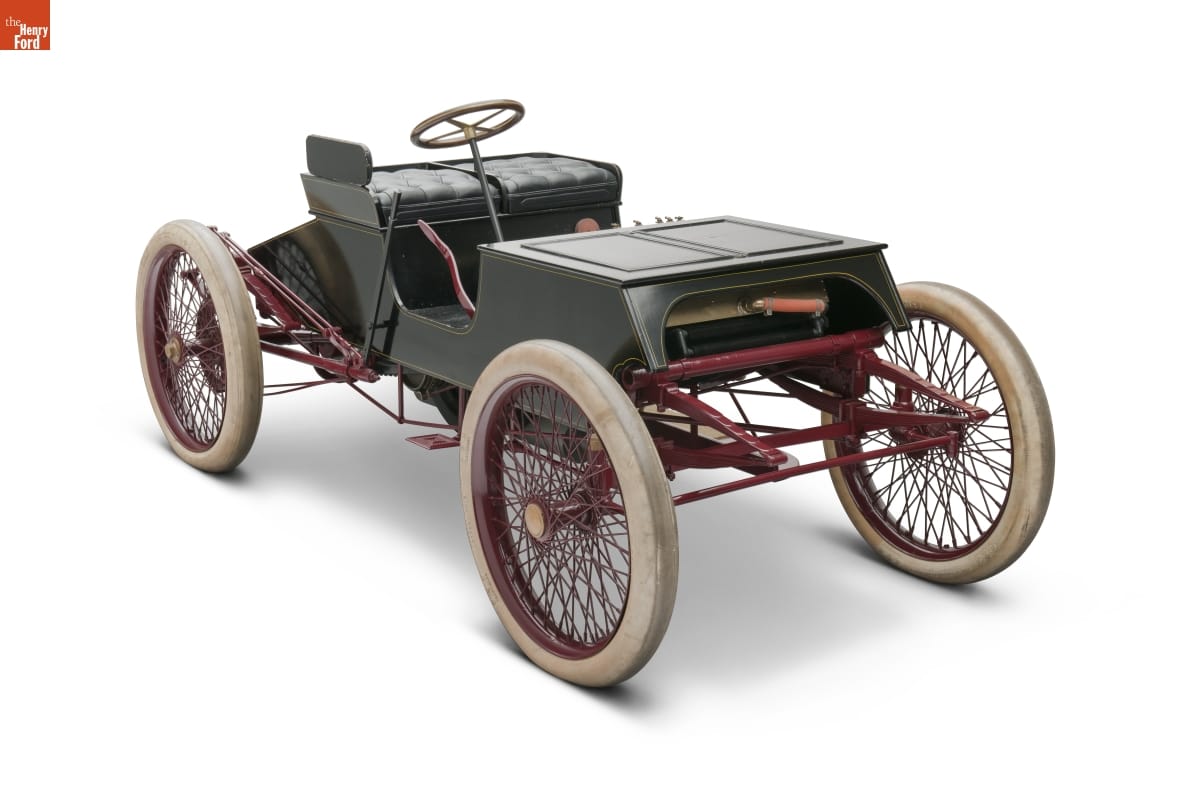
1901 Ford "Sweepstakes" Race Car
This is Henry Ford's first race car. After his first auto company failed, Ford turned to racing to restore his reputation. He raced "Sweepstakes" against Alexander Winton on October 10, 1901, and, to everyone's surprise, the novice Ford beat the established Winton. The victory and resulting publicity encouraged financiers to back Ford's second firm.
View Artifact1965 Lotus-Ford Race Car
Scotsman Jim Clark won the Indianapolis 500 with this rear-engine car in 1965. After his victory, a traditional front-engine car never won that race again. The Lotus-Ford combined a European Formula One-inspired lightweight chassis with a big Ford V-8 engine. The Lotus-Ford's success effectively killed the traditional Indy roadster and established a new design for American race cars.
View Artifact1965 Goldenrod Land Speed Race Car
On November 12, 1965, Goldenrod streaked across Utah's Bonneville Salt Flats at 409.277 miles per hour, setting a new land speed record for wheel-driven cars. Builders Bob and Bill Summers powered Goldenrod with four massive Chrysler V-8 engines. Although other car builders copied its sleek design, Goldenrod held the record until 1991.
View Artifact1972 McLaren M16A Race Car, Driven by David "Salt" Walther
This hulk is what remains from one of the worst crashes in Indianapolis 500 history. On the first lap of the 1973 race, David "Salt" Walther's car crashed into the outside wall, exploded, and overturned. Though badly burned, Walther survived. After a lengthy rehabilitation, he returned to compete at Indy the following year.
View Artifact1987 Ford Thunderbird Stock Car, Raced by Bill Elliott
Bill Elliott set NASCAR's all-time speed record with this car when he qualified for the 1987 Winston 500 at Talladega at 212.809 miles per hour. By the 1980s, "stock cars" only looked stock. Underneath this Thunderbird sheet metal is a purpose-built steel tube frame, racing suspension and brakes, and a racing engine that no Ford dealer ever sold.
View Artifact1933 Willys Drag Racer
When machinist George Montgomery started racing in 1953, all drag racers were amateurs with "real jobs" supporting their hobby. This car helped change all that. Montgomery bought an old Willys in 1958 and built a dragster so successful that promoters started paying him to run at drag strips nationwide. In 1966, Montgomery became one of drag racing's first full-time professional drivers.
View Artifact1960 Buck & Thompson Slingshot Dragster
Sam Buck and Bob Thompson built this car in 1960. They bought the chassis as a kit, and the 1948 Ford engine was highly modified with special cylinder heads, crank, pistons, magneto, camshaft, and fuel injectors. In this style of dragster, popular from the mid-1950s through the early 1970s, the driver sat behind the rear wheels "like a rock in a slingshot."
View Artifact1967 Ford Mark IV Race Car
Learn more about how the Mark IV fits into the story of Racing in America by reading From the Curators: Racing in America, available at http://www.thehenryford.org/education/erb/RacinginAmerica.pdf
View Artifact1906 Locomobile "Old 16" Race Car
In 1908, driver George Robertson and mechanician Glenn Ethridge took this car to victory in the Vanderbilt Cup, America's first great automobile race. It marked the first time an American-built car won a major international road-circuit race. The Locomobile competed while wearing number 16, and it's been known as "Old 16" ever since.
View Artifact1902 Ford "999" Race Car, Built by Henry Ford
Henry Ford hired a fearless bicycle racer named Barney Oldfield to drive "999." Although he had never driven a car, Oldfield learned quickly and won his first competition. He went on to become America's first nationally famous racing hero, known for his thrilling exhibition races and the trademark cigar he chewed to protect his teeth in a crash.
View Artifact1984 March 84C-Cosworth Race Car
Tom Sneva set the fastest qualifying lap at the 1984 Indianapolis 500 with this car, but a broken rear suspension forced him out early during the actual race. The car's front and rear wings and underbody ground effects represent the aerodynamic advances that increasingly shaped race cars in the 1970s -- and continue to do so today.
View Artifact1935 Miller-Ford Race Car
Harry Miller, one of America's most important racing designers, built this car for Ford Motor Company's effort at the 1935 Indianapolis 500. It has all of Miller's hallmarks -- innovation, craftsmanship, and an almost sculptural presence. All that it lacks is a victory. Miller built ten similar cars, but a hurried production schedule led to mechanical problems and none finished the race.
View Artifact1903 Packard Model F Runabout
In 1903 this car became only the second to drive across America coast-to-coast. Packard plant foreman Tom Fetch and journalist Marius C. Krarup made the trip from San Francisco to New York City in 61 days. Their journey was an enormous challenge. Roads scarcely existed west of the Mississippi, and those east of the river were often simple dirt paths.
View Artifact1939 Soap Box Derby Car
Mason Colbert placed third with this car in the 1939 All-American Soap Box Derby national championship in Akron, Ohio. The first official derby was held in 1934. Young contestants built their cars from soap boxes, orange crates, and baby carriage wheels. Over the years, designs became more elaborate and materials more sophisticated. But the "fuel" remained the same -- gravity.
View Artifact

