
Online Railroad Collection
Share
share
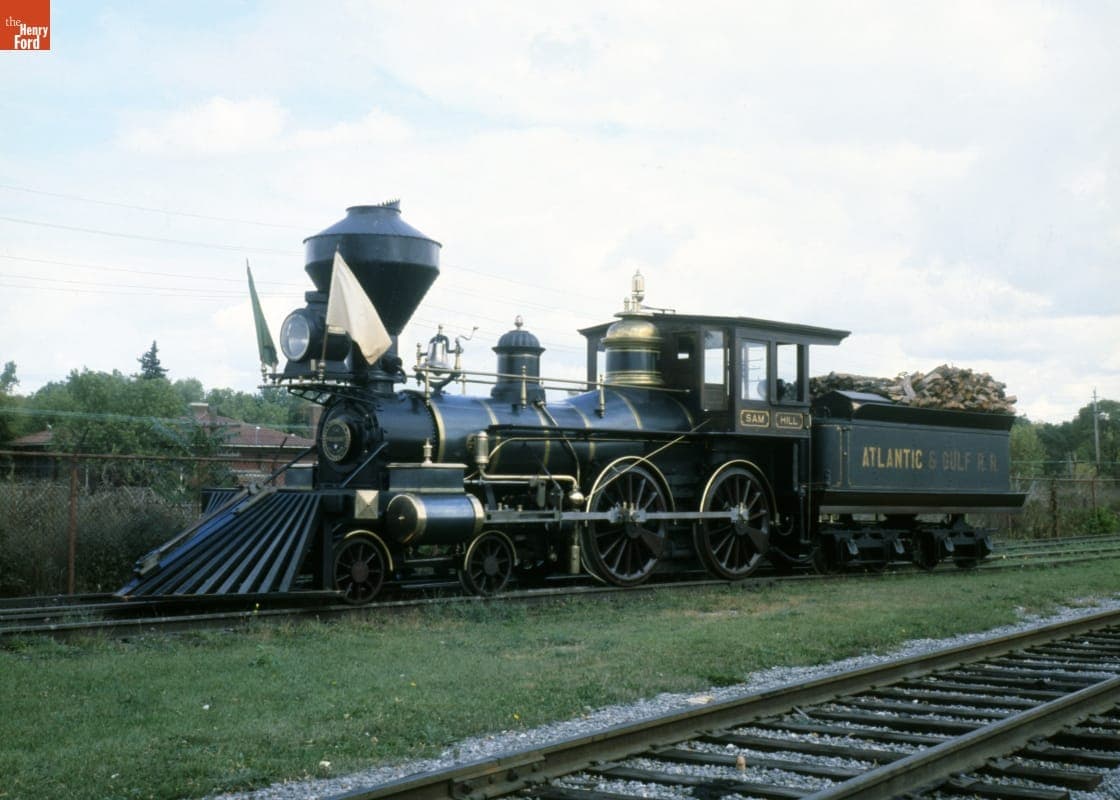
THF91565
Steam Locomotive "Sam Hill," 1858
This 1858 Rogers steam locomotive is typical of those used in the United States in the second half of the 19th century. Its flexible wheel arrangement, high power output, and light weight were well suited to the tight curves, steep grades, and hastily constructed track that characterized American railroads. This locomotive struck an agreeable balance between practicality, safety, and economy.
View ArtifactTHF176772
Bangor & Aroostook Railroad Passenger Coach Replica
This coach replicates a typical passenger car used on American railroads circa 1860. Its varnished interior surfaces resisted dirt and stains, while its mohair-covered seats stood up to heavy use. Opening windows offered ventilation in summer, and a woodstove provided heat in winter. Other amenities included a drinking water dispenser and a small restroom.
View ArtifactTHF91583
Baldwin "Consolidation" Steam Locomotive, 1909
Locomotives like this hauled heavy freight at relatively slow speeds. These brutes were based on practicality and increasing understandings of scientific principles, not aesthetics. This locomotive brought iron ore south and coal north on the Bessemer and Lake Erie Railroad, connecting Pittsburgh with Lake Erie. The B&LE played a limited but utterly crucial role in a nationally important heavy industry: steel.
View ArtifactTHF80600
Detroit & Mackinac Railway Combination Car, 1901-1905
The combination car combined the functions of a baggage car and a passenger coach. These economical railcars were ideal for distant branches or short-line operations where traffic was light. This car, built circa 1905 and used on Michigan's Detroit & Mackinac Railway, includes three compartments: a baggage area, a smoking compartment, and a seven-seat parlor.
View ArtifactTHF186258
Henry Ford's Private Railroad Car "Fair Lane," 1921
By 1920, Henry and Clara Ford found it increasingly difficult to travel with any degree of privacy. They purchased a private railcar and named it Fair Lane. The car had four private rooms, an observation lounge, a dining room, and a fully equipped kitchen. It could accommodate eight passengers. The couple made over 400 trips using Fair Lane before selling the passenger car in 1942.
View ArtifactTHF80594
Detroit Toledo & Ironton Railroad Caboose, 1925
The caboose was the conductor's office, the crew's quarters, and the observation platform from which to spot problems with the train. It could also be dangerous. "Slack action" -- sudden movement when slack ran in and out of a moving train -- could toss riders about. Computerized record keeping, trackside defect detectors, and smaller crews made the caboose obsolete by the 1980s.
View ArtifactTHF67890
Ingersoll-Rand Number 90 Diesel-Electric Locomotive, 1926
This is one of the earliest diesel-electric locomotives used on American railroads. Diesel-electrics offered many advantages over steam locomotives. They required less maintenance, were more fuel efficient, and could be operated by smaller crews. This locomotive's body houses an Ingersoll-Rand diesel engine that drives a General Electric generator, which in turn powers electric motors on the axles.
View ArtifactTHF134572
Allegheny Steam Locomotive, 1941
The Chesapeake & Ohio Railway's massive Allegheny, introduced in 1941, represents the peak of steam railroad technology. Among the largest and most powerful steam locomotives ever built, it weighed 1.2 million pounds with its tender and could generate 7,500 horsepower. Just 11 years later, C&O began pulling these giants from service. Diesel-electric locomotives proved more flexible and less expensive.
View Artifact

