
Past Lives of the Eagle Tavern
Share
share
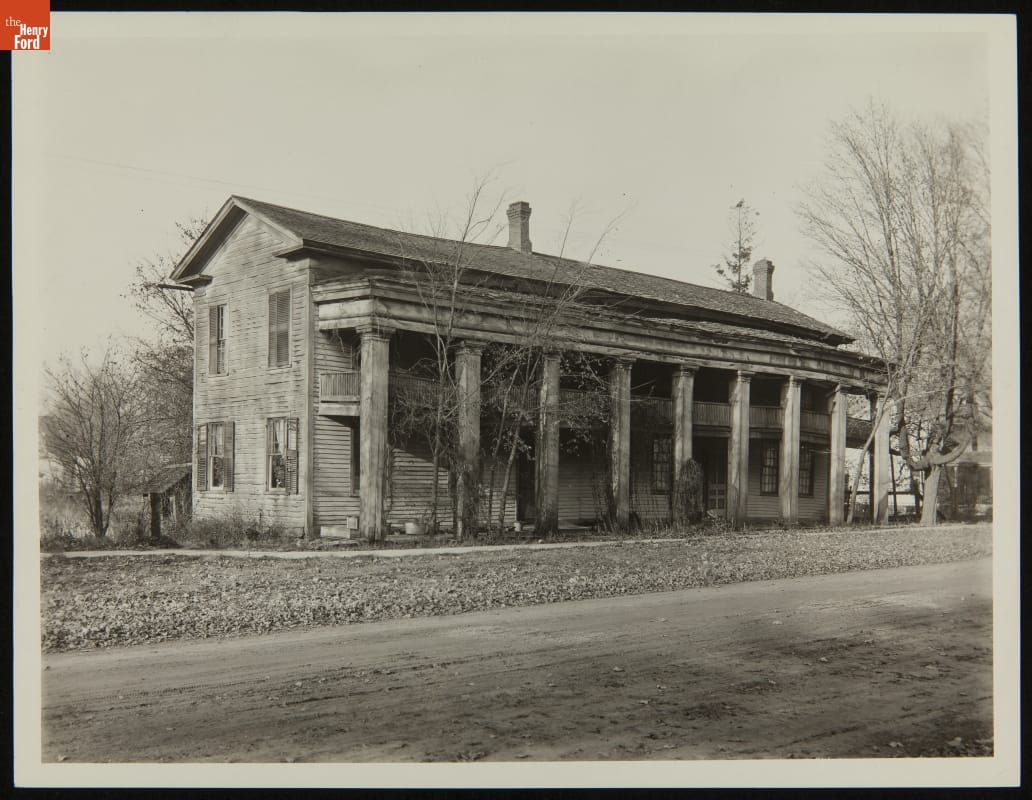
Originally constructed in the early 1830s as a stagecoach stop along the Detroit-to-Chicago road, the Eagle Tavern was the first structure Henry Ford acquired for Greenfield Village. Today, it is historically interpreted as an 1850 tavern.
THF237242
Eagle Tavern in Clinton, Michigan, February 2, 1925
This tavern, constructed 1831-2 in Clinton, Michigan, was originally a stagecoach stop on the Detroit-to-Chicago road. In 1927, Henry Ford purchased the run-down building from resident Ella Smith -- the daughter of Walter Smith, who had run the hostelry as Smith's Hotel between 1868 and 1896. Moved to Greenfield Village, the restored and renamed Clinton Inn opened in 1929.
View ArtifactOld Stage House, Clinton, Mich., November 7, 1909
This "Old Stage House," constructed 1831-2 in Clinton, Michigan, was originally a stagecoach stop on the Detroit-to-Chicago road. In 1927, Henry Ford purchased the building from resident Ella Smith -- the daughter of Walter Smith, who had run the hostelry as Smith's Hotel between 1868 and 1896. Moved to Greenfield Village, the restored and renamed Clinton Inn opened in 1929.
View ArtifactViews of Clinton, Michigan, Including Eagle Tavern, circa 1915
These scenes from Clinton, Michigan, include the tavern (upper left) that was moved, restored, and renamed Clinton Inn in Greenfield Village. Built 1831-2, it was originally a stagecoach stop on the Detroit-to-Chicago road. In 1927, Henry Ford purchased the building from resident Ella Smith -- daughter of Walter Smith, who had run the hostelry as Smith's Hotel between 1868 and 1896.
View ArtifactEagle Tavern in Clinton, Michigan, circa 1925
This tavern, constructed 1831-2 in Clinton, Michigan, was originally a stagecoach stop on the Detroit-to-Chicago road. In 1927, Henry Ford purchased the run-down building from resident Ella Smith -- the daughter of Walter Smith, who had run the hostelry as Smith's Hotel between 1868 and 1896. Moved to Greenfield Village, the restored and renamed Clinton Inn opened in 1929.
View ArtifactEagle Tavern at its Original Site, Clinton, Michigan, circa 1920
This tavern, constructed 1831-2 in Clinton, Michigan, was originally a stagecoach stop on the Detroit-to-Chicago road. In 1927, Henry Ford purchased the run-down building from resident Ella Smith -- the daughter of Walter Smith, who had run the hostelry as Smith's Hotel between 1868 and 1896. Moved to Greenfield Village, the restored and renamed Clinton Inn opened in 1929.
View ArtifactEagle Tavern in Clinton, Michigan, 1912
This "Old Stage House," constructed 1831-2 in Clinton, Michigan, was originally a stagecoach stop on the Detroit-to-Chicago road. In 1927, Henry Ford purchased the building from resident Ella Smith -- the daughter of Walter Smith, who had run the hostelry as Smith's Hotel between 1868 and 1896. Moved to Greenfield Village, the restored and renamed Clinton Inn opened in 1929.
View ArtifactLuncheon Meeting at Eagle Tavern, Greenfield Village, circa 1931
When Henry Ford restored the Clinton Inn in 1929, he installed a modern kitchen and added a large dining room to serve students of the Greenfield Village schools. Here, members of Ford's staff have lunch in the Clinton Inn dining room. Henry Ford relied especially on this group of employees to help oversee the schools and museum and village operations.
View ArtifactVocational Education Teachers Visiting Eagle Tavern in Greenfield Village, April 19, 1954
In 1929, Henry Ford restored the Clinton Inn--a nineteenth-century stagecoach stop--with a modern kitchen and dining room to serve students of the Greenfield Village schools. The building was redecorated and opened for public meal service in 1951. Visitors could enjoy a cafeteria-style lunch in the dining room and view period-room exhibits in the formal parlor, barroom, and sitting room.
View ArtifactHenry Ford with a Group in Eagle Tavern in Greenfield Village, July 30, 1942
Henry Ford celebrated his 79th birthday with a favorite activity -- a visit to Greenfield Village. He was joined by his wife, Clara, son, Edsel, and several Ford Motor Company officials. The group enjoyed a meal at Clinton Inn (now Eagle Tavern) and attended a performance at Martha-Mary Chapel, where students of the Edison Institute schools presented Ford with a basket containing 79 yellow roses.
View ArtifactClara and Henry Ford with Guests at a Costume Party, Eagle Tavern, Greenfield Village, circa 1937
Having attended many of Henry Ford's old-fashioned dancing parties, some of Ford's guests decided to give a special dinner party in honor of Henry and Clara Ford. Everyone dressed in historical costumes and enjoyed dinner at the Clinton Inn (now Eagle Tavern) in Greenfield Village, where they posed for this photograph. Then they proceeded to nearby Lovett Hall for dancing.
View ArtifactColonial Cooking Class Held at Eagle Tavern in Greenfield Village, 1978
Since its opening in 1929, the restored Clinton Inn (now Eagle Tavern) in Greenfield Village featured several period-room exhibits -- including a "colonial kitchen" with a large open fireplace. During the 1970s, adult education classes were held here, taught by instructor Margaret Chalmers. Chalmers, a native of Glasgow, Scotland, later published a cookbook of recipes used in these classes.
View ArtifactEagle Tavern at Its Original Site, Clinton, Michigan, circa 1905
Ella Smith's family owned the Clinton, Michigan, Eagle Tavern--which they renamed Smith's Hotel--from 1868 to 1927. The hotel closed in the 1890s. When Ella posed for this photo about 1910, she still lived in the tavern, giving piano lessons and taking in boarders to earn a living. Henry Ford moved the building to Greenfield Village in the late 1920s.
View ArtifactEagle Tavern (Then Known as Smith's Hotel) at Its Original Site, Clinton, Michigan, circa 1890
Walter and Mary Smith (shown here about 1890 with their daughter Ella) operated the Clinton, Michigan, Eagle Tavern -- renamed Smith's Hotel -- from the late 1860s into the 1890s. Though this 1830s tavern's days as a bustling stagecoach stop were long past, the Smiths offered hospitality to the locals and to the fewer travelers who still passed through the rural village.
View ArtifactHorse-Drawn Carriages outside Eagle Tavern, Greenfield Village, 1929-1950
Early visitors to Greenfield Village rode horse-drawn carriages from the gatehouse to a welcoming center at the Clinton Inn (now Eagle Tavern). But by 1936, growing crowds forced the discontinuation of this service. Horse-drawn vehicles continued to rumble along the village streets empty or, on occasion, carrying special visitors.
View ArtifactLord Mountbatten with Group, Dining at Eagle Tavern in Greenfield Village, April 8, 1972
Lord Mountbatten was great-grandson of Queen Victoria, a British World War II hero and viceroy of India in 1947 during that country's partitioning and independence. In April 1972, he toured Henry Ford Museum and Greenfield Village, accompanied by Henry Ford II and Edison Institute's president, Donald Shelley. The group hit all the institute's highlights, including a dinner at Eagle Tavern.
View ArtifactVisitors Lunching at Eagle Tavern, Greenfield Village, 1958
In 1929, Henry Ford restored the Clinton Inn--a nineteenth-century stagecoach stop--with a modern kitchen and dining room to serve students of the Greenfield Village schools. The building was redecorated and opened for public meal service in 1951. Visitors could enjoy a cafeteria-style lunch in the dining room and view period-room exhibits in the formal parlor, barroom, and sitting room.
View Artifact"Bill of Fare, Eagle Tavern, Greenfield Village," 1952
In 1929, Henry Ford restored the Clinton Inn--a nineteenth-century stagecoach stop--with a modern kitchen and dining room to serve students of the Greenfield Village schools. The building was redecorated and opened for public meal service in 1951. Visitors could enjoy a cafeteria-style lunch in the dining room and view period-room exhibits in the formal parlor, barroom, and sitting room.
View ArtifactGeneral Store and Eagle Tavern in Greenfield Village, August 1929
Henry Ford already owned four historic buildings destined for Greenfield Village by the time construction commenced in October 1927. Two of these--the Waterford General Store and the Clinton Inn--were re-erected around what would become the village green. This photograph shows the buildings nearly ready for the official dedication of Greenfield Village on October 21, 1929.
View Artifact"Colonial Fireplace Cooking & Early American Recipes," 1979
Since its opening in 1929, the restored Clinton Inn (now Eagle Tavern) in Greenfield Village featured several period-room exhibits -- including a "colonial kitchen" with a large open fireplace. During the 1970s, adult education classes were held here, taught by instructor Margaret Chalmers. Chalmers, a native of Glasgow, Scotland, later published this cookbook of recipes used in these classes.
View Artifact

