
School Buses
Share
share
As rural schools consolidated and good roads spread, motorized school buses became a part of student life. The bus business thrived through much of the 20th century, first due to consolidation and later when baby boomers headed off to class. Automakers, truck manufacturers, and specialized builders produced a range of buses that promised safety for students and economy for schools.
THF291171
Mack Model AB 2-Ton Motor Bus Operated by Santa Maria High School, Santa Maria, California, 1911-1916
Founded in Brooklyn, New York, in 1900, Mack Brothers Company relocated to Allentown, Pennsylvania, in 1905 and adopted the name Mack Trucks in 1922. Sightseeing buses were the company's first products, and school buses were a natural extension of that business. Mack built more than 22,000 school, transit, and intercity buses before ending bus production in 1960.
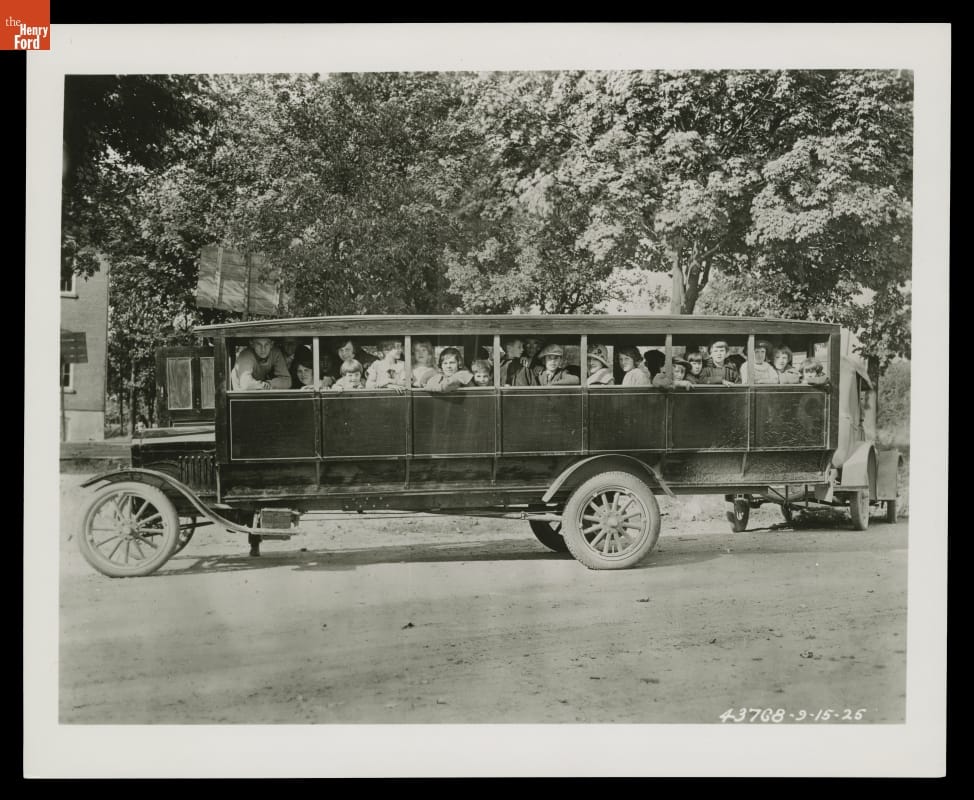
View Artifact1924 Ford Model T Bus Transporting School Children, September 1925
Ford Motor Company's Model TT truck chassis -- made from 1917 until 1927 -- could be mounted with a multitude of body styles. An unknown maker built a passenger school bus body for this 1924 TT. Other Ford trucks carried ice or coal, delivered everything from flowers to furniture, and even fought fires.
View ArtifactWayne Works Catalog, "The Wayne School Car, Guaranteed School Transportation," circa 1922
Wayne Works of Richmond, Indiana, promoted its school bus bodies in this circa 1922 catalog. Wayne marketed its versatile "Combination Transportation" bodies to rural school districts where road quality varied with the weather. These bodies could be mounted on motorized truck chassis when roads were dry or remounted on horse-drawn running gear when mud or snow required it.
View Artifact1927 Blue Bird School Bus
This 1927 Blue Bird is the oldest surviving school bus in America. Albert Luce, Sr., built his first bus in 1925 by mounting a purchased wood body to a Ford truck frame. The body could not withstand the Georgia roads. Luce, convinced he could make a better bus, applied a steel framework under the wood body. His success led him to make school buses full time.
View ArtifactAnnouncing the Ford School Bus for the Safe and Economical Transportation of Children, August 1931
Ford added school buses to its product line in 1931. The Model AA school bus featured a steel body on a 157-inch wheelbase chassis. It accommodated 32 students -- 20 on two seats running lengthwise along the sides, and 12 on six crosswise seats down the center. Safety glass was standard for all windows, and three doors eased loading and unloading.
View Artifact1932 Ford School Bus Used in the Fordson School District, Dearborn, Michigan, December 1931
Ford Motor Company expanded its commercial lines to combat sagging Depression-era sales, offering an array of body types for its truck chassis -- from police patrols and ambulances to garbage trucks and school buses. Here, students of the Fordson School District -- in what is now Dearborn, Michigan -- board a 1932 Ford school bus.
View Artifact"Time for Our New Superior School Bus," 1941
Superior Coach Company's origins were in the Garford Motor Truck Company founded in Elyria, Ohio, in 1909. The firm adopted the "Superior" name when it relocated to Lima, Ohio, in 1925. Superior specialized in hearses and school buses. The company scaled back its bus production in 1980 after baby boomers aged out of school and hurt the business.
View ArtifactLet the Man Behind the Wheel Tell You About Oneida School Bus Bodies, 1955
Established in Canastota, New York, in 1946, Oneida Products Corporation built school bus bodies at a time when the post-World War II baby boom made it a lucrative business. Oneida's school bus operations were sold to Marmon-Harrington Company in 1960 and subsequently moved to Indianapolis, Indiana.
View ArtifactExcel, the Standard of Styling and Safety in School Bus Transportation, 1958
Excel Body Corporation built school buses in Durant, Oklahoma, from the 1940s into the 1960s. In this 1958 brochure, the company emphasized safety and styling -- the latter a quality not often associated with school buses. Wraparound front and rear windshields gave Excel's buses a slightly streamlined appearance.
View ArtifactGMC Trucks, School Bus Chassis, Gasoline and Diesel Powered, 1966
In 1911, General Motors established its GMC Division in Pontiac, Michigan. In 1943, GMC acquired Yellow Coach, a manufacturer of buses and taxis. For decades GMC built urban transit buses, intercity motor coaches, and school buses. Growing competition in the 1970s and 1980s pushed the company out of the market. GMC built its last buses in 1987.
View ArtifactIf a Mother Could Design a School Bus, This Would Be It, 1990
Not surprisingly, safety is a long-running theme in school bus advertising. Navistar's International brand promoted the safety of its 3000-series buses in this 1990 ad. The buses were described as reliable, maneuverable, up-to-date, and efficient -- qualities, the ad suggested, that would appeal to any mother.
View Artifact

