
The Lincolns in the White House
Share
share
The Lincolns resided in the White House for a little over four years – the most tumultuous in the nation’s history. Not only was the nation devastated by the Civil War – the White House itself was decoratively transformed during the Lincoln years.
THF95148
Print, Abraham Lincoln with the Emancipation Proclamation, 1863
Following the American Civil War, this print commemorated a crucial event and became popular for home and classroom display across the country. President Lincoln is shown in this hand colored lithograph with a draft of the Emancipation Proclamation. Publicly announced by Lincoln in September 1862 to become law on January 1, 1863, it was the essential first legal step in eliminating slavery.
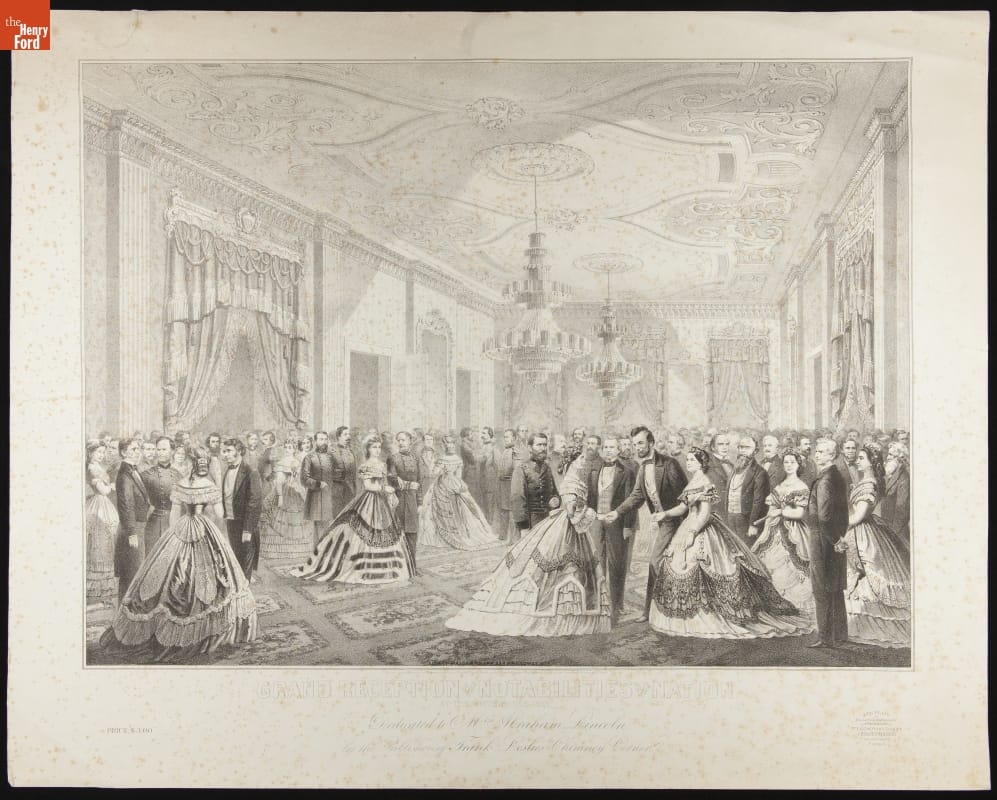
View ArtifactLithograph, "Grand Reception of the Notabilities of the Nation," 1865
This reception was held in the East Room of the White House just after President Lincoln's second inauguration on March 4, 1865. The President and the first lady are prominently placed in the foreground receiving General and Mrs. Grant in a room filled with notable figures in the U. S. Government and Army. The scene is one of the last major public events before the President's Assassination on April 14, 1865.
View ArtifactAbraham Lincoln Presidential Dinner Service, 1861
First Lady Mary Todd Lincoln made great efforts to provide fashionable and impressive dining experiences at the White House. She bought huge quantities of specially designed Haviland china in 1861, and added to the service when Lincoln was re-elected. The china blanks were made in France and decorated in New York. Later, the china was determined to be outdated and was sold.
View ArtifactPrint, Abraham Lincoln, 1861
Loosely based on a photograph, this beardless portrait of Abraham Lincoln was first issued as a campaign print during the Republican convention in 1860. In the campaign piece, the words "Republican candidate for" were placed between the words reading "Abraham Lincoln" and "Sixteenth President of the United States." After the election the image was reused for this piece.
View ArtifactEngraving, "Lincoln and His Family," 1866
Produced as a memorial in 1866, this image presents the Lincolns around a center table in an idealized White House. Older son Robert stands behind the table while the youngest, Tad sits at his father's feet. On the wall is a portrait of William, who died of Typhoid in 1862. A bust of George Washington presides over the scene, making a visual connection between the two great presidents.
View ArtifactEngraving, "The First Reading of the Emancipation Proclamation Before the Cabinet" 1866
Following the American Civil War, this engraving commemorated a crucial event and became popular for classroom display across the country. On July 22, 1862, President Abraham Lincoln first read the Emancipation Proclamation to his cabinet officers. Publicly announced by Lincoln in September 1862 to become law on January 1, 1863, it was the essential first legal step in eliminating slavery.
View ArtifactLithograph "Mrs. Lincoln," circa 1862
At the time this lithograph was made, Mary Lincoln faced many difficulties generated by political divisions within the nation. She also faced difficulties balancing her White House social responsibilities with rivalries and intrigues circulating during the Civil War. Mary worked hard as First Lady, including redecorating the public and private rooms in the White House as well as the purchase of new china.
View Artifact

