
Thinking on Paper: Notebooks, Sketches, and Jot Books
| Written by |
|---|
Rachel Yerke-Osgood is an associate curator at The Henry Ford.
Share
share
Jotting, doodling, and sketching serves many purposes. These processes can help us organize our thoughts, convey the inner workings of our brain, or respond to the world around us. Relaxed or formal, rushed or intentional, sketches and jottings help reveal our minds.
THF157301
Henry Ford's Jot Book, 1920-1947
Henry Ford always carried a small notebook to jot down important pieces of information or simple reminders of things to remember. The over 50 small jot books give a sense of a busy man trying to capture information on the fly. The contents vary from questions to ask Thomas Edison to names and addresses to grocery lists.
View ArtifactAutomotive Design Sketch, 1959
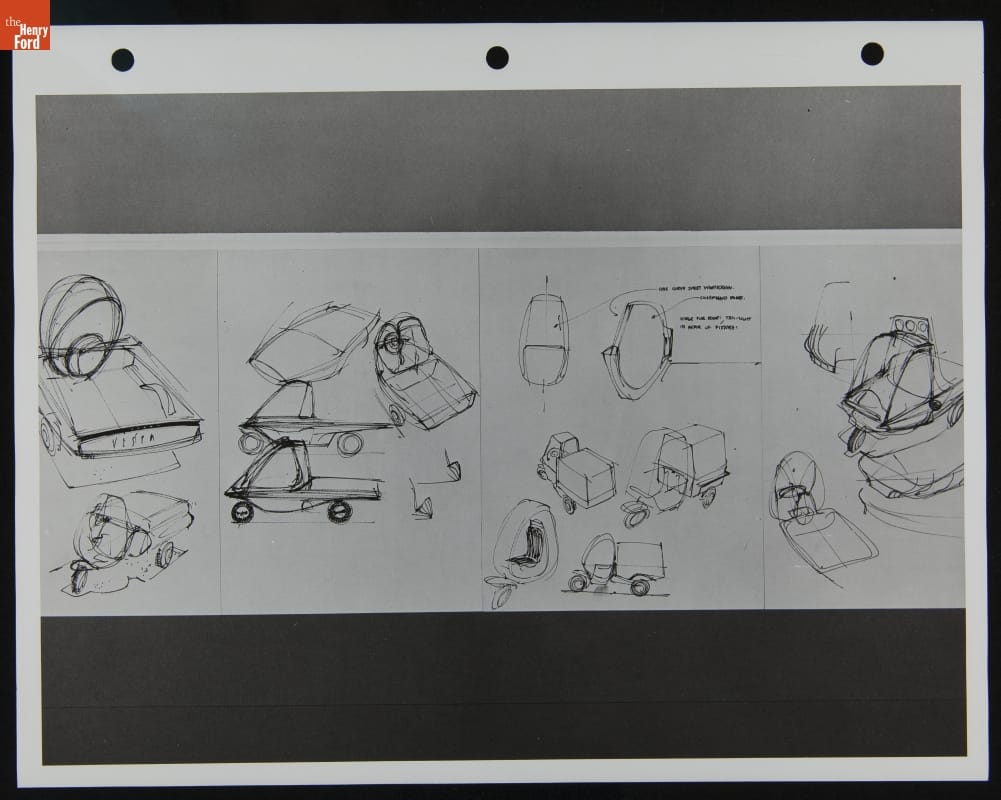
Syd Mead combined his interests in automobiles and science fiction into an influential career in industrial design. In these early sketches, you can see that even amidst the quick, roughly drawn lines, there are particularly sharp details. These drawings capture the work of a mind both creative and precise.
View ArtifactSketchbook, Knit Seating Designs by Bill Stumpf, 1970
Sketches often serve as an early iteration of a future product design. In this sketchbook, Bill Stumpf — known for his study of ergonomic seating — brainstorms a possible future chair design. The mesh-like knit seen in the first drawing is reminiscent of the material that would be used in the Aeron chair, over twenty years later.
View Artifact"Detroit Industry" Fresco Cycle Sketches on Wall, 1932
While muralists may not always use paper, they still create sketches of their work. In 1932, the Detroit Institute of Arts commissioned Mexican artist Diego Rivera to paint murals depicting the city's industrial activities. Rivera spent eight months creating 27 frescoes in the institute's interior courtyard. This photo shows his early sketch as he plotted out his design.
View ArtifactTattoo Sketch, 1915-1950
Tattoo “flash” designs are pre-drawn images that customers can pick from. Artists create their own sketches, rather than responding to client requests. In the early 1900s, "Professor" Waters apprenticed as a tattoo artist in carnivals and New York's Bowery District. He ran a successful supply shop in Detroit (1918-1939), patenting the standard "two-coil" tattoo machine in 1929. Designs from his flash sheets continue to inspire tattooists today.
View ArtifactSketchbook with Notes and Artwork by Lillian F. Schwartz
Lillian Schwartz was a pioneer of computer-generated art. From 1969-2002, she was a "resident visitor" at Bell Laboratories, producing groundbreaking films, videos, and multimedia works. This sketchbook of hers contains a little bit of everything – artwork that she created, handwritten notes, and doodles in the margin. The sketchbook reflects Lillian’s ability to create connections between science, art, and technology.
View ArtifactSketches and Designs of an Orange, 1959
While some sketches are inspired by what’s inside the artist’s mind, others are drawn from the world around them. This drawing from Syd Mead shows various views of an orange and its segments.
View Artifact"Man and Cart" by Lillian F. Schwartz, 1949
This sketch from Lillian Schwartz is at first glance a quick study of a man and his cart. But looking to the right, we see other figures penciled in – a man with his chin resting on his hand, and the profile of what appears to be a young child. This compilation of various images indicates that they were likely done for fun or practice, rather than attempts at generating a final, composed piece of art.
View ArtifactLewis Miller Sketchbook of Watercolor Drawings of Central Park in New York, with Handwritten Notes, 1864
Lewis Miller is known today as a Pennsylvania folk artist. A carpenter by trade, Miller is noted for his many journals, illustrated with watercolors of historical and everyday events. He traveled widely in Europe and America. This 54-page album documents the early features and structures of New York City's Central Park--the greatest landscape project in 19th-century America.
View ArtifactSketchbook of Robert Propst, 1950-1985
Robert Propst is best known for being the inventor of the Action Office system; however, he also had a background in graphic design and sculpture. He had a curious mind, and was always interested in inventing better systems. His curiosity, creative, and artistic training are evident in this sketchbook, which includes several studies done from the work of other artists.
View ArtifactFrom Sketch to Sky: How Leonardo da Vinci Thought Like an Inventor
Leonardo di ser Piero da Vinci was heavily reliant on his notebooks, now called the codices, where he sketched, wrote, and diagramed everything from his shopping lists to early drafts of his paintings; they serve as a gateway into his creative and innovative process. His notebooks were an outlet for his thoughts on engineering, and his observations about mathematics and physics led him to sketch conceptual devices.
View Article

