
Transportation Networks
Share
share
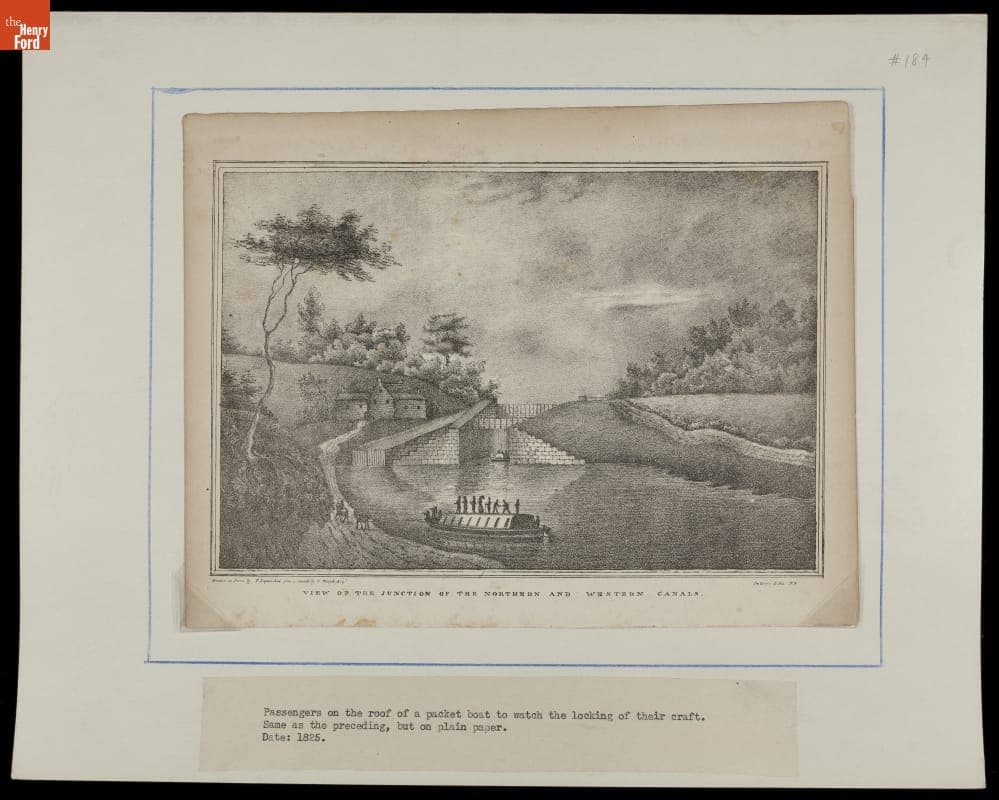
THF203983
"View of the Junction of the Northern and Western Canals," 1825
Canals opened new lands to settlement and commerce in the first half of the 19th century. New York's Erie Canal, completed in 1825, connected Albany with Buffalo. It also joined with other canals to make more areas of the state accessible. This print shows the junction of the "Northern" (Champlain) and the "Western" (Erie) canals.
View ArtifactTHF204241
Wood Engraving, "View of the Public Landing at Louisville, Kentucky," 1850-1855
By the 1850s, Louisville, Kentucky, was the nation's tenth largest city and the largest Ohio River port between Pittsburgh and St. Louis. Manually operated flatboats and steam-powered riverboats carried freight and passengers up and down the river. Louisville was also the largest slave trading center in the country, with between 2,500 and 4,000 enslaved people passing through each year.
View ArtifactTHF104062
Harbor Freeway in Los Angeles, California, 1956
Few American cities embraced the automobile like Los Angeles. The southern California metropolis opened the first of its many limited-access freeways in 1940. Work on the Harbor Freeway, seen here, began in the early 1950s. Now designated Interstate 110, this freeway connects the downtown area with the Port of Los Angeles to the south, and with Pasadena to the northeast.
View ArtifactTHF119028
Taking Mount Washington Railway Trains, Base Station, White Mountains, New Hampshire, circa 1910
Passengers scurry to board trains to take them to the top of Mount Washington in New Hampshire's White Mountains in this circa 1910 photograph. Mount Washington is the highest peak in New England and a favorite tourist spot. Trains still carry visitors to the top of the 6,288-foot summit.
View ArtifactTHF76860
Wood Engraving, "The Centennial--The Evening Rush for the Cars," 1876
Philadelphia's Centennial Exposition of 1876, commemorating the 100th anniversary of America's independence, attracted some ten million patrons. This illustration from Harper's Weekly gives some idea of the overwhelming crowds that attended this and subsequent world's fairs and expositions. Huge crowds look for spots on too-few streetcars; the exhibition buildings they are leaving can be seen in the background.
View Artifact

