


RadWagon 5 Joins the Bicycle Collection
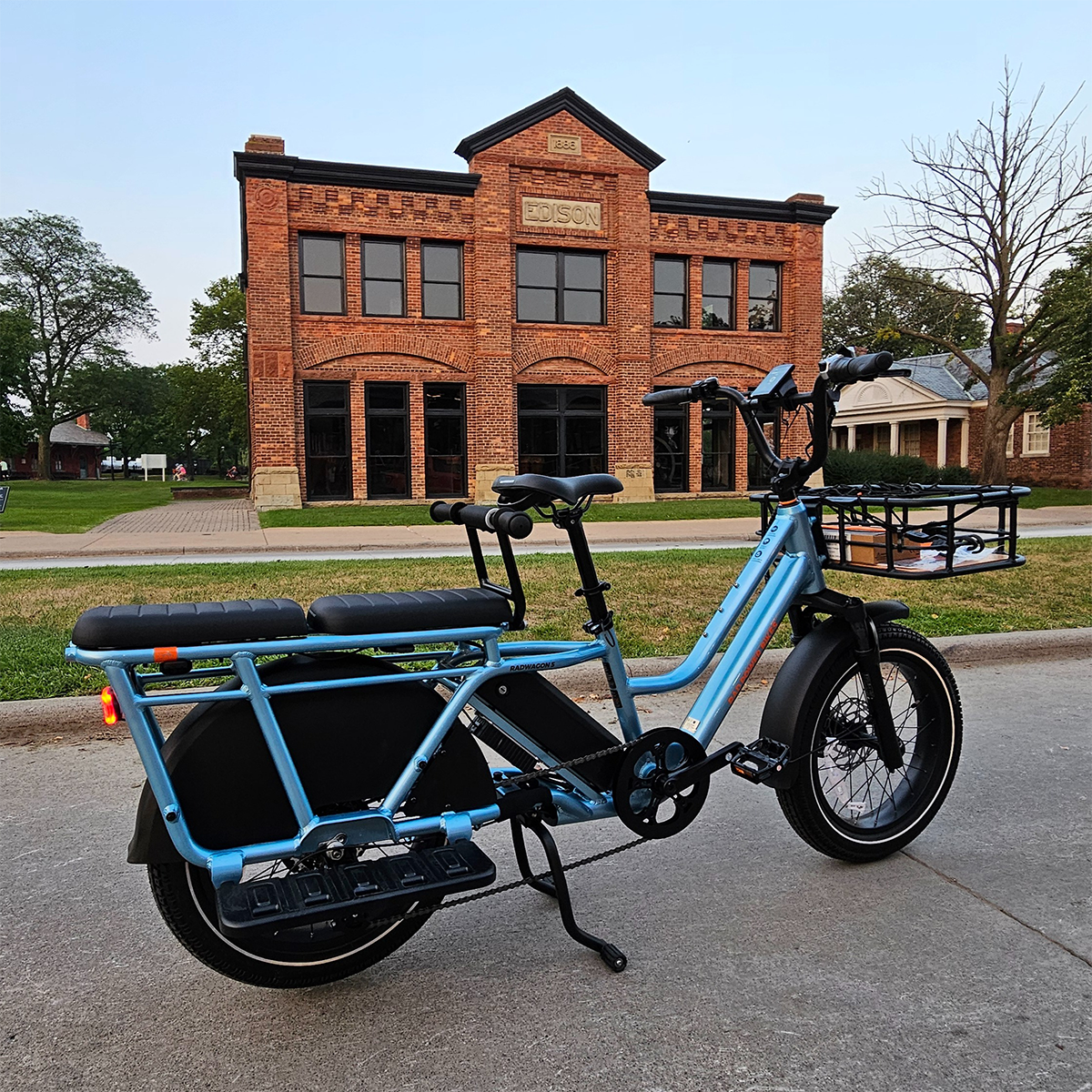
The RadWagon 5 electric bicycle with an appropriate backdrop, Edison Illuminating Company’s Station A. / Image by Staff of The Henry Ford
Recent visitors to Henry Ford Museum of American Innovation know that bikes are prominent right now. The Bicycles: Powering Possibilities exhibit in the Collections Gallery features seventeen two-wheelers covering two centuries of bicycle history and technology, and it remains on view through February 15, 2026. Our bicycle collection continues to grow, and The Henry Ford acquired a new addition this fall: a RadWagon 5 electric cargo bicycle. It’s the first regular-production e-bike in the museum’s collection. (Our 2015 Ford Mode:Flex is also an e-bike, but it’s strictly a prototype.)
E-bikes, with electric motors to assist with propulsion, represent the most significant shift in the bicycle industry in years. Depending on the design, an e-bike’s motor might either add to the rider’s own muscle power by providing a boost when needed, or it might eliminate the need to pedal altogether. Modern e-bikes are capable of speeds up to 28 miles per hour, and their batteries are good for anywhere from 30 to 60 miles between charges.
While motorized bikes seem like a recent idea, patents for electric bicycles date back at least to the 1890s. But high cost and high weight, combined with low battery range, discouraged serious interest in e-bikes for a century. There was a more fundamental issue too: a widespread and long-held belief among riders and manufacturers that motors violated the very spirit of the human-powered bicycle. In the 1990s, advancing technologies and shifting attitudes began to make e-bikes practical. Ironically, former Ford and Chrysler executive (and consummate “car guy”) Lee Iacocca was a major promoter. In 1997, he founded EV Global Motors and sold about 25,000 e-bikes to consumers.
E-bikes gained a following in Asia and Europe, where bicycling itself is more common, but growth in the United States lagged due to a car-centric culture, a lack of bike lanes and charging infrastructure, and a general perception of cycling as a recreational or fitness activity rather than a regular mode of transportation. Then came COVID-19. Americans got more interested in outdoor activities, and they looked for socially distanced alternatives to carpools and public transit. Stimulated by these unique circumstances, U.S. e-bike sales topped one million units for the first time in 2022 — a significant milestone.
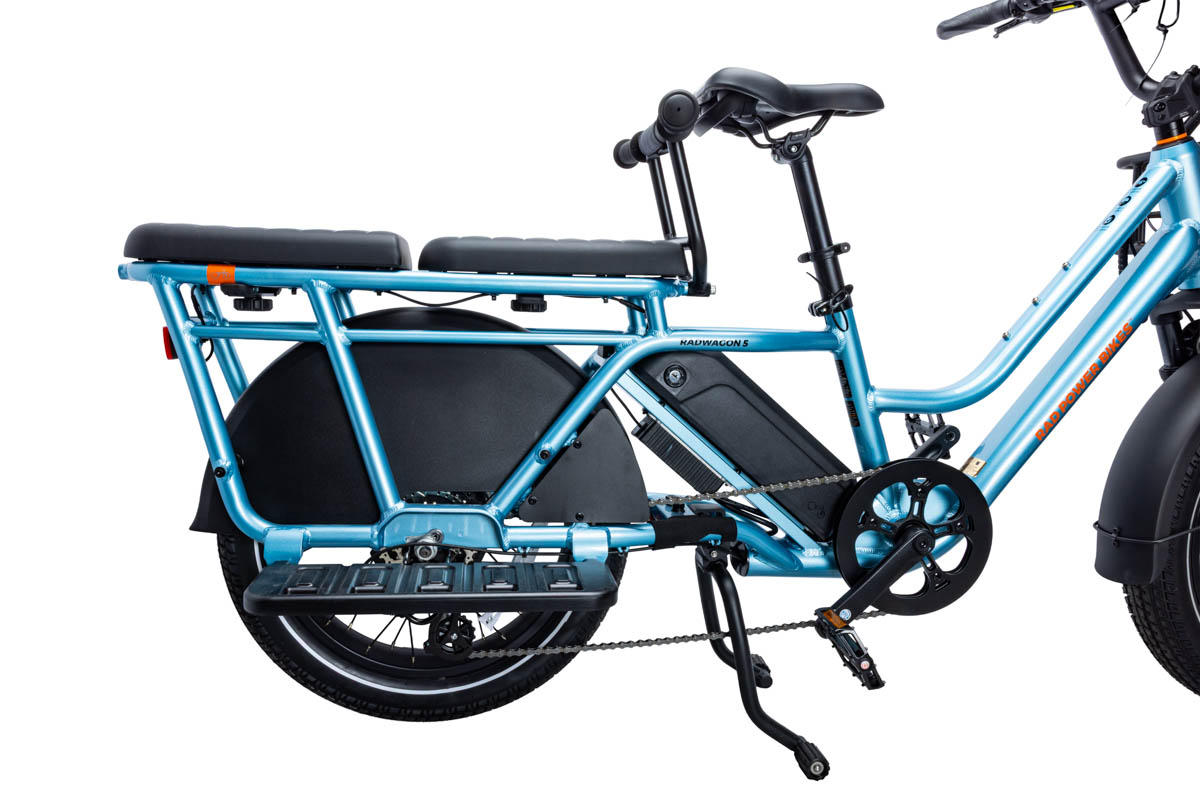
Cargo bikes are designed to haul. The RadWagon 5’s extended rear frame provides room for groceries, packages or — with seats and handlebars — young children. / THF806493
The Henry Ford’s newly acquired e-bike is a product of — and a gift of — Rad Power Bikes of Seattle, Washington. The company was formed by Mike Radenbaugh, whose interest in electric bicycles dates to his teenage experiments with motors and bikes in his parents’ garage. He launched the company in 2007 and introduced the RadWagon e-bike in 2015. With a longer frame, space at the rear for child seats or packages, and a carrying capacity of 350 pounds, the RadWagon cargo bike offered a practical, two-wheeled alternative to the family car. And like an automobile, the RadWagon went through several subsequent generations of technology and design updates. The model at The Henry Ford, a RadWagon 5, debuted in 2024 and boasted improvements like a front suspension fork, hydraulic disc brakes, and an increased cargo capacity of 375 pounds. The bike’s 750-watt motor has a top speed of 28 miles per hour and a range of about 60 miles between charges.
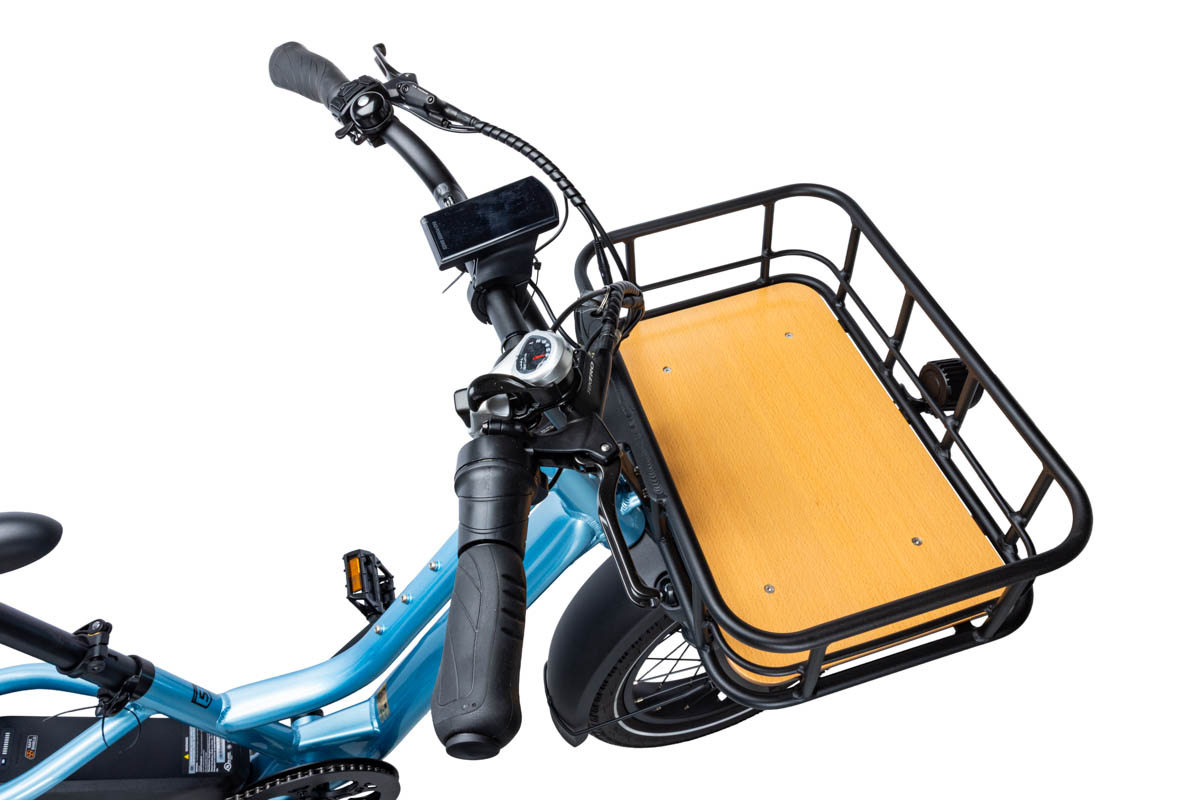
The RadWagon 5’s brake and shift controls resemble those on a traditional bike. Its display screen, near the center of the handlebars, includes a battery-level indicator, a speedometer, and a timer and trip meter, among other functions. / THF806494
E-bikes are still an emerging technology, and the regulations that govern them are evolving. Specific rules vary by state and city, but e-bikes are generally designated as one of three classes that determine where and how they may be ridden. Class 1 e-bikes are limited to 20 miles per hour, and their electric motors work only when the rider is pedaling. Usually, these bikes are allowed on bicycle paths that might otherwise be designated for non-motorized vehicles. Class 2 e-bikes are also limited to 20 miles per hour, but they have throttle controls that activate the motor even if the rider isn’t pedaling. Class 3 e-bikes operate at speeds up to 28 miles per hour, and they may or may not have throttle controls. Class 3 e-bikes are generally allowed in on-road bicycle lanes, but they are not permitted on separate bike paths or multiuse trails. One of the RadWagon 5’s key advantages is that it can be switched between Class 1, 2, or 3 settings depending on the rider’s location or needs.
The RadWagon 5 is an important addition to The Henry Ford’s bicycle collection. It helps us to document the growth of electric bikes and the increasing popularity of cargo bicycles among American riders. (Indeed, some of those rising cargo bike sales are due to electric motors — the power boost making it easier to ride with heavy loads.) E-bike sales are expected to climb at an annual rate of about 15 percent throughout the rest of the decade. It’ll be interesting to see how these machines change our laws, landscapes, and lives in the years ahead.
Matt Anderson is Curator of Transportation at The Henry Ford.
Facebook Comments