
Children's Car Seats
Share
share
For much of the 20th century, kids rode in cars unrestrained or in seats designed more for parents’ convenience than children’s safety. Nobody seemed particularly concerned. Even after child safety seats became available in the late 1960s, few parents used them—or they used them incorrectly. But child passenger laws – passed in every state between 1978 and 1985 – now require kids to ride in child seats that meet federal safety standards.
THF102570
Child's Car Seat, 1925-1935
Children usually roamed free in moving vehicles in the early years of the automobile travel. Restraints, if any, were for the convenience of the parent. This child car seat from around 1930 kept the child seated and within view of mother or father. It offered little protection during an accident.
View ArtifactTHF106483
1935 Chrysler Airflow Advertisement, "Yes, Son, You're Safe in a Bridgework of Steel"
Ways of protecting child passengers have changed. In this 1935 Chrysler ad, children and passenger are not restrained with seatbelts or safety seats. Protection, according to the ad, comes from "a bridgework of steel." Today, children travel securely strapped into well-anchored and cushioned car seats and are much safer -- even when daddy speeds smoothly along at sixty miles per hour.
View ArtifactTHF102575
Child's Sit-N-Stand Car Seat, 1965
Montgomery Ward sold this "Tiny World Deluxe Sit-N-Stand Car Seat" in the mid-1960s. As suggested, little children could ride in a seated or standing position--a convenient feature for the parent. For protection, a catalog ad stated the seat's padding would absorb "bumps." Would you trust your child's safety in this seat today?
View ArtifactTHF103560
Young Boy Sitting in a Car Seat Equipped with a Toy Steering Wheel, Pittsburgh, Pennsylvania, 1961
The child in this car seat has his own steering wheel to occupy his time while on the road. This unanchored car seat from the early 1960s, however, offered little protection in case of an accident.
View ArtifactTHF155407
Infant Safety Carrier, 1973
Child seats are as old as automobiles, though for many years they were more about keeping the child out of mom's and dad's way than protecting her in an accident. General Motors' rear-facing Infant Love Seat, introduced in 1969, became a model for future infant car seats and helped inspire states to pass safety seat laws starting in 1978.
View ArtifactTHF256310
"GM Love Mobile Answers Mothers' Requests," 1977
General Motors introduced its rear-facing "Infant Love Seat" in 1969. The design became a model for future infant car seats and helped push states to pass safety seat laws starting in 1978. GM promoted convenience as well as safety in these 1977 photos. The company's available folding "Love Mobile" unit turned the car seat into a stroller.
View ArtifactTHF155409
"Child Love Seat" Safety Seat, 1973
Child seats are as old as automobiles, though for many years they were more about keeping the child out of mom's and dad's way than protecting her in an accident. General Motors' Child Love Seat, introduced in 1967, became a model for future child car seats and helped inspire states to pass safety seat laws starting in 1978.
View ArtifactTHF140492
Ford Motor Company's Tot-Guard Car Seat, 1973
American car manufacturers developed child restraints designed for crash protection in the late 1960s. One of the first was Ford's Tot-Guard, seen in this photograph. The seatbelt secured the padded shield and seat. This early and effective restraint was not widely used, however. Only with more stringent regulations, public education, and mandated use would children safely ride in automobiles.
View ArtifactTHF700929
Saturn Advertisement, 1991, "When You Design a Car for Families"
General Motors' Saturn Corporation, which produced cars from 1990 to 2010, built its brand on being different from other American carmakers. Its operations were in Spring Hill, Tennessee -- far from Detroit in distance and philosophy. This 1991 ad paints the Saturn as a car designed with passenger safety foremost in engineers' minds. Special latches and seat belts keep children secure.
View ArtifactTHF256328
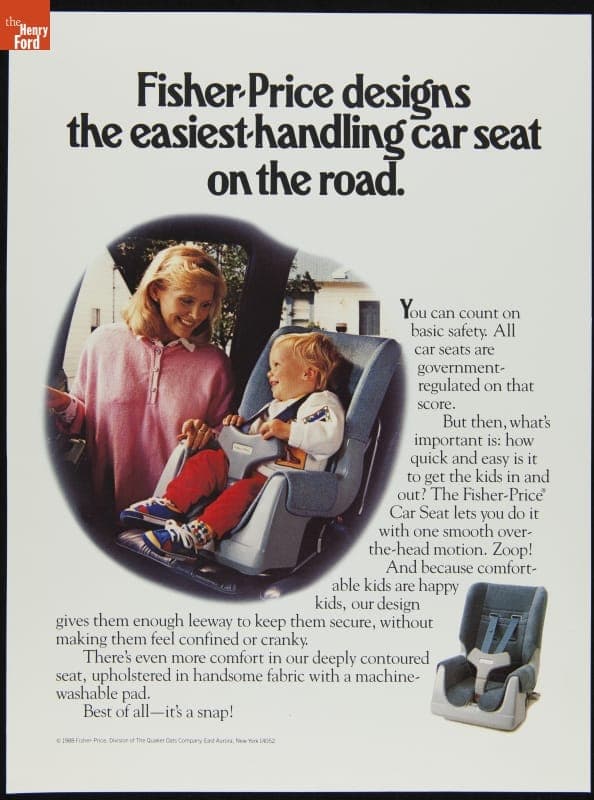
"Fisher-Price Designs the Easiest-Handling Car Seat on the Road," 1988
The first state laws requiring child safety seats -- passed in 1978 -- not only protected young passengers, they also stimulated the market for the seats themselves. Automakers, baby products companies and toy manufacturers all got into the safety seat business at various times. This 1988 advertisement promotes the comfort and convenience of a seat produced by toymaker Fisher-Price.
View ArtifactTHF102581
Fisher-Price Infant Car Seat, 1991
Fisher-Price produced this infant safety seat in 1991. It provided security for the infant while in the car, but also provided convenience for the parent. The seat doubled as an infant carrier. The baby could be transported comfortably and securely in or out of a car with this seat.
View ArtifactTHF103558
Eva Lundeen Sitting in Child's Safety Car Seat, April 26, 2003
Kids are physically safer in the crashed-tested car seats of today. They have lost the freedom to play unrestrained, however. This digital image, taken in 2003, shows Eva Lundeen safely strapped in a booster seat ready for travel.
View ArtifactTHF150035
Britax "Marathon" Child Car Seat, 2007
Child passenger safety begins when children are born and continues as they grow. Britax manufactured this seat for a child weighing up to 65 pounds. A child's weight and height influenced the location and installation of the seat within the vehicle. The instruction booklet, stored under the seat cover, provided quick access to proper set up requirements.
View Artifact

